Invitation to Cheongdo's Unique Wine Tunnel Made from Bansi Persimmons
4 stops · 1 day
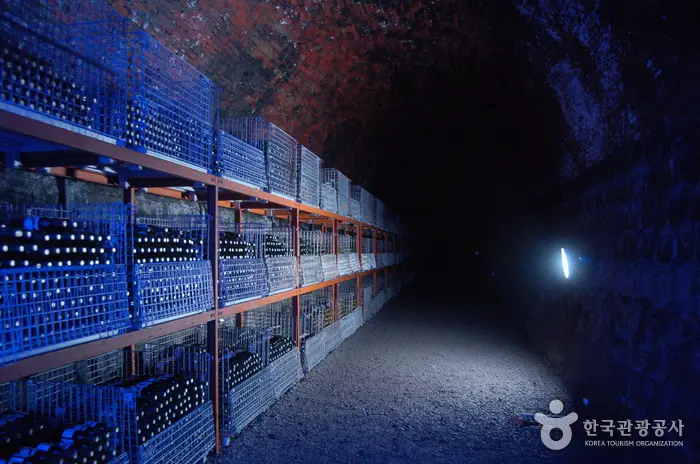
A Gyeongbu Line railway tunnel from the late Korean Empire period has now been transformed into a wine cellar. Here, visitors can taste wine brewed using Cheongdo's famous specialty, bansi (flat seedless persimmons). You can observe the wine aging process and sample it for yourself. Combined with Cheongdo's hidden tourist attractions, it promises to be an enjoyable journey.
- Duration
- 1 day
- Distance
- 42.77km
Along the way
- 1
Cheongdo Wine Tunnel
청도 와인터널
The 'Wine Tunnel,' opened in Songgeum-ri, Namseonghyeon, Cheongdo-gun, Gyeongsangbuk-do, has gained popularity as a delightful date spot for couples, families, and friends. Cheongdo Wine Co., Ltd., located in Bonggi-ri, Punggak-myeon, Cheongdo-gun, crafts wine using Cheongdo's specialty bansi (persimmons) and attracted attention by transforming a train tunnel into a wine aging cellar and cafe. Located in Songgeum-ri, Hwayang-eup, Cheongdo-gun, Gyeongsangbuk-do, the tunnel measures 1.01 km in length, 5.3 m in height, and 4.5 m in width, storing and aging over 150,000 bottles of wine. MoreLess
- 2Cheongdoeupseong Walled Town
청도읍성
Having existed since the Goryeo period, the fortress at the time was a combined earthen and stone structure containing buildings such as government offices, guest quarters (gaekgwan), local administrative offices (yuhyangso), an armory, seoyeokso, and jakcheong. In 1590 (the 23rd year of King Seonjo's reign), the earthen fortress was rebuilt in stone, but the east, west, and north gates were lost and the walls destroyed during the Japanese invasions (Imjin War). Although the walls were later repaired and the gate pavilions reconstructed, the walls were torn down again under the town fortress demolition policy during the Japanese colonial period, and the gate pavilions were rebuilt as well. Today, only parts of the walls and base foundations remain due to urban expansion. MoreLess
- 3Cheongdohyanggyo Local Confucian School
청도향교
Also known as Hwayanghyanggyo, it was originally built in Gopyeong-ri in 1568 (the 1st year of King Seonjo's reign), moved to Hapcheon-ri in 1626 (the 4th year of King Injo's reign), and relocated to its current site in 1734 (the 10th year of King Yeongjo's reign). During the era when Confucianism flourished, it was a place to honor renowned scholars, inherit their academic pursuits and devotion, and conduct memorial services for past sages. It enshrines 16 prominent Confucian sages, including Seol Chong, An Yu, Yi Hwang, Yi I, Choe Chi-won, and Yi Eon-jeok. MoreLess
- 4
Unmun Dam, Dongchangcheon Stream
운문댐. 동창천
Embracing the sky, clouds, and greenery, Unmun Dam offers scenery that changes depending on where you stop along its winding road, making it impossible to take your eyes off it for even a moment. The two branching roads at the entrance of Unmun Dam divide into paths heading toward Gyeongju and Ulsan. Over time, the dam road has become a fantastic scenic drive. MoreLess
Source: Korea Tourism Organization (TourAPI) · Machine-translated