Exploring the Historic Ruins in the Central Plain of the Daegu Basin
4 stops · 1 day
Gyeongsan is a deeply historic region that was once home to Apdokguk, a small local state under Silla before the Three Kingdoms period, and where many ancient stone tombs have been discovered. The surrounding area has been developed into a lovely park that is especially enjoyable for its autumn scenery. In particular, the Yeungnam University Museum, renowned for its extensive research on Silla relics, offers a wealth of sights to explore.
- Duration
- 1 day
- Distance
- 72.32km
Along the way
- 1
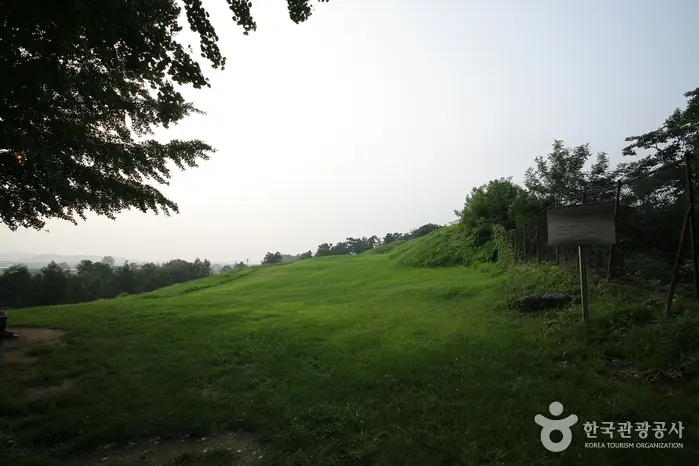
Ancient Tombs in Imdang-dong and Joyeong-dong, Gyeongsan
경산 임당동과 조영동 고분군
Mounded tombs are densely clustered on the hills (50–75 m above sea level) in front of Yeungnam University in northeastern Gyeongsan, located at the edge of the Amniang Hill running north-south in the center of the Gyeongsan Basin. These large tombs are divided into the Imdang-dong Tumuli to the west, the Joyeong-dong Tumuli in the center, and the Bujeok-ri Tumuli to the east. Among these, the Imdang-dong Tumuli are situated where the branch ridge extending southwest from the main hill ridge in front of Yeungnam University meets the Gyeongsan Plain. Seven large mounded tombs are distributed along the upper ridge; while some appear to be single circular mounds, others have merged with multiple burials under connected mounds to form what resembles a single large hillock. MoreLess
- 2
Yeungnam University Museum
영남대학교박물관
The Yeungnam University Museum was established to comprehensively collect, preserve, and exhibit materials in domestic history, archaeology, art, folklore, and anthropology—particularly Silla and Gaya cultural artifacts excavated and researched in the Daegu and Gyeongsan regions. Through these efforts, the museum contributes to academic research and promotes the transmission and development of local culture and human civilization. MoreLess
- 3
Hyegwangsa Temple (Gyeongsan)
혜광사(경산)
The site of Hyegwangsa Temple is said to be an auspicious location known as 'Yeonhwabusu,' resembling a lotus floating on water. Though a small sanctuary in the city center, it is unmistakably a place where the truth of the Buddha manifests. Just as the gate of liberation opens upon hearing the Buddha's teachings, Hyegwangsa serves as a warm haven and place of prayer for sentient beings. Moreover, the radiant flower beds throughout the temple grounds—carefully tended with bleeding hearts, canola flowers, and aster yomena—welcome visitors as if adorned for the Lotus Realm. It evokes the feeling of being in a tranquil mountain temple, reflecting the gentle devotion of the practicing monks. MoreLess
- 4
Seongbaksup Forest in Gyeongsan-ri, Seongju
성주 경산리 성밖 숲
A forest of Korean willow trees (Salix chaenomeloides) created outside Seongjueupseong Walled Town in Gyeongsan-ri, Seongju-eup, Seongju-gun, Gyeongsangbuk-do. Seongbaksup Forest is a traditional village biborim (geomantic forest) embodying local identity and history based on village geomancy, history, culture, and beliefs. According to oral tradition, during the mid-Joseon period, when village children outside the West Gate kept dying without reason, a geomancer claimed it was because Jokduribawi Rock and Tanggeonbawi Rock around the village faced each other. Following his advice that planting a forest in between would avert disaster, a chestnut forest was initially planted along the Icheon Stream outside the West Gate of the earthen-walled Seongjueupseong. After the Imjin War (Japanese invasions), when village discipline slackened and public sentiment grew uneasy, the chestnut trees were cut down and replaced with Korean willow trees, which remain today. The area is now used as a rest area, sports ground, and event venue near the town center. MoreLess
Source: Korea Tourism Organization (TourAPI) · Machine-translated