Set Off in Search of Pohang's Spectacular Views!
5 stops · 1 day
Pohang offers much more than just the sea. Encounter the bizarre rock cliffs of Unjesan Mountain and savor a plate of sweet, fresh raw fish at Jukdo Market. Above all, taking your leisure amidst the cool streams of the 12 Waterfalls and the thousand-year-old Bogyeongsa Temple will offer a restful break that needs no separate label of healing.
- Duration
- 1 day
- Distance
- 58.28km
Along the way
- 1
Unjesan Mountain (Daewangam Rock)
운제산(대왕암)
Unjesan Mountain (478m) is said to have earned its name when Great Monk Wonhyo named Wonhyoam and Jajangam hermitages to practice and preach Buddhism. Because the two hermitages sat on craggy cliffs across a valley, making passage difficult, a cloud bridge was built between them to travel back and forth. Another story tells that it was named after the sacred altar of Lady Unje, queen of King Namhae, the second king of Silla. It is said that high monks such as Jajang, Wonhyo, and Hyegong practiced asceticism on this mountain in the past. MoreLess
- 2
Lunch (Pohang Jukdo Market Hoe Town)
점심식사(포항 죽도시장 회타운)
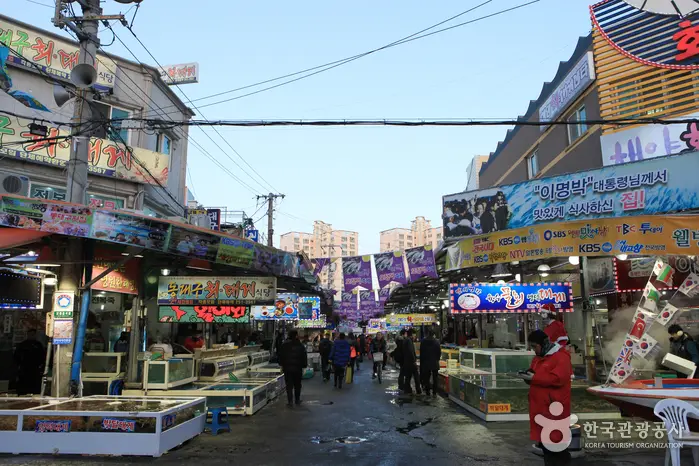
Located 500 meters east of Ogeori, the center of Pohang, Jukdo Fish Market is the largest permanent market on the East Coast. Inside the seafood auction hall, around 200 raw fish restaurants are clustered together, allowing visitors to purchase fresh East Coast raw fish at reasonable prices in all four seasons. Visitors can also eat right away at nearby shops by only paying for condiments such as chojang (spicy dipping sauce). In winter, you can especially enjoy gwamegi (semi-dried Pacific saury/herring), a specialty of Pohang. MoreLess
- 3
Bogyeongsa 12 Waterfalls
보경사 12폭포
Located in the 10km-long Bogyeongsa Valley at the foot of Naeyeonsan Mountain (930m), about 30km north of Pohang, twelve waterfalls cascade one after another, just as the name suggests. The 12 Waterfalls are a rare sight globally and are bustling with vacationers in midsummer. Ssangsaengpok (5m high), the first waterfall, is located about 1.5km from Bogyeongsa Temple. The most famous waterfalls are Gwaneumpok, the 6th waterfall, and Yeonsanpok, the 7th waterfall. Gwaneumpok is a 72m-high two-stream waterfall featuring Gwaneumgul Cave, measuring about 33㎡ (10 pyeong), on its rock wall, while Yeonsanpok is 30m high with a rock cliff called Haksudae. MoreLess
- 4
Bogyeongsa Temple
보경사
Bogyeongsa Temple was founded in 602 by Monk Jimyeong of Silla upon his return from studying in the Chen Dynasty. Jimyeong told King Jinpyeong, 'If you find an auspicious site on a famous mountain along the East Coast, bury the Eight-Sided Bogyeong (precious mirror) I received from a Taoist in Chen, and erect a Buddhist hall above it, it will not only prevent invasions by Japanese pirates and neighboring countries, but also unite the Three Kingdoms.' Pleased, the king traveled north along the East Coast with him, buried the mirror in a large pond below Naeyeonsan Mountain in Hae-a-hyeon, filled the pond, built the main hall (Geumdang), and named the temple Bogyeongsa. MoreLess
- 5
Yeonsan Hot Spring Park
연산온천파크
Yeonsan Hot Spring is located in Songra-myeon, Buk-gu, Pohang-si, where you can find Naeyeonsan County Park, known for its superb natural scenery, and Bogyeongsa Temple, an ancient East Coast temple. Naeyeonsan County Park features rugged mountains and gorges formed by the peaks of the Taebaek Mountain Range stretching north and south along the East Coast from the blue waters of Yeongil Bay and the port city of Pohang. The Jungsancheon Stream, originating from Naeyeonsan Mountain (710m), Cheonryeongsan Mountain (775m), and Hyangrobong Peak (930m), connects to Gwangcheon Stream, cascading through the valley to form 12 waterfalls and dragon pools before emptying into the East Sea. The crystal-clear waters flowing throughout the four seasons showcase nature's mystery, drawing a steady stream of tourists year-round. MoreLess
Source: Korea Tourism Organization (TourAPI) · Machine-translated