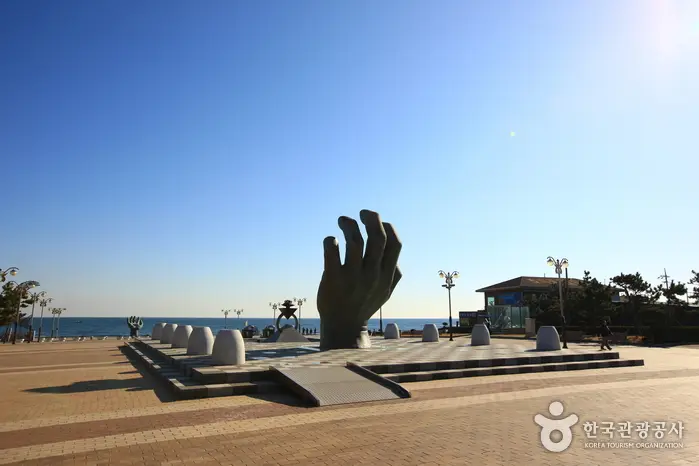
Let's Go Watch the Sunrise at Homigot
6 stops · 1 day
You might be familiar with the sight of a right hand powerfully rising above the sea. That very place is Homigot, a symbol of vibrant sunrise watching. It doesn't have to be New Year's Day. Every morning brings a fresh start, so if you are traveling before beginning something new, may you gain strength while witnessing the dynamic morning here.
- Duration
- 1 day
- Distance
- 80.49km
Along the way
- 1Homigot Sunrise Square
호미곶 해맞이광장
Pohang is adjacent to Gyeongju, the thousand-year capital of Silla, so many traces from that era remain. In addition, because Japanese pirates frequently appeared from early on, many fortress walls were constructed. Some of them still retain their ancient appearance. When viewing the Korean Peninsula in the shape of a tiger, Homigot (Janggigot) is located at the point that protrudes into the East Sea like the tiger's tail. MoreLess
- 2Homigot Lighthouse
호미곶등대
At the time of its construction, the lighthouse was named Dongoegot Lighthouse (冬外串燈臺), then changed to Janggigap Lighthouse (長?甲燈臺) in 1934, to Janggigot Lighthouse (長?串燈臺) in 1995, and to the current Homigot Lighthouse (虎尾串燈臺) in February 2002. This lighthouse is an octagonal brick structure built purely out of bricks without reinforcing steel. The interior has six floors, and the tower is 26.4 meters high. The ceiling of each floor inside the tower is carved with the plum blossom emblem (李花文), the imperial symbol of the Korean Empire, and the entrance door and windows are decorated in the pediment style of ancient Greek temple architecture. MoreLess
- 3
Lunch (Odaeyang Mulhoe Restaurant)
점심식사(오대양물회식당)
Although the original home of Pohang mulhoe (cold raw fish soup) is said to be Jukdo Market, locals who know the true taste of Pohang mulhoe frequently visit Odaeyang Mulhoe Restaurant located along the roadside of Bukbu Market. Refreshing and cool mulhoe served with a side dish of bapsikhae (fermented rice and fish) is the specialty of this place. MoreLess

- 4
Ilwolji Pond
일월지
In ancient times during the Silla period, it was called "Haedalmot" (Sun and Moon Pond), but after Chinese characters were introduced to Korea, it began to be called by its Hanja name, Ilwolji Pond. It was also called Gwangbokji because the light of the sun and the moon returned. It forms a roughly circular shape with an east-west boundary of about 250 m, a north-south width of about 150 m, and a total area of about 16,529 m² (5,000 pyeong). MoreLess
- 5Oeosa Temple
오어사(포항)
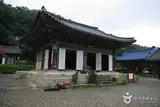
Oeosa Temple on Unjesan Mountain is a place where the profound fragrance of Buddha lingers, and where the lake, seeming to embrace a dragon, harmonizes with fantastic rocky cliffs like an Oriental painting. Oeosa Temple is a sacred site that produced the four great patriarchs of Silla. It was founded during the reign of King Jinpyeong (579–632), the 26th king of Silla, and was originally called Hangsasa Temple. However, when Great Master Wonhyo and Zen Master Hyegong practiced asceticism here, they held a contest to revive fish in the stream using their Buddhist spiritual powers. One fish did not survive while the other survived and swam vigorously, and as each monk claimed it was the fish he had saved, the temple was named Oeosa (吾魚寺), using the characters "o" (吾, meaning "I" or "my") and "eo" (魚, meaning "fish"). MoreLess
- 6Yeongildae Beach
영일대해수욕장
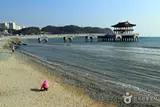
Featuring a white sandy beach with a length of 1,750 m, a width of 40–70 m, and an area of 406,613.4 m² (123,000 pyeong), this is the largest beach on the east coast. Along with nearby Songdo Beach, it is renowned as a representative beach of Pohang and is ideal for family vacations. Located in the urban area, there is little inconvenience in accessing convenience and lodging facilities in downtown Pohang, and an abundance of seafood allows visitors to enjoy instant raw fish (hoe). MoreLess
Source: Korea Tourism Organization (TourAPI) · Machine-translated