Tasting Uiseong's Apple Wine and Exploring Its Dinosaur Sites
5 stops · 1 day
Uiseong, Gyeongsangbuk-do, isn't famous just for garlic. At Korea Applies, you can try a wine-making experience using apples, and Sachon Village, known for its refined, upright character, is said to have produced many talented people in the past. Above all, visiting the Jeori dinosaur footprint site and the remains of a Samhan-era tribal state also makes for a great hands-on history lesson.
- Duration
- 1 day
- Distance
- 54.30km
Along the way
- 1
Uiseong Sachon Village
의성 사촌마을
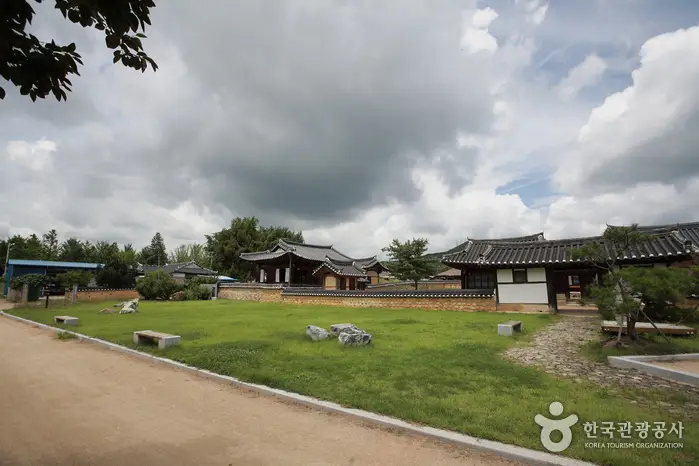
Mention Uiseong, Gyeongsangbuk-do, and the first word that likely comes to mind is garlic. But there's another word worth not overlooking — the name 'Uiseong' itself. Uiseong, meaning 'righteous fortress,' was home to enough righteous scholars to earn that name, and it is a place with many 'banchon,' or noble-scholar villages. There's Sanun Village, called the banchon of the south, and also 'Sachon Village,' known as the banchon of the north, a clan village of the Andong Kim, Andong Gwon, and Pungsan Ryu families. The name Sachon Village is said to have been modeled on a place called Sajin-ri in China. Scholars such as Songeun Kim Gwang-su and Seoae Ryu Seong-ryong were born here, and it is said that 18 people born in Sachon Village passed the higher civil service examination (daegwa) and 31 passed the lower examination (sogwa).\nMoreLess
- 2
Lunch (Gyeongdong Charcoal-Grilled Galbi)
점심식사(경동숯불갈비)
Gyeongdong Charcoal-Grilled Galbi is located in a residential area just off the main street in downtown Uiseong. The restaurant buys whole racks of top-grade 1++ Korean beef galbi, prepares and ages the meat by hand for 24 hours, and then seasons it fresh with Uiseong's signature garlic along with seven other ingredients before serving. \nMoreLess

- 3
Gounsa Temple
고운사
Gounsa Temple is the head temple of the 16th district of the Jogye Order of Korean Buddhism. It was founded in 681, the first year of King Sinmun of Silla, by the monk Uisang. At the time of its founding it was called Gounsa, written with characters meaning 'High Cloud Temple.' About 200 years later, when Choe Chi-won, whose pen name was Gowun ('Lone Cloud'), came to practice here and built Gaunru and Uhwaru pavilions, the temple's name was changed to use his pen name instead, becoming Gounsa, written with the characters for 'Lone Cloud Temple' — though pronounced the same. During the reign of King Heongang, the monk Doseon built a statue of the Medicine Buddha (Bhaisajyaguru) and a stone pagoda here. \nMoreLess
- 4
Jeori Dinosaur Footprint Fossil Site
제오리 공룡발자국 화석 산지
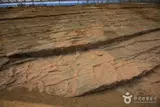
These are dinosaur footprint fossils from the Cretaceous period of the Mesozoic era, dating back roughly 115 million years. They were designated Natural Monument No. 373 on June 1, 1993. 'Dinosaur' refers collectively to the massive reptiles, 5 to 25 meters long, that flourished from the Jurassic through the Cretaceous periods of the Mesozoic era. The dinosaur footprint fossils at Jeori, Uiseong, were discovered when the hillside was cut away during the widening of a local road.\nMoreLess
- 5
Geumseongsan Tumuli
금성산 고분군
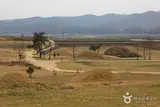
The Geumseongsan Tumuli are spread across Dae-ri, Tapri-ri, and Hangmi-ri, comprising around 200 burial mounds; the artifacts excavated from them are estimated to date from the 5th to 6th centuries. The site is densely packed with a mix of large mounds (15–19m in diameter, 3–4m high), medium mounds (10–15m in diameter, 2–4m high), and small mounds (under 10m in diameter), most of which are round earthen mounds. \nMoreLess
Source: Korea Tourism Organization (TourAPI) · Machine-translated