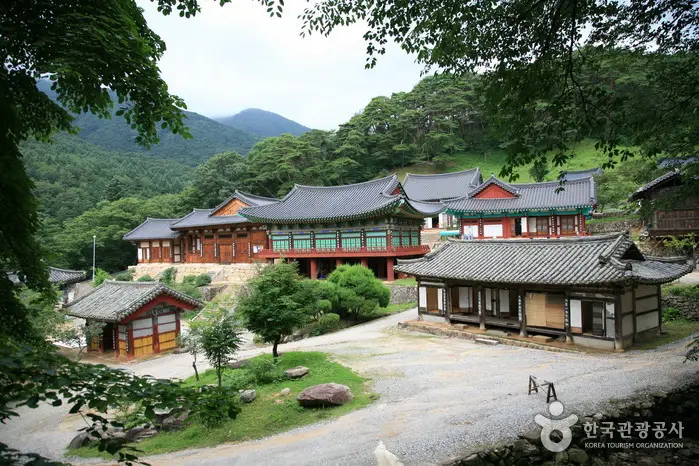
A Journey Through Mungyeong's Old-World Temples
5 stops · 6 hours
Daeseungsa, a thousand-year-old temple, is beautiful for the lotus carvings on the stone base of its main hall and the fish, dragons, and flower-lattice windows under its eaves. In its faded dancheong paintwork, you can feel the strong trace of the passing years, and with it, a genuine sense of Korean beauty. Don't miss the fun of riding the rail bike along tracks that once carried coal twenty years ago, taking you the whole length of Mungyeong.
- Duration
- 6 hours
- Distance
- 41.15km,
Along the way
- 1
Gimnyongsa Temple
김룡사
Gimnyongsa Temple — according to , it is recorded that in 588, the 10th year of King Jinpyeong of Silla, the monk Undal renovated the temple and named it Unbongsa. It is thought that this original name, Unbongsa, continued to be used even into the late Joseon period, since a hanging-painting record (gwaebul hwagi) handed down within the temple also records it under the name Unbongsa. At some point, however, the name was changed to Gimnyongsa.\nMoreLess
- 2
Daeseungsa Temple
대승사
Daeseungsa Temple on Sabulsan Mountain preserves a relatively rich historical record along with a beautiful founding legend. Details of its history after its founding are not entirely clear, but according to , Master Seochong rebuilt the monks' hall west of the main hall in 1604, the 37th year of King Seonjo, and Master Gyeongmuk later rebuilt the meditation hall east of the main hall in 1651, the 2nd year of King Hyojong. \nMoreLess
- 3Lunch (Jinnam Maeuntang)
점심식사(진남매운탕)
Jinnam Maeuntang was opened in the late 1960s by Lee Bong-seon, and today her youngest daughter, Kim Yeong-hui, carries on the family's second-generation recipe, cooking spicy stew made with wild-caught freshwater fish. Back then, major coal mines such as Daeseong Coal Mine, Bongmyeong Mining Station, and Eunseong Mining Station operated nearby, and the dish was popular among their staff and workers. The mines have since all closed one after another, but people who can't forget the flavor still come back, and after the Jungbu Naeryuk Expressway opened, many visitors from across the country began coming to see Jinnam Gyoban, ranked the number-one scenic spot of Gyeongbuk's Eight Views — and along the way, many of them taste the freshwater spicy stew here and keep coming back for more.\nMoreLess
- 4
Mungyeong Rail Bike
문경 철로자전거(레일바이크)
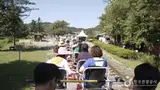
The railway that once carried coal more than twenty years ago has now been transformed into a tourism resource, reborn as the 'Mungyeong Rail Bike,' the first ride of its kind in Korea to run along an old railroad track. Developed by putting to new use the tracks that once transported coal during Mungyeong's mining heyday, it is Korea's very first rail bike. It runs near Jinnam Gyoban, ranked the number-one scenic spot among Mungyeong's Eight Views, and riding along the track that follows the Yeonggang riverbank, you can take in the surrounding mountains and scenery together, adding an extra touch of charm.\nMoreLess
- 5Gomosanseong Fortress
고모산성
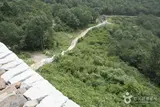
Gomosanseong is a valley-enclosing mountain fortress located on Gomosan in Sinhyeon-ri, Maseong-myeon, Mungyeong, with a main wall of 1,256m and an auxiliary wall of 390m, for a total length of 1,646m. The fortress, including its western wall, was built to defend against enemies attacking from every direction. Its construction is estimated to date from sometime after 156 CE, around the end of the 2nd century. Yulgang (a river) wraps around its west and south sides, while to the east lies a rugged ridge extending down from Jojeongsan (810m). Because of this, the western wall was built in the pyeonchuk-sik style, using the natural cliff face and stacking stone only on the outer side, while the remaining three sides were built in the hyeopchuk-sik style, stacking stone on both the inner and outer faces of the wall according to the terrain.\nMoreLess
Source: Korea Tourism Organization (TourAPI) · Machine-translated