A Journey Through Sangju's Old Historic Sites and Bicycle History
4 stops · 8 hours
This course takes in historic sites across Sangju as well as a museum tracing the history of the bicycle. The distance is a bit long, but it's a course that can comfortably be covered in a single day. At the Filial Son Jeongjesu Memorial Hall, reflect on the meaning of filial devotion, a virtue increasingly forgotten, then wrap up your trip to Sangju by visiting the battle site of the Japanese invasions and an old historic temple.
- Duration
- 8 hours
- Distance
- 74.01km
Along the way
- 1
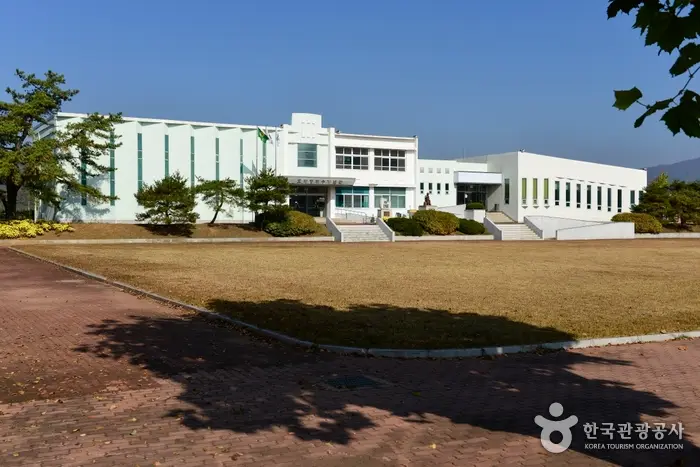
Filial Son Jeong Jae-su Memorial Hall
효자 정재수 기념관
This memorial hall was built to honor the filial devotion of Jeong Jae-su, a boy who died at the young age of ten while trying to save his father. It was built on the site of the former Sasan Elementary School, Jeong Jae-su's alma mater, and opened on June 12, 2001. The Filial Son Jeong Jae-su Memorial Hall, the only memorial hall in the country dedicated to the theme of "filial devotion," was established at the former Sasan Elementary School (the late Jeong Jae-su's alma mater) in Sasan-ri, Hwaseo-myeon, Sangju, Gyeongsangbuk-do, in order to re-establish the increasingly forgotten value of "filial devotion" in modern times and to serve as a living educational site on filial piety for the children growing up today. \nMoreLess
- 2
Sangju Imnan Bukcheon Battle Site
상주 임란북천 전적지
The Imnan Bukcheon Battle Site is a sacred site of national defense where about 900 soldiers gave their lives fighting the main Japanese force during the Japanese invasions of 1592, in a clash between Joseon's central army and local militia. When Japanese forces landed at Busan in 1592, around 60 troops of Joseon's central army marched south to stop them. Together with roughly 800 young men mustered overnight by Sangju magistrate Gwon Gil and Bak Geol, this force of some 900 fought fiercely against 17,000 Japanese soldiers, and all of them fell in battle. The site was designated Local Monument No. 77 in 1988.\nMoreLess
- 3Sangju Bicycle Museum
상주자전거박물관
The Sangju Bicycle Museum, Korea's first museum themed around bicycles, has been expanded, relocated, and newly reopened in Donam-dong, Sangju, Gyeongsangbuk-do. Offering a complete overview of bicycle history, it is quite literally a "bicycle paradise" containing everything related to bicycles. The roughly 60 bicycles on display trace the full history of the bicycle at a glance. Its main facilities include, on the basement floor, a bicycle rental station, storage vault, and mechanical room; on the first floor, a special exhibition hall, a 4D theater, and a corner promoting local agricultural specialties; and on the second floor, a permanent exhibition hall, a multipurpose hall, and management offices.\nMoreLess

- 4
Namjangsa Temple
남장사
Namjangsa Temple, set on the slope of Noaksan, was originally founded by National Preceptor Jingam, Master Hyeso, in the 7th year of King Heungdeok, the 42nd king of Silla. In the 16th year of King Myeongjong of Goryeo, it is said to have been rebuilt at its current location and renamed Namjangsa. It is especially notable as the first place where eosan (beompae), traditional Buddhist ritual music, was transmitted in Korea. \nThe iron Vairocana Buddha statue and the wooden relief altarpiece behind it, carved from sandalwood and enshrined in Bogwangjeon Hall, are considered an outstanding masterpiece and representative of Korean Buddhist art. \nMoreLess
Source: Korea Tourism Organization (TourAPI) · Machine-translated