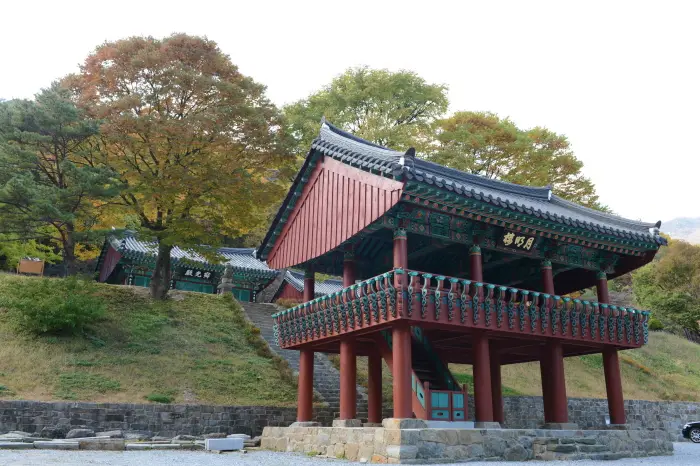
Experience Yeongju's Hot Springs and Punggi Ginseng
4 stops · 8 hours
Yeongju, famous for Punggi ginseng, is also known for the fine waters of Punggi Hot Springs. It is an alkaline spring rich in fluoride, said since ancient times to be good for skin conditions. Beyond the warm hot spring water and well-known sites like Buseoksa Temple, you can also visit old temples such as Huibangsa and Birosa. Don't forget to stop by the famous Punggi Ginseng Market as well.
- Duration
- 8 hours
- Distance
- 35.02km
Along the way
- 1
Huibangsa Temple
희방사
Located at 850m elevation on the slopes of Sobaeksan, about 4km northeast of Huibang Station, Huibangsa Temple was founded in 643, the 12th year of Queen Seondeok of Silla, by Master Duun. It once preserved the printing woodblocks for Volumes 1 and 2 of the Worin Seokbo, which burned along with the temple during the Korean War; the woodblocks resurfaced not long ago. The temple's entrance is shaded by dense natural forest that blocks the sunlight, and Huibang Falls, at 28m high, is the tallest waterfall in Korea's inland region.\nMoreLess
- 2
Lunch (Sobaeksan Sanmaru Restaurant)
점심식사(소백산산마루식당)
Located on the left side as you climb Jungnyeong Pass on National Route 5, this restaurant offers a garden-style dining setting with sweeping views of Jungnyeong Pass and Sobaeksan, making it a great spot to eat while out on a drive. Though somewhat removed from downtown Punggi, it has become popular by word of mouth among Sobaeksan hikers, and during peak season it fills up with tourists to the point of running out of seats.\n\nMoreLess
- 3
Birosa Temple (Yeongju)
비로사(영주)
Birosa Temple is a mountain temple set on the southern slope of Birobong Peak, Sobaeksan. Founded in 680, the 20th year of King Munmu of Silla, by Great Master Uisang, this old Silla temple retains relics such as a Buddha statue and flagpole supports (danggan-jiju) that speak to its deep history. Right at the upper left of the temple's entrance stand the Yeongju Samga-deung flagpole supports. Dating from the Silla period, they stand 4.8m tall, facing one another. The inner faces of both pillars are flat, while their front and back carry carved bands running along the edges and center. They also have a base stone to support the flagpole and a hole for inserting it, showing an overall meticulous structure.\nMoreLess
- 4
Punggi Ginseng Market
풍기인삼시장
In September 1990, a ginseng market with a floor area of 1,436 pyeong opened in front of Punggi Station, permanently selling fresh ginseng, white ginseng, and other ginseng products. As of 2001, around 60 stores operate there. With the full opening of the Jungang Expressway in December 2001, the resulting inflow of visitors from other regions via the "Punggi IC" boosted sales by more than 50%, energizing the market; commerce has also grown through the development of related menu items and products such as Punggi ginseng galbi, Punggi ginseng gomtang, and samgyetang (ginseng chicken soup). In addition, the Punggi Ginseng Festival is held every year from late September to early October, featuring events such as a hands-on ginseng-digging experience, a Ginseng Beauty Pageant, and a ginseng cuisine exhibition, drawing many tourists from both Korea and abroad. \nMoreLess
Source: Korea Tourism Organization (TourAPI) · Machine-translated