The Famous Andong Hahoe Village Travel Course
6 stops · 8 hours
Andong Hahoe Village is such a well-known destination that most Koreans have at least heard of it. If you want to properly cover Andong, this course should be just right. Try the traditional hanji papermaking experience and visit the Mask Museum as a matter of course, then pass through Byeongsan Seowon, a hall of learning for the Sarim (literati) faction, and finish at Buyongdae, from where you can take in the whole of Hahoe Village at a glance.
- Duration
- 8 hours
- Distance
- 21.44km
Along the way
- 1
Andong Hanji Experience
안동한지체험
Located at the entrance to Hahoe Village, where the traditional way of life and culture of our ancestors is best preserved, Andong Hanji pours its heart into producing traditional hanji paper that carries Korea's own beauty and spirit. With the living breath of our ancestors still present, serving as a place of learning for students, and offering a wide range of things to see, Andong Hanji is emerging as one of Andong's tourist attractions.\nMoreLess
- 2Buyongdae
부용대
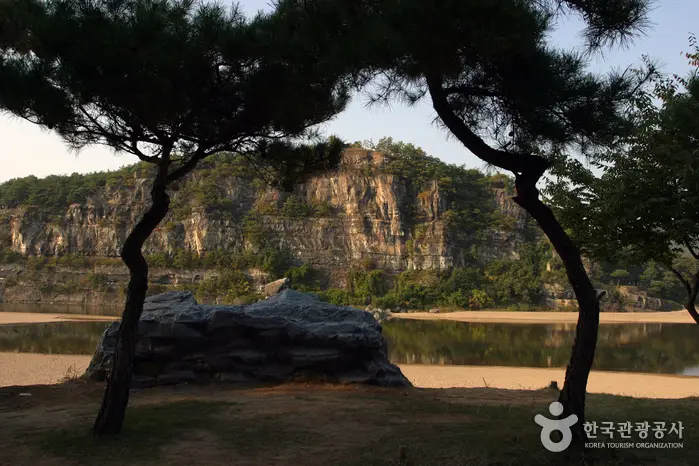
Buyongdae is a 64m cliff at the very end of the Taebaek mountain range, from whose summit you can take in the whole of Andong Hahoe Village at a glance. The name Buyongdae comes from a Chinese classical reference, where 'buyong' means lotus flower. It is said to derive from the way Hahoe Village, viewed from here, resembles a lotus blossom, and since this is the best spot to view the village, it came to be called Buyongdae. It was originally called 'Buk-ae,' meaning 'the hill north of Hahoe.' Below, where the Nakdong River winds and flows, stand Okyeonjeongsa, Gyeomamjeongsa, and Hwacheon Seowon.\n\nMoreLess
- 3
Hahoe Okyeonjeongsa
하회옥연정사
Hahoe Okyeonjeongsa was built with the help of the monk Tanhong, a close acquaintance of Seoae Ryu Seong-ryong (1542–1607), as a place for him to pursue scholarship and train disciples. \nAfter building Wonjijeongsa, Master Seoae found it too close to the village, too busy, and lacking the serene atmosphere he wanted, so he chose a site across the river at the foot of Buyongdae — but his family's finances were too meager to build the retreat. Learning of this, the monk Tanhong volunteered to take charge of the construction and bear the cost himself. Construction began in 1576 (the 9th year of King Seonjo) and was finally completed a full ten years later, in 1586 (the 19th year of King Seonjo), when Master Seoae was 45 years old. \nMoreLess
- 4Andong Byeongsan Seowon
안동 병산서원
Byeongsan Seowon's predecessor was Pungak Seodang, a school in Pungsan-hyeon that served as a hall of learning for the Sarim (literati) scholars from the late Goryeo period onward. In 1613 (the 5th year of King Gwanghaegun), by consensus of the local Confucian community led by Master Ubok Jeong Gyeong-se (1563–1633), Jondeoksa Shrine was founded to honor the scholarship and virtue of Master Seoae Ryu Seong-ryong (1542–1607), and his spirit tablet was enshrined there. In 1629, his third son, Master Suam Ryu Jin (1582–1635), was also honored alongside him. In 1863 (the 14th year of King Cheoljong), it received the royal name plaque 'Byeongsan.' When Regent Heungseon Daewongun ordered the abolition of seowon academies in 1868 (the 5th year of King Gojong), it was one of only 47 nationwide — and one of just two in Andong — spared from closure. \nMoreLess
- 5Hahoe-dong Mask Museum
하회동 탈 박물관
The Hahoe-dong Mask Museum is located in Andong Hahoe Village, designated Important Folklore Cultural Heritage No. 122. Hahoe Village is one of Korea's most representative traditional folk villages, and it is also the home of the Hahoe masks, National Treasure No. 121, and the Hahoe Byeolsingut Mask Dance, Important Intangible Cultural Heritage No. 69. The Hahoe-dong Mask Museum displays not only the Hahoe masks but virtually every kind of Korean mask, laid out so they can be viewed at a glance in one place, and it has further gathered important masks from around the world so visitors can compare them side by side with Korean masks.\nMoreLess
- 6Andong Hahoe Village [UNESCO World Heritage Site]
안동 하회마을[유네스코 세계문화유산]
Andong Hahoe Village is a folk village so famous it needs little introduction. Encircled by a looping bend of the Nakdong River, forming a classic 'river-turning' village, Hahoe is a clan village of the Pungsan Ryu family, and even today about 70% of its residents bear the Ryu surname. The Pungsan Ryu clan settled here roughly 600 years ago; before they took root, the Heo and An clans are said to have already been living in the area. \nMoreLess
Source: Korea Tourism Organization (TourAPI) · Machine-translated