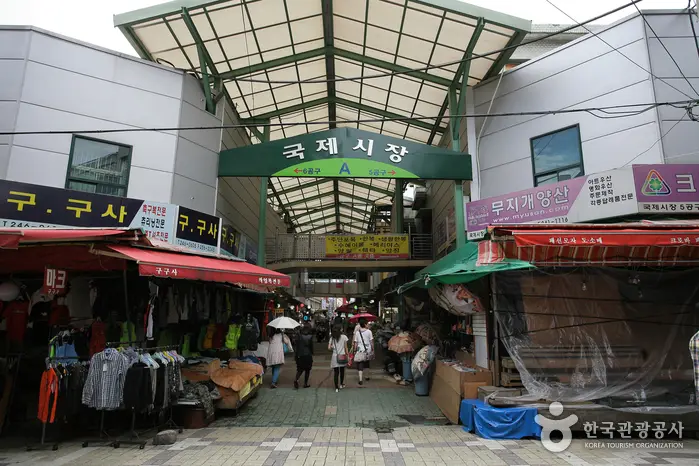
Poking Around Gukje Market
4 stops · 5 hours
They say if you want to see what a place is really like, go to its market. Markets, alive with vibrant energy, remain, along with our childhood memories, among the things most closely tied to our lives even today. Street food that can fill a hungry stomach even on a light budget is still much loved by market vendors and continues to shape the market's own distinctive street culture. Gukje Market was once the place where new goods from abroad could be encountered fastest through trade, while Bupyeong Market, the oldest traditional market in the Jung-gu area, has recently drawn fresh attention for its night market. This was also home to many theaters, including Chosun Kinema Co., the birthplace of Korea's film industry, and a commemorative plaza honoring the Busan International Film Festival, which carries on that spirit, still stands here. Let's set off to explore this lively 'dotdoegi (jumble) market' with all its different flavors. Source: Busan Tourism Organization
- Duration
- 5 hours
- Distance
- 2.38km
Along the way
- 1
BIFF Square
BIFF광장
This symbolic space was created with the start of the Busan International Film Festival in 1996, and the handprints of famous actors and directors are set into the pavement here. It was originally called PIFF Square, but was renamed BIFF Square when PUSAN was changed to BUSAN. Sitting between Jagalchi Market and Gukje Market, it sees heavy foot traffic and is full of street snacks such as ssiat hotteok (seed-filled pancakes). In the early days of the film festival, films were screened at the theaters of Nampo-dong, but once the Busan Cinema Center was built in Haeundae, most festival events moved to the Haeundae area. Today only Busan Theater and Daeyeong Cinema still keep the tradition alive here.\nMoreLess
- 2Gukje Market
국제시장
A large market in Nampo-dong divided into sections such as Food Alley, Street of Youth, Street of All Things, Kkangtong (Tin Can) Market, Arirang Street, and the secondhand-clothes alley. It is also popularly known as a 'dotdoegi market.' A 'dotdoegi market' refers to a chaotic, bustling, informal market where all kinds of goods — new, used, and scrap — are sold wholesale, retail, or under the table. The name is said to come from the postwar practice of auctioning off bundles of belongings left behind by Japanese returning to Japan after liberation, sold in bulk lots. Back then, it's said some lucky buyers struck it rich, almost like winning the lottery. Today it's a paradise of snacking, overflowing with street food such as bibim dangmyeon (spicy glass noodles), sweet red bean porridge, and tteokbokki. \nMoreLess
- 3
Bupyeong Kkangtong (Tin Can) Market
부평깡통시장
The name is a blend of Bupyeong Market and Kkangtong (Tin Can) Market; this traditional market became well known after the Korean War for selling supplies and canned goods that came out of U.S. military bases, hence the 'tin can' nickname. Alongside porridge shops, there are many stores specializing in side dishes such as kimchi, salted seafood, seasoned vegetables, and fish cakes. From near BIFF Square, through Jokbal (pig's trotter) Alley and on to Bupyeong Market, restaurants and nightlife spots do brisk business, and in 2013 the Bupyeong Kkangtong Night Market opened, selling unusual foreign foods; it has since become a popular destination for many tourists. \nMoreLess
- 4
Street of Art
미술의 거리
Located in Sinchang-dong, Jung-gu, Busan, the Street of Art has, since its debut on April 16, 2005, hosted exhibitions large and small — including commemorative exhibitions for the street itself, special exhibitions tied to the Busan International Film Festival, and cultural experience events — along with various demonstrations, hands-on classes, and mentoring for younger artists, as well as the production and distribution of a wide range of artworks. It has taken on the role of an avant-garde force in Busan's art scene, faithfully serving as a hub of Jung-gu's tourism and cultural belt while contributing to raising the standard of Busan's culture and arts.\nMoreLess
Source: Korea Tourism Organization (TourAPI) · Machine-translated