Climbing Yongdusan to See Busanpo
4 stops · 8 hours
Busan is a region that has maintained long exchanges with Japan, a country both near and far. Through the Joseon Tongsinsa (diplomatic missions to Japan), it conveyed Korean culture to the Japanese, and through trade it supplied them with daily necessities. Beyond that, Korea even set aside Waegwan (Japan House) on its own territory and built a Japanese settlement there. What's more, Korean commoners were mobilized for corvee labor and great sums were spent to build the Waegwan. It could be seen as a kind of 'Sunshine Policy' of the Joseon era. Let's walk around the Yongdusan Park area, where traces of that time remain, and see how the terrain changed as the Japanese began to settle there. This may be a chance to look squarely at our modern history through Busan's recent past. Source: Busan Tourism Organization
- Duration
- 8 hours
- Distance
- 210.51km
Along the way
- 1
Gwansuok and the Site of Choryang Waegwan
관수옥과 초량왜관 터
This was where the Gwansu, the head of Choryang Waegwan, resided. At the time, the area east of Yongdusan was the first to develop into a town, since it was close to the pier where boats docked. Japanese people came in by boat and began settling mainly to the east, passing through Gwansuok on their way into the Waegwan. Stone steps still remain today on the site where Gwansuok once stood.\nMoreLess
- 2
Gwangbok-ro
광복로
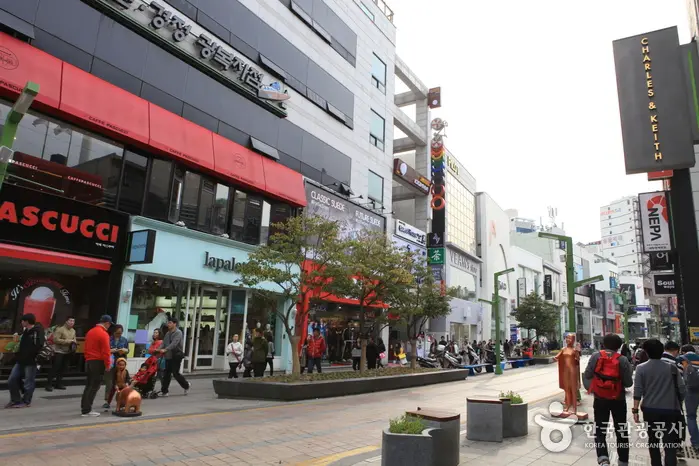
The road now used by people and vehicles as Gwangbok-ro was originally a stream. Before it was covered over, it was known as Songhyeoncheon (Soljaenae). Until the 1600s, clear water flowing down from Yongdusan and Bokbyeongsan passed through this stream and entered the sea at Choryang Harbor, near the right side of Yongmisan, around the entrance to Yeongdo Bridge.\n In the late Joseon period, during the era of Choryang Waegwan, it became a stream within the Waegwan. After the port opened in 1876, Japanese residents planted cherry trees along its banks, and it came to be called Sakura-gawa, or Aengcheon (Cherry Stream). When Choryang Waegwan became the official exclusive Japanese settlement and its population grew past ten thousand, Aengcheon became filthy and foul-smelling, and the need to cover it over was raised. It was later covered to create today's Gwangbok-ro. During the Japanese colonial period, Gwangbok-ro was known as Jangsu-tong or Byeoncheon-jeong, and it became a bustling street lined on both sides with two-story permanent shops.\nMoreLess
- 3Yongdusan Park
용두산공원
Yongdusan takes its name from its resemblance to a dragon rising from the sea. It once held the Konpira Shrine and Benzaiten Shrine and was developed as a sacred site for Japanese residents, but after liberation the shrines were torn down and Yongdusan turned into a shantytown for refugees. However, the great Yongdusan fire of 1954 burned everything to the ground, and the mountain was newly redeveloped as a park. Today it is home to the Dragon Tower symbolizing Yongdusan, Busan Tower, and various other facilities. Busan Tower was designed to evoke the Dabotap Pagoda of Bulguksa Temple in Gyeongju and the lighthouse that symbolizes Busan; from it you can take in all four directions of the city at a glance, and on clear days you can even see Tsushima Island. \n* Busan Fire Prevention Prayer Monument \n Around the time of the Korean War, large fires repeatedly struck Busan, so in 1955, on the first full moon of the lunar new year, heads of Busan's institutions erected a talisman-shaped stone monument to ward off fire. This is the 'Fire Prevention Prayer Monument,' located on the hillside behind Busan Tower in Yongdusan Park, Jung-gu. At its center is the character for fire '火,' surrounded on all four sides by four characters for water '水.' It embodies an earnest wish that no fire would ever break out. \nMoreLess
- 4
Daegaksa Temple
대각사
In the 9th year of Japan's Meiji Restoration, Higashi Honganji's Busan branch temple, the first Japanese temple in Korea, was built here. Yu Dae-chi (a herbal physician), a key figure of the Enlightenment Party, advised the monk Yi Dong-in (of Bongeunsa Temple) on enlightenment policy, and together with about 40 reformists including Kim Ok-gyun, Park Yeong-hyo, Seo Gwang-beom, and Yun Chi-ho, made repeated trips to and from Japan, using this site as a foothold. It is a historic ground that left a major mark on the modernization and enlightenment of Joseon. After liberation it was returned to the Korean government and re-founded as a Korean temple, becoming today's Daegaksa Temple. \nMoreLess
Source: Korea Tourism Organization (TourAPI) · Machine-translated