A Water Journey Following the Geumgang River
4 stops · 7 hours
Though landlocked, Chungbuk holds within it a sea reminiscent of a multi-island archipelago—thanks to the scenery created by the Geumgang River and Daecheongho Lake. A trip to Okcheon and Daejeon is a journey that follows the waterway, centered on the Geumgang River and Daecheongho Lake. Your heart will swell at the true landscape painting nature unfolds—the lake seen from a mountaintop, and the lake kept close at your side as you cycle along it. Source: Chungcheong, More Charming the Longer You Stay
- Duration
- 7 hours
- Distance
- 26.30km
Along the way
- 1Yongamsa Temple (Okcheon)
용암사(옥천)
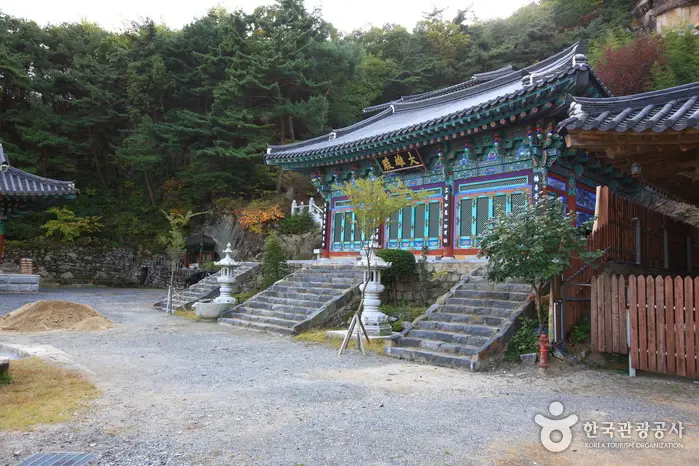
Yongamsa Temple is set partway up Jangyongsan Mountain in Okcheon-gun, Chungbuk, and boasts dense forest and long-standing charm. Yongamsa is a branch temple of Beopjusa, the head temple of the 5th District of the Jogye Order of Korean Buddhism, and was founded by the monk Uisin in 552 (the 13th year of King Jinheung's reign), during the Silla period. Unlike a typical temple layout, the stone pagoda at Yongamsa is situated on a low northern peak that offers a sweeping view in every direction; it appears to have been built following the Goryeo-era belief of sancheon bibo, which held that erecting pagodas or buildings could bolster the waning energy of mountains and rivers.\nMoreLess
- 2
Busodamak
부소담악
In Buso-munui Village, Gunbuk-myeon, Okcheon-gun, Chungbuk, you can find the stunning scenery of Busodamak. Busodamak is a jagged cliff of oddly shaped rocks rising over the water, stretching an astonishing 700m in length. It is the crowning scene of the Chuso Eight Views, which the Joseon-era scholar Song Si-yeol praised as a 'little Geumgangsan.' Busodamak was not originally a waterside cliff. It was once a mountain, but when Daecheong Dam was completed, part of the mountain was submerged, creating a scene like a rock screen wrapped around the water. Chusojeong Pavilion is the best spot to properly take in the spectacular view of Busodamak.MoreLess
- 3
Birth House of Jeong Ji-yong
정지용생가
The poet Jeong Ji-yong (鄰芷溶, 1902-1950) was born on May 15, 1902 (by the lunar calendar), at 40-1 Hagye-ri, Okcheon-eup, Okcheon-gun, Chungcheongbuk-do. He spent his childhood here and attended Okcheon Public Common School (now Jukhyang Elementary School), located not far from his birth house; after graduating from common school at age 14, he left home to begin life away from his hometown. Jeong Ji-yong's original birth house was torn down in 1974 and another house was built in its place, but on July 30, 1996, it was restored to its original appearance.\nMoreLess
- 4Jeong Ji-yong Literature Museum
정지용 문학관
Hagye-ri, Okcheon-eup, Okcheon-gun, Chungbuk, is the hometown where the poet Jeong Ji-yong, well known to us for his poem 'Nostalgia,' was born and raised. Next to Jeong Ji-yong's birth house stands the neighboring Jeong Ji-yong Literature Museum, a space for understanding his life and literature and for appreciating and experiencing his representative works in various ways. The literary exhibition hall is arranged by theme so visitors can encounter Jeong Ji-yong's literature, with various spaces including a chronology of his life, his life and literature, a literary map, and a display of first editions of his poetry and prose collections.MoreLess
Source: Korea Tourism Organization (TourAPI) · Machine-translated