In Search of Beauty Built Up Layer by Layer Over Time
5 stops · 2 days, 1 night
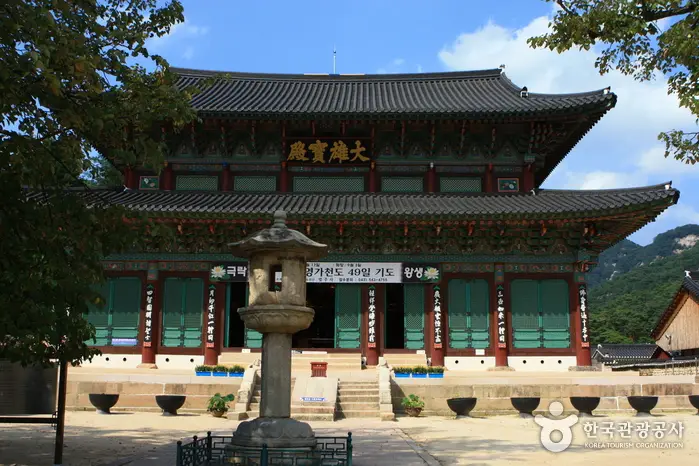
Beopjusa Temple, nestled in the embrace of Songnisan Mountain—whose name suggests 'leaving the secular world'—sits amid such dense forest that it lets you briefly forget the world outside. Contemplate alongside the trees of Beopjusa here and heal a mind worn down by daily life. Perhaps, by touring the 99-kan old house of Seon Byeong-guk in Boeun and strolling through Samnyeonsanseong, the Three Kingdoms-era fortress that guarded the peace, you can find the ease of mind to start everyday life anew... Source: Chungcheong, More Charming the Longer You Stay
- Duration
- 2 days, 1 night
- Distance
- 135.55km
Along the way
- 1Beopjusa Temple, Chungbuk
충북 법주사
Beopjusa Temple on Songnisan Mountain was founded 1,400 years ago by the monk Uisin, in 553 CE, the 14th year of King Jinheung's reign—24 years after Buddhism entered Silla. It was later rebuilt in 776 under monks Jinpyo and Yeongsim, and by the mid-Joseon period it had grown into a great temple with a commanding presence, comprising over 60 buildings and about 70 hermitages. However, nearly all of the temple's buildings were burned to the ground during the Japanese invasions of 1592-98, and it was rebuilt once again in 1624, the 2nd year of King Injo's reign, by the monk Byeogam.\nMoreLess
- 2
Seon Byeong-guk House, Boeun
보은 선병국 가옥
Built between 1919 and 1921, this house is a representative building of a period that was moving away from traditional construction techniques, showing a trend toward larger bays and greater heights in buildings. Geographically, it stands at the center of an island-like delta formed where the Samgacheon Stream, flowing down from Songnisan Mountain, widens into a large stream—a 99-kan tile-roofed house surrounded by a forest of pine trees so thick you can't wrap your arms around them.\nMoreLess
- 3
Lunch (Gangseo Myeonok)
점심식사(강서면옥)
Opened in 1979, this Pyongyang-style naengmyeon restaurant has a history of over 20 years. The mildly bland yet clean broth and the savory noodles taste just as they always have at Gangseo Myeonok. The broth, made purely from simmered beef brisket without any bone stock mixed in and seasoned with clear dongchimi (radish water kimchi) juice, gives a refreshing, clean flavor that shows off classic, uncompromising Pyongyang naengmyeon taste. \nMoreLess
- 4Samnyeonsanseong Fortress
삼년산성
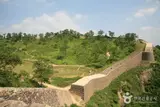
At 104 Seongju 1-gil, Boeun-eup, Boeun-gun, Chungbuk, stands Samnyeonsanseong, a Silla-era mountain fortress. With a circumference of 1.7km, a width of 8-10m, and a height of 13-20m, Samnyeonsanseong is an impregnable stronghold. Standing at the base of its walls, you're overwhelmed by the precise craftsmanship of stones cut into regular hexagonal blocks and by its tall, sturdy dignity. The name Samnyeonsanseong ('Three-Year Mountain Fortress') is said to come either from the fact that it took three years to build the fortress, or from the fact that Boeun's place-name during the Three Kingdoms period was Samnyeon-gun. The Silla troops that attacked and defeated King Seong of Baekje at the Battle of Gwansanseong were stationed here. It is also the place where King Taejong Muyeol received envoys from Tang China, and where Wang Geon of Goryeo was defeated and forced to retreat. \nMoreLess
- 5Bidangang Sup (Forest) Village, Yeongdong
영동비단강숲마을
Bidangang Sup Village is a purely rural village engaged in mixed farming. Historically, it lay on the border between Silla and Baekje, and in the Goryeo period, it is home to Yeongguksa Temple, where King Gongmin took refuge from the Red Turban rebellion. Originally part of Yangsan-hyeon, it belonged to Yangnae-myeon, Okcheon-gun, before being incorporated into Yeongdong-gun in 1906. Following the 1914 reorganization of administrative districts, it was merged with Daegok-dong and named Sudu-ri. Since Sudu-ri lies at the head of the Yangsan forest, it came to be called Sup-meori ('forest head') or Su-meori.\nMoreLess
Source: Korea Tourism Organization (TourAPI) · Machine-translated