Savoring the Sea's Delicacies Together with West Coast Scenery
5 stops · 4 hours
After briefly experiencing Boryeong's nature and culture, head back to Daecheon, the beach of mud. Boryeong's west coast, stretching to Muchangpo, will captivate travelers with a sunset that wears a different expression each time. The seas of Hongseong and Boryeong are the essence of a Chungnam coastal trip, where you can enjoy both the pleasure of sightseeing and of good food. Source: Chungcheong, More Charming the Longer You Stay
- Duration
- 4 hours
- Distance
- 15.03km
Along the way
- 1Gwangcheon Earthen-Cave Salted Shrimp Village
광천토굴새우젓단지
The area around Eungampo along Gwangcheon-ro in Gwangcheon-eup, Hongseong-gun, Chungnam, is the Gwangcheon Earthen-Cave Salted Shrimp Village. Gwangcheon's salted shrimp has a history going back to the Goryeo dynasty. The salted-shrimp shops lining Gwangcheon-ro are its descendants. The methods for aging salted shrimp have also developed further over the years. Today there are around 40 earthen caves, large and small, including newly dug ones. Because buyers can visit the caves themselves to buy salted shrimp, an earthen-cave salted shrimp experience naturally takes place.\nMoreLess
- 2
Boryeong Seawall
보령방조제
The seawall connecting the Soseong intersection on Chungcheongsuyeong-ro in Ocheon-myeon, Boryeong-si, Chungnam, to Cheonbuk-myeon cuts boldly across the sea between two stretches of land. There's no shoulder, so you can't park on the seawall road itself, but it's worth parking in the lot and walking along the breakwater. On the West Sea side, alongside Ocheon Port, Cheonbuk Marina is located there, and the anchored yachts create an exotic scene. Since oysters are a local specialty of nearby Cheonbuk-myeon, having an oyster dish for a meal is also a good idea.\nMoreLess
- 3
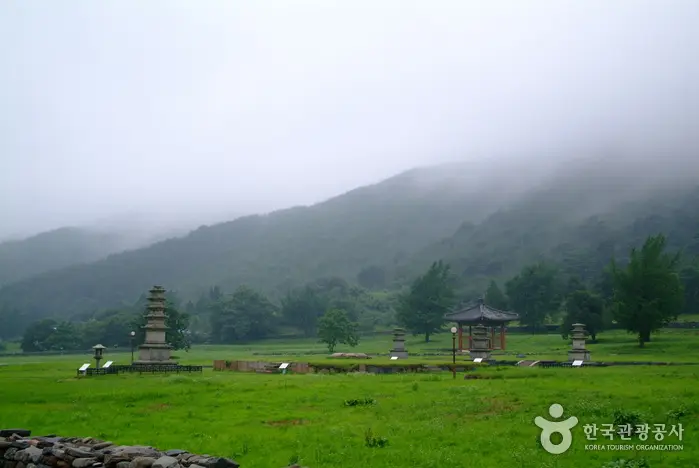
Seongjusa Temple Site, Boryeong
보령 성주사지
A once highly renowned and very prosperous temple, known as one of the Nine Mountain Seon Schools of the late Silla period. According to the Samguk Sagi (History of the Three Kingdoms), the temple was founded by King Beop of Baekje under the name Ohapsa. It is said to have been built to console the souls of those who died in the wars among the Three Kingdoms, at a time when King Beop was still a prince. It was renamed Seongjusa toward the end of Unified Silla. The name means 'temple where a sage resides,' referring to the great National Preceptor Muyeom of the late Silla period. When National Preceptor Muyeom served as the temple's abbot, Seongjusa was a massive complex of about a thousand kan (bays) in total, including 80 kan of Buddha halls, 7 kan of water pavilions, and around 50 kan of storehouses. At that time, the monks devoted to practice at Seongjusa are said to have numbered around 2,000. \nMoreLess
- 4
Gaehwa Art Park
개화예술공원
Gaehwa Art Park is located around Seongjusan-ro in Seongju-myeon, Boryeong-si, Chungnam. Covering about 18ha, it consists of the Mosan Sculpture Art Museum, the world's largest sculpture park, the Hwa-in Concert Hall, and Herb Land. The orange-roofed Mosan Sculpture Art Museum was built with black stone quarried in Boryeong, and visitors can view works by numerous promising artists. The sculpture park displays roughly 1,500 works in total, including statues and poem monuments. Even before entering the gate, huge sculptures line the way, most of them made of black stone. A handwritten poem monument park engraved with poems by living poets is also worth seeing.\nMoreLess
- 5
Ginkgo Village, Boryeong
보령 은행마을
Ginkgo Village, on Oseosan-gil in Cheongna-myeon, Boryeong-si, Chungnam, is a village surrounded by ginkgo trees. It is also called the Green Rural Experience Village or (Cheongna) Ginkgo Village. As you enter the village, various painted panels greet you, but as its name suggests, the village's pride is its ginkgo trees. Korea's largest cluster of ginkgo trees turns the village bright yellow in autumn, a sight that holds its own against any in the country. Janghyeon Elementary School, closed in 1991, has been used since 2011 as a rural experience center and direct-sale farmers' market. \nMoreLess
Source: Korea Tourism Organization (TourAPI) · Machine-translated