Feeling the Breath of Baekje's Land
5 stops · 2 days 1 night
In Gyeryong-si, the site King Taejo Yi Seong-gye once planned to make the new capital after founding Joseon, Goemokjeong Pavilion and Sagye Historic House are well worth seeing. If you study up on Baekje enough before taking this course, you'll be able to experience a living lesson in Baekje history. Source: Chungcheong, More Charming the Longer You Stay
- Duration
- 2 days 1 night
- Distance
- 38.30km
Along the way
- 1
Nonsan Myeongjae Historic House
논산명재고택
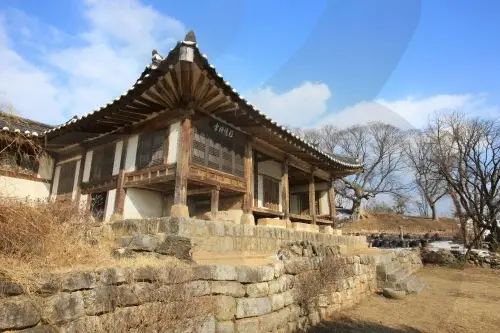
Tradition holds that this house was built by Yun Jeung during the reign of King Sukjong of Joseon, but its construction details suggest it was actually built around the mid-19th century. It sits facing south at the foot of Mt. Isan, home to Noseongsanseong Fortress, alongside Noseong Hyanggyo Confucian school. The U-shaped main women's quarters spreads its wings and sits toward the rear; the men's quarters in front is offset and shifted east along the axis so as not to block passage through the middle gate. There is no separate servants' quarters in front of the men's quarters, leaving the front open, and a neat Joseon-style well was built directly in front of the main quarters' axis, with a small pond also created to its southwest. MoreLess
- 2
Baekje Military Museum
백제군사박물관
Nonsan was the Deukanseong region of the Eastern Quarter during Baekje's Sabi period -- a naturally strategic location and a militarily important stronghold for a thousand years. The Baekje Military Museum, located on the grounds around the tomb of General Gyebaek, who led the 5,000-strong suicide corps into the Battle of Hwangsanbeol and died a heroic death, organizes its exhibits around the theme of Baekje and its military, displaying not only Baekje-era relics but also the military life of the period, allowing visitors to vividly experience Baekje's military culture. MoreLess
- 3
Lunch (Luce)
점심식사(루체)
Located on the shore of Tapjeong Reservoir, this cafe lets you fully take in the changing seasons even from inside. Above all, it's a cafe of outstanding architectural artistry, offering a relaxed architectural beauty and a space filled with light. It was designed by Lee Eun-seok, a professor of architecture at Kyung Hee University, and was selected as a building of note by the Daejeon Ilbo in the Year of Architecture 1999, as well as being chosen as an outstanding building by Chungcheongnam-do. MoreLess
- 4
General Gyebaek Historic Site
계백장군유적지
This is the historic site of General Gyebaek, counted alongside Seongchung and Heungsu as one of the Three Loyal Subjects of late Baekje, located near Hwangsanbeol, the site of the final decisive battle. When the tomb was discovered in 1966, more than half of the burial mound had collapsed, exposing the inner burial chamber, with parts of the chamber walls also damaged and left neglected. Residents of Bujeok-myeon then installed a memorial stone, sealed the plastered inner chamber walls, and restored the mound to a circumference of 47.6m, a diameter of 15.15m, and a height of 6.5m. On May 19, 1976, an earthen mound was raised and a stele erected. The stele reads, "Jeon Baekje Gyebaek Janggun-ji Myo" (傳百濟階伯將軍之墓, "Traditionally Held to Be the Tomb of Baekje General Gyebaek"). MoreLess
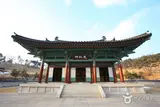
- 5Gwanchoksa Temple
관촉사
Gwanchoksa Temple sits at the foot of Mt. Banyasan (100m), a little over 3km from downtown Nonsan. The temple houses the Stone Standing Maitreya Bodhisattva of Gwanchoksa (Treasure No. 218), construction of which began in the 19th year of King Gwangjong of Goryeo (967) and was only completed 38 years later by the monk Hyemyeong. According to legend, a woman gathering bracken on Mt. Banyasan heard a child crying and went to look, but found no child -- only a large rock emerging from the ground. When the royal court heard the news, it had a Buddha statue carved from this rock. MoreLess
Source: Korea Tourism Organization (TourAPI) · Machine-translated