A Baekje Tour Amid the Calm Lotus Blossoms of Buyeo
7 stops · 4 hours
The lotus blossoms in bloom at Gungnamji Pond deepen Buyeo's quiet, timeworn atmosphere. The museum where you can see Buyeo's culture, and the vast green lawn of the Neungsan-ri Ancient Tombs, are great places for children to run around. The mood of the Baengma River, sailed by the Goransa excursion boat, is refreshing beyond compare. Source: Chungcheong, More Charming the Longer You Stay
- Duration
- 4 hours
- Distance
- 21.92km
Along the way
- 1Busosanseong Fortress
부소산성
As you enter Buyeo, the first thing that catches your eye to the north of the city is the low, 106m Mt. Busosan, covered in dark green forest. As the guardian mountain of Buyeo, Mt. Busosan holds Nakhwaam Rock, where countless Baekje women are said to have fallen like flower petals to their deaths to preserve their honor, along with Baekhwajeong Pavilion, Sajaru Pavilion, Banwollu Pavilion, Gungnyeosa Shrine, Goransa Temple, Busosanseong Fortress (Historic Site No. 5), Yeongillu Pavilion for watching the sunrise, Samchungsa Shrine honoring the loyal Baekje subjects Seongchung, Heungsu, and Gyebaek, Gunchangji, the site of a former grain storehouse, and Suhyeol Byeongyeongji, the pit-dwelling barracks of Baekje soldiers. Every earthen rampart that catches your steps here is steeped in the history of Baekje and the tales of its royal court. MoreLess
- 2Nakhwaam Rock
낙화암
Nakhwaam Rock is a cliff standing tall as if looking down over the Baengma River to the north of Mt. Busosan. It is said that when Sabiseong Fortress was overrun by the allied Silla-Tang forces, countless Baekje women threw themselves into the Baengma River like falling flower petals. This legend gave the rock its flowery, poignant name, "Nakhwaam" (Falling Flower Rock), though the Samguk Yusa records it as "Tasaam" (墮死岩, "the rock where people fell to their deaths"). MoreLess
- 3
Goransa Excursion Boat
고란사유람선
Aboard the excursion boat on the Baengma River, which flows silently, cradling the history of Baekje, you'll encounter Baekje at every stop along the way -- Cheonjangdae, where important state affairs were once decided, along with Nakhwaam Rock, Joryongdae, Gudeurae, Busan and Daejaegak, Jaondae, and Subukjeong. MoreLess
- 4
Lunch (Solnaeum)
점심식사(솔내음)
Lobster brushed with Solnaeum's signature sauce, topped with cheese and oven-baked for extra flavor, along with fish cutlets, egg-and-rice bowls, and shrimp cutlets, let you take in the flavors of the sea at a glance -- and a glass of white wine makes the delicious food taste even better. MoreLess
- 5Seodong Park and Gungnamji Pond
서동공원과 궁남지
Gungnamji Pond (Historic Site No. 135) is Korea's first known artificial pond, said to have been built by King Mu of Baekje, famous for his love with Princess Seonhwa, as part of a detached palace south of the royal palace. It is named "Gungnamji" ("South Palace Pond") based on records in the Samguk Sagi. According to the Samguk Sagi, in the 35th year of King Mu (634), "a pond was dug south of the palace walls, water was drawn from a source over 20 li away, willow trees were planted around it, and an island modeled on Bangjangseonsan -- one of the Three Divine Mountains of Chinese legend -- was built in the middle of the pond." The current pond was restored between 1965 and 1967 and is about one-third the size of the original natural wetland. MoreLess
- 6
Buyeo National Museum
국립부여박물관
Located at the foot of Mt. Geumseong in southeastern Buyeo, the Buyeo National Museum traces its origins to 1929, when the foundation "Buyeo Historic Site Preservation Society" was established and began gathering Baekje cultural properties and relics to display at the guest house of a Joseon-era government office south of Mt. Busosan. From 1939 it was called the "Buyeo Branch of the Government-General Museum of Joseon," finally gaining the name "Buyeo Museum." In 1970, a new museum building was constructed at the southern foot of Mt. Busosan, exhibiting Baekje cultural relics gathered from Buyeo and the wider Baekje region. MoreLess

- 7
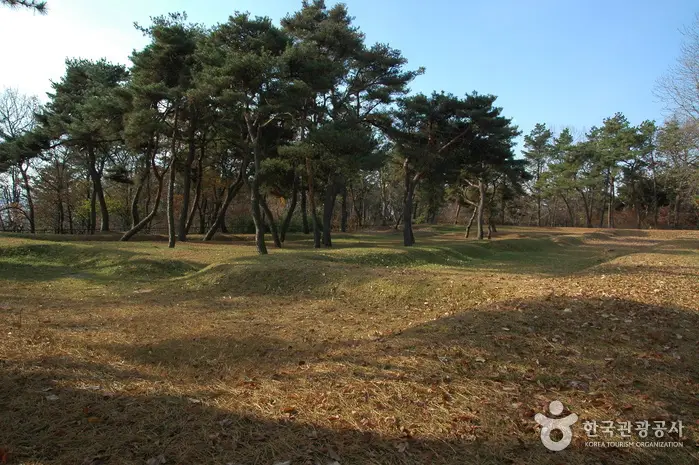
Buyeo Neungsan-ri Ancient Tombs
부여 능산리 고분군
Located in Neungsan-ri, Buyeo-eup, Buyeo-gun, Chungcheongnam-do, these are Baekje-era tombs situated partway up the southern slope of the 121m Neungsan-ri mountain. The site of the tombs was chosen according to the geomantic principles of pungsu (feng shui), giving it the classic topography of a burial ground: the mountain behind serves as the main peak, with the Blue Dragon to the east and the White Tiger to the west, and Mt. Yeomchang-ri in front serving as the southern Vermilion Bird. It is a south-facing royal communal burial ground, with the Neungsan-ri stream flowing about 200m in front of it. MoreLess
Source: Korea Tourism Organization (TourAPI) · Machine-translated