A Road in Search of Daejeon's History
4 stops · 1 day
Standing in the temple courtyard of Biamsa, it feels as though the 810-year-old zelkova tree is telling stories of days gone by. History dwells everywhere across this land. In the history held within a single stone on the road or a single tree, we search for a way to live in the present.Source: Chungcheong, More Charming the Longer You Stay
- Duration
- 1 day
- Distance
- 48.67km
Along the way
- 1
Unjusanseong Fortress
운주산성
Also known as Gosansanseong, this is a relic from the Baekje period. Unjusan (459.7m) rises at the boundary where Migok-ri and Cheongsong-ri in Jeondong-myeon meet Donggyo-ri and Sinjeong-ri in Jeonui-myeon. Unjusanseong is a mountain fortress built making use of this very mountain. The Gyeongbu high-speed rail line runs below the fortress to the west. A grand Baekje-era mountain fortress with a perimeter of 3,210m, a width of 2m, and walls 2 to 8m high, Unjusanseong offers a superb view thanks to its basin-shaped terrain and beautiful scenery. MoreLess
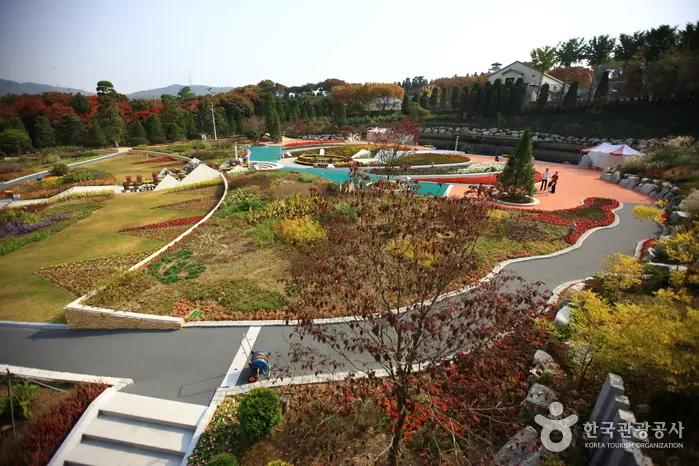
- 2Bear Tree Park
베어트리파크
Located in Jeondong-myeon, Sejong Special Self-Governing City, Bear Tree Park is a private arboretum founded by Chairman Lee Jae-yeon. It began when Chairman Lee, from his younger days working in the business world, would head there every weekend to tend and cultivate the grounds. Over 45 years, junipers transplanted from a countryside stone wall have grown into stately, full-grown trees, and a pair of Asiatic black bears and deer have, generation after generation, grown into herds of several hundred animals, bringing the park to what it is today. MoreLess
- 3
Biamsa Temple
비암사
Located about 10 kilometers south of Jeonui Station on the Gyeongbu Line. With no surviving records, its exact founding date is unknown. According to tradition, it is said to be an old temple of the Three Han period, founded in the first year of the Wufeng era of Emperor Xuan of Han (a date around 2,000 years ago), though this is not certain. Judging from the Geungnakbojeon Hall of Biamsa and its three-story stone pagoda, both designated Chungcheongnam-do cultural properties, the temple is presumed to have been founded in the mid-Goryeo period MoreLess
- 4
Yeongpyeongsa Temple
영평사
A branch temple of Magoksa, the head temple of the 6th district of the Jogye Order of Korean Buddhism, it is a place of practice designated Traditional Temple No. 78 of Korea, with six traditional buildings recognized as cultural assets and three earthen huts. Though the mountain itself is small, in feng shui terms it is called an "reverse dragon" (yeongnyong) climbing back up against the flow of the Geumgang River, said to be a powerful auspicious site. Janggunsan ("General Mountain")! In Korea, where seven-tenths of the land is mountains, there are many mountains with peaks named "Janggunbong" (General Peak). But, perhaps due to limited knowledge, one whose very name — not just a peak — is "General Mountain" is rarely heard of. MoreLess
Source: Korea Tourism Organization (TourAPI) · Machine-translated