A Historic Road That Echoed Through Auenae Market
4 stops
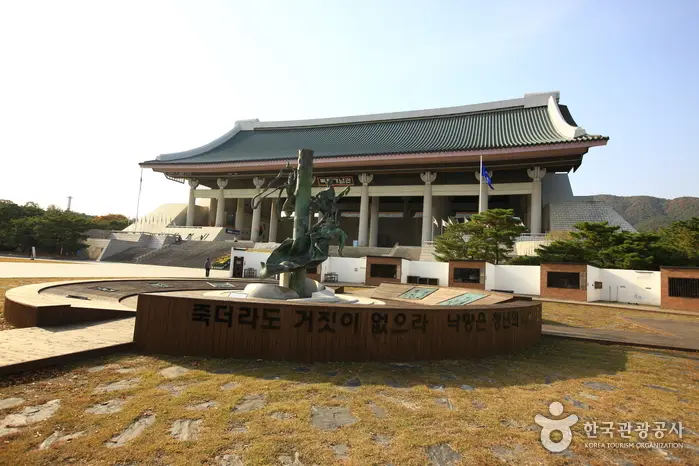
Looking at the remains of the Japanese Government-General building displayed at the Independence Hall of Korea, you can see the righteous path of those who devoted body and soul to independence. Standing before the memorial hall at the Yu Gwan-sun Historic Site, you can feel a burning love of country. Before this road of history woven into this land, let us reflect deeply on the new path we must walk from here on. Source: Chungcheong, More Charming the Longer You Stay
- Distance
- 10.5km
Along the way
- 1
Independence Hall of Korea
독립기념관
The Independence Hall of Korea was built on August 15, 1987, funded by the heartfelt donations of the entire nation, with the aim of establishing the identity of Korean national culture and instilling in citizens a firm national spirit and view of the state, by collecting, preserving, exhibiting, surveying, and researching materials related to the history of the Korean people's struggle to overcome foreign invasions and to defend national self-determination and independence, and to the nation's development. MoreLess
- 2
Yu Gwan-sun Memorial Hall
유관순열사기념관
Opened on April 1, 2003 to mark the 100th anniversary of the martyr Yu Gwan-sun's birth, the memorial hall presents her life story, from birth to her death in prison as a martyr, through exhibits and video, giving the many visitors who come to pay their respects a chance to reflect anew on the circumstances of the time and the martyr's spirit. It also greatly contributes as a place of living education, offering a wall-experience corner where visitors can directly experience what it was like for the martyr to be tortured while standing against a wall, and a hands-on space where visitors can print their own Taegukgi (Korean flag) and come to understand it more fully. MoreLess
- 3
Auenae Market
아우내장터
Auenae means "where two streams meet," and the market lies along the route linking Gyeongsang-do and Hanyang (old Seoul). Located in Byeongcheon-myeon, Dongnam-gu, Cheonan, Auenae Market has, since the Joseon dynasty, been a gathering place where merchants from across the country brought regional specialties and cattle from places such as Cheongju, Jincheon, Jochiwon, and Yesan to form a marketplace, and it flourished as the largest among the markets in the surrounding area. Also known as Byeongcheon Market, it is held on the 1st, 6th, 11th, 16th, 21st, and 26th of each month, and is famous for byeongcheon sundae — pork intestine casing stuffed with minced cabbage, green onion, chili, garlic, and blood sausage filling — making it a noted food destination in Cheonan. It is also the site where, in 1919, the martyr Yu Gwan-sun handed out Taegukgi to the crowd and led cries of "manse" (long live Korea); nearby stand the birth houses of Yu Gwan-sun and Dr. Cho Byeong-ok. MoreLess
- 4
Cheonan Byeongcheon Sundae Street
천안 병천순대 거리
Whether in the countryside or the city, sundae gukbap (blood sausage soup with rice) — a way to fill a hungry stomach cheaply — is a dish loved by everyone. On a cold day, if you want a bowl of hot sundae gukbap to go with a drink, Cheonan's Auenae (Byeongcheon) Market is paradise for enthusiasts. The market is currently home to some 20 "sundae specialty restaurants," each proud of its own taste and portions. With so many claiming to be the "original," it's easy to be skeptical about who truly started it all, but Cheonghwajip is the shop that regulars here widely recognize as the original. MoreLess
Source: Korea Tourism Organization (TourAPI) · Machine-translated