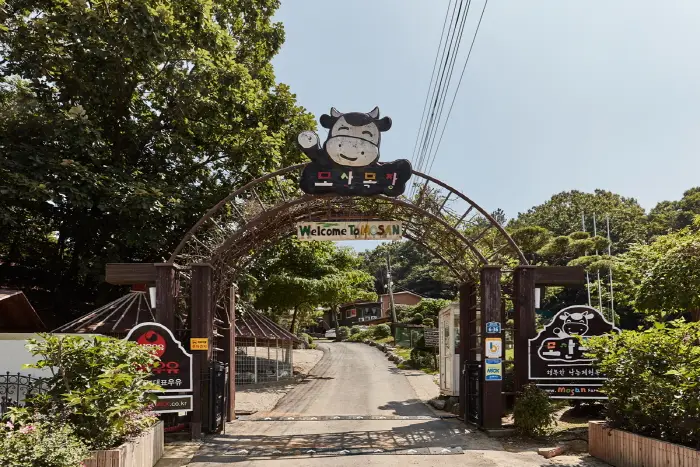
A Great Trip to Enjoy in Paju
3 stops · 1 day
Paju has a wealth of sights to see and activities to enjoy. It makes for a meaningful experiential trip to try hands-on dairy farming with children at Mosan Farm, stroll along streets filled with diverse arts and culture in Heyri Art Village, and take a quiet, reflective tour around the solemn Imjingak Resort.
- Duration
- 1 day
- Distance
- 63.67km
Along the way
- 1
Mosan Farm (Dairy Experience)
모산목장 (낙농체험)
The general public now has the opportunity to experience dairy farming firsthand. This was made possible as the Korea Dairy Committee collaborated with dairy farmers nationwide to operate Milk Schools. If you are looking for a place that brings joy to children beyond typical amusement parks, nowhere compares to this. Experience the full spectrum of educational hands-on programs, allowing children to run around freely without risk of injury while trying fascinating activities. Visitors can try milking cows, making cheese from milk, tasting freshly milked milk on the spot, and experiencing everything you can do with milk. MoreLess
- 2Heyri Art Village
헤이리 문화예술마을
Heyri Art Village is a comprehensive arts and culture village where the creation, exhibition, performance, festival, and education of culture and arts all take place in one location. In 1997, during the process of planning a "Book Village" in connection with Paju Book City, artists from other disciplines joined in, expanding the concept into a "Culture and Art Village." It comprises about 370 members across various artistic fields, including prominent cultural figures such as singer Yoon Do-hyun, novelist Park Bum-shin, broadcaster Hwang In-yong, and film directors Kang Je-gyu and Kang Woo-suk. MoreLess
- 3
Imjingak Resort (Pyeonghwa Nuri Park)
임진각관광지(평화누리공원)
Located approximately 54 km northwest of Seoul City Hall, Imjingak is a place steeped in the sorrow and heartache of the Korean War. Standing on a site of about 19,834 m² (6,000 pyeong) with one basement level and three above-ground floors, Imjingak was built in 1972 for displaced families from North Korea and is now widely known as a tourist attraction. It also houses the Gyeonggi Peace Center, which conveys the importance of peace and the environment. MoreLess
Source: Korea Tourism Organization (TourAPI) · Machine-translated