Spending a Day Amidst the Bustle of an Old Market and Wildflowers at Hongneung Arboretum
4 stops · 1 day
The history of the Seoul Yangnyeong Market dates back to the 1960s. It began when agricultural products and medicinal herbs from across the country gathered here after the Korean War. The traditional market, which can be considered the largest in Seoul, and Hongneung Arboretum, filled with wildflowers, offer contrasting vibes yet share a certain natural charm. Exploring Seoul's historic spots and enjoying lunch at the nostalgic Sindang-dong Tteokbokki Alley will make for a delightful day.
- Duration
- 1 day
- Distance
- 660.65km
Along the way
- 1
Seoul Yangnyeongsi Market
서울약령시장
A Yangnyeongsi (medicine market) was originally a hub for herbal medicine dealers established by royal decree during the reign of King Hyojong of the Joseon Dynasty, where provincial governors were stationed in major herbal production regions to collect rare medicinal herbs. At that time, it operated as a seasonal market held twice a year—the Spring Market and the Autumn Market—aligned with the harvesting and gathering periods of herbs. Today, while several medicine markets exist across the country, including Daegu and Jecheon, Seoul Yangnyeongsi is the largest in terms of scale and history. MoreLess
- 2
Hongneung Arboretum
홍릉수목원
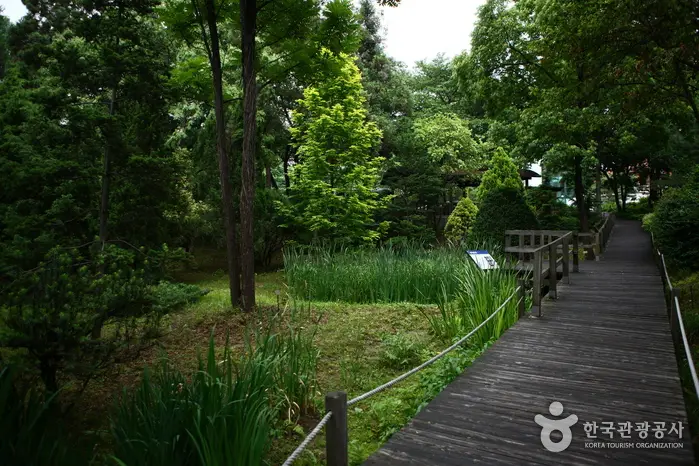
Hongneung Arboretum was Korea's first generation arboretum, established in 1922 along with the forestry experiment station in Hongneung, Seoul. It was named "Hongneung Arboretum" because it was originally the site of Hongneung (1897), the royal tomb of Empress Myeongseong, the wife of King Gojong of the Joseon Dynasty; the tomb has since been relocated, leaving only a marker behind. As an affiliated specialized arboretum of the National Institute of Forest Science, it is an experimental research forest created to systematically collect and manage diverse plant genetic resources from home and abroad, promoting the advancement of basic plant sciences and securing plant genetic resources. MoreLess
- 3
Seoul Sindang-dong Tteokbokki Alley
서울 신당동 떡볶이 골목
At first, tteokbokki was made simply by adding red pepper paste (gochujang). Starting this way, Sindang-dong tteokbokki has evolved over several decades from a casual snack into a full-fledged dish that makes a satisfying meal. Nowadays, alongside staple additions like boiled eggs, glass noodles, fish cakes, chewy jjolmyeon noodles, and ramen noodles, ingredients like squid, shrimp, and cheese are added to captivate modern palates. MoreLess
- 4Cheonggyecheon Stream
청계천
Cheonggye Plaza, built at Sejong-ro where Cheonggyecheon Stream begins. Spanning from in front of the Dong-A Ilbo building, the starting point of the stream's restoration, to Sindap Railway Bridge, it covers an area of 6,962 m² with a length of 160 meters and a width of 50 meters. Featuring fountains, waterfalls, a miniature model of Cheonggyecheon Stream, walking paths, and exploration trails, it is designed as a space that embodies the meaning of the stream's restoration as well as aspirations for encounter, harmony, peace, and unification. MoreLess
Source: Korea Tourism Organization (TourAPI) · Machine-translated