A Journey Through Gimhae's Traditional Culture and the Daeseong-dong Tumuli Museum
4 stops · 4 hours
Let's go to Gimhae to study history. Starting at the Tomb of King Suro, founder of Garak-guk, and continuing through Gimhae Hyanggyo to the Gimhae Cultural Center, you can enjoy a pleasant time exploring glimpses of Korea's past. At the Daeseong-dong Tumuli Museum, you can finally come face to face with the reality of the Geumgwan Gaya kingdom. If you bring elementary-school-age children along, it will make for a fun and educational trip.
- Duration
- 4 hours
- Distance
- 4.10km
Along the way
- 1Tomb of King Suro
수로왕릉
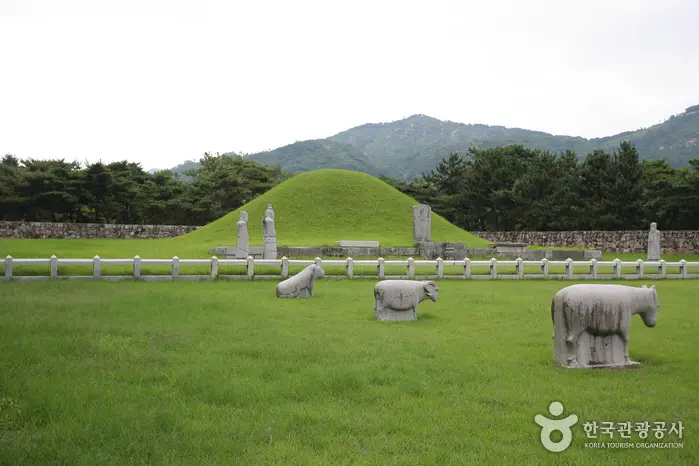
King Suro ascended the throne in AD 42 as the founder of Garak-guk, and in AD 48 took Princess Heo Hwang-ok of the Indian kingdom of Ayodhya as his queen. He is the progenitor of the Gimhae Kim clan. The tomb was given its present form in 1580 (the 13th year of King Seonjo's reign) by Heo Yeop, governor of the Yeongnam region. Within the tomb grounds are several buildings, including Sungseonjeon Shrine, which enshrines the memorial tablets of King Suro and his queen, along with Anhyanggak, Jeonsacheong, and Jegigo, as well as stone monuments such as memorial steles. The gravestone in front of the tomb was erected in 1647 (the 25th year of King Injo of Joseon), and the name 'Sungseonjeon' was bestowed by the king in 1884 (the 21st year of King Gojong).MoreLess
- 2
Gimhae Hyanggyo (Confucian School)
김해향교
It appears that the Seomu (west shrine hall) and Daeseongjeon (main shrine hall) were built first. Later, when the mountain behind the hyanggyo (main geomantic backdrop) collapsed, the school was relocated to its current site in 1688 (the 14th year of King Sukjong). The east and west dormitories (dongjae and seojae) were built in 1689, the spirit tablet hall in 1692, and Myeongnyundang Hall and the south gate tower in 1693, completing its overall form. It enshrines the spirits of Confucius along with the Five Sages and Eighteen Confucian Worthies.MoreLess
- 3
Gimhae Cultural Center
김해문화원
The Gimhae Cultural Center opened in September 1956, was authorized as an incorporated association on October 21, 1964, and continued its activities before being officially established as the Gimhae Cultural Center in September 1994 under the Local Cultural Center Promotion Act, continuing its work to the present day. It has excavated and passed down traditions such as Gimhae Ogwangdae (mask dance), farmers' music bands, and Gimhae Seokjeon Nori (stone-fight game), and hosts a wide range of cultural and arts events — including a folk artifact exhibition hall, the National Gayageum Competition, and the Yi Yun-jae Memorial Writing Contest — that keep citizens coming back, making it a vibrant, ever-active cultural center that strives to meet the cultural needs of the community.MoreLess
- 4Daeseong-dong Tumuli Museum
대성동고분박물관
By displaying artifacts unearthed over four excavations at the Daeseong-dong tumuli, this museum reveals the long-hidden reality of Geumgwan Gaya and helps visitors understand that this site was the center of the Geumgwan Gaya kingdom. The museum has an exhibition hall on the ground floor and supporting facilities in the basement. The three exhibition rooms on the ground floor are divided into five sections: Introduction, Opening, Tombs, Exchange, and Culture.MoreLess
Source: Korea Tourism Organization (TourAPI) · Machine-translated