Visiting the Resting Place of the King and Queen of Garak-guk in Gimhae
5 stops · 4 hours
Gimhae is a city steeped in the long tradition and history of the Gaya kingdom. Follow Gimhae's iconic cultural heritage sites to visit the cultural treasures resting peacefully within the city. Starting from the Tomb of Queen Heo Hwang-ok, the wife of King Suro, and continuing to the Tomb of King Suro, Gimhae's foremost heritage site, you can retrace the history of Gaya.
- Duration
- 4 hours
- Distance
- 2.5km
Along the way
- 1
Tomb of Queen Suro (Heo Hwang-ok)
수로왕비릉
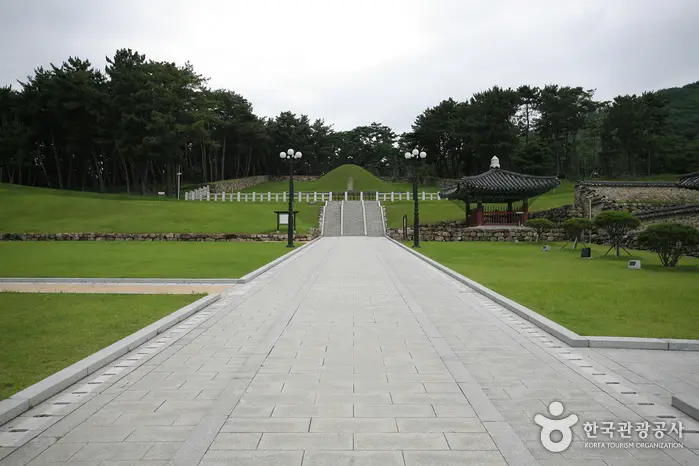
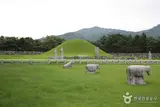
Located in Gusan-dong, Gimhae, this is a Gaya-period royal tomb — the tomb of Queen Heo, wife of King Suro, founder of Garak-guk (National Historic Site No. 74). It is a large round earthen mound, with a retaining wall of long stone slabs at the front and a low stone wall encircling a broad area around it. In front of the tomb stands a memorial stone, inscribed in two lines when the tomb was renovated in 1647 (the 25th year of King Injo), reading 'Tomb of Queen Suro of Garak-guk, Empress Dowager Boju of the Heo Clan.'MoreLess
- 2
Gujibong Peak
구지봉
This is the place where King Suro, the founder of Gaya, is said to have descended from heaven. It was originally called 'Gusubong' (Turtle Head Peak) because of its resemblance to a turtle's head — the flat area where the Tomb of Queen Suro (Historic Site No. 74) now sits was seen as the turtle's body, while the peak jutting out to the west resembled the turtle's head, giving rise to this name.MoreLess
- 3Gimhae National Museum
국립김해박물관
Located at the foot of Gujibong Peak in Gimhae, the site of Gaya's founding legend, the Gimhae National Museum brings together and displays Gaya cultural heritage, along with exhibits on the prehistoric culture of the Busan and Gyeongsangnam-do region and the cultural heritage of Byeonhan, the confederacy on which Gaya's growth was based.MoreLess

- 4Daeseong-dong Tumuli Museum
대성동고분박물관
By displaying artifacts unearthed over four excavations at the Daeseong-dong tumuli, this museum reveals the long-hidden reality of Geumgwan Gaya and helps visitors understand that this site was the center of the Geumgwan Gaya kingdom. The museum has an exhibition hall on the ground floor and supporting facilities in the basement. The three exhibition rooms on the ground floor are divided into five sections: Introduction, Opening, Tombs, Exchange, and Culture.MoreLess
- 5Tomb of King Suro
수로왕릉
King Suro ascended the throne in AD 42 as the founder of Garak-guk, and in AD 48 took Princess Heo Hwang-ok of the Indian kingdom of Ayodhya as his queen. He is the progenitor of the Gimhae Kim clan. The tomb was given its present form in 1580 (the 13th year of King Seonjo's reign) by Heo Yeop, governor of the Yeongnam region. Within the tomb grounds are several buildings, including Sungseonjeon Shrine, which enshrines the memorial tablets of King Suro and his queen, along with Anhyanggak, Jeonsacheong, and Jegigo, as well as stone monuments such as memorial steles. The gravestone in front of the tomb was erected in 1647 (the 25th year of King Injo of Joseon), and the name 'Sungseonjeon' was bestowed by the king in 1884 (the 21st year of King Gojong).MoreLess
Source: Korea Tourism Organization (TourAPI) · Machine-translated