Walking the Last Capital of Baekje
5 stops · 6 hours
This is a trip to Buyeo experienced not through a museum but on foot, seeing history with your own eyes. Explore the dense forest that blocks out the sky and Goransa Temple, imbued with the sorrow of King Uija, Baekje's last king, and the legend of the 3,000 court ladies, and crossing the Baengmagang River by pleasure boat is a special experience too. Along the path from Jeongnimsa Temple Site and Gungnamji Pond to the Neungsan-ri Ancient Tombs, the history of Buyeo, Baekje's last capital, remains vividly preserved.
- Duration
- 6 hours
- Distance
- 6.4km
Along the way
- 1Busosanseong Fortress
부소산성
As you enter Buyeo, the first thing that catches your eye is Busosan, a low, 106m-high hill covered in dark green forest to the north of the city. Busosan, Buyeo's guardian mountain, is home to Nakhwaam Rock, where countless Baekje women are said to have fallen to their deaths like flower petals to preserve their honor; Baekhwajeong Pavilion; Sajaru Pavilion; Banwollu Pavilion; Gungnyeosa Shrine; Goransa Temple; Busosanseong Fortress (Historic Site No. 5); Yeongilru Pavilion, where the sunrise is greeted; Samchungsa Shrine, honoring the loyal Baekje subjects Seongchung, Heungsu, and Gyebaek; Gunchangji, the site of a former grain storehouse; Suhyeolbyeongyeongji, the pit-dwelling site of Baekje soldiers' barracks; and earthen ramparts that catch the eye wherever you turn — the history of Baekje and its royal court is steeped in every corner. MoreLess
- 2
Lunch (Gudeurae Dolssambap, Hyangujeong)
점심식사(구드래돌쌈밥, 향우정)
[Gudeurae Dolssambap] \nThe vegetables served with the ssam (wrap) rice here are pesticide-free, grown under contract on dedicated farms completely free of agricultural chemicals; paired with a homemade dipping paste made with 20–30 rare medicinal herbs and edible flowers not commonly found in everyday meals, along with the vegetables, the flavor is exceptional. \n[Hyangujeong] \nRice grown in Buyeo, cooked in a stone pot with black rice, jujubes, gingko nuts, and beans, served with hearty doenjang jjigae (soybean paste stew) and cheonggukjang (fermented soybean stew), is a wonderful meal, accompanied by house-made kimchi and various side dishes. MoreLess
- 3Jeongnimsa Temple Site, Buyeo. Five-Story Stone Pagoda of Jeongnimsa Temple Site
부여 정림사지. 정림사지 오층석탑
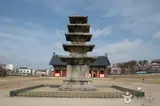
This site was home to the central temple of the period (538–660) when Baekje moved its capital to Buyeo. During excavation, among the roof tile fragments unearthed at the lecture hall site, an inscription reading 'Taepyeong 8-nyeon Mujin Jeongnimsa Daejangdangcho' (太平八年 戊辰 定林寺 大藏唐草) was found. 'Taepyeong 8' refers to an era name of the Liao dynasty, corresponding to the 19th year of King Hyeonjong of Goryeo (1028). This inscription was the most numerous among the Goryeo-era roof tiles excavated here, making it a relic representative of Jeongnimsa Temple as rebuilt during the Goryeo period. MoreLess
- 4Seodong Park and Gungnamji Pond
서동공원과 궁남지
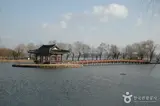
Gungnamji Pond (Historic Site No. 135), said to have been created by King Mu of Baekje, famous for his love story with Princess Seonhwa, as part of the southern detached palace of the royal residence, is Korea's oldest known artificial pond, taking its name 'Gungnamji' ('Pond South of the Palace') from records in the Samguk Sagi (History of the Three Kingdoms). According to the Samguk Sagi, in the 35th year of King Mu's reign (634), “a pond was dug south of the palace walls, water was drawn in from more than 20 li away, willows were planted around its edge, and in the middle of the pond, an island was made in imitation of Mount Fangzhang, one of the Three Divine Mountains of Chinese legend.” The present pond was restored between 1965 and 1967 and is about one-third the size of the original natural wetland. MoreLess
- 5
Neungsan-ri Ancient Tombs
능산리 고분군
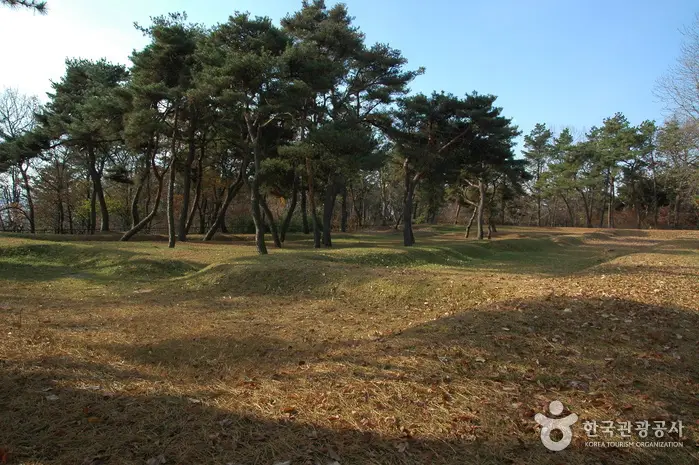
Located in Neungsan-ri, Buyeo-eup, Buyeo-gun, Chungcheongnam-do, these Baekje-era tombs sit on the midslope of the south face of Neungsan-ri Hill, at 121m above sea level. The site of the tomb cluster follows the classic burial geomancy (feng shui/pungsu) principles for selecting a tomb location: the hill behind serves as the main mountain, with the Blue Dragon to the east and the White Tiger to the west, and Yeomchang-ri Hill in front serves as the southern Vermilion Bird; about 200m in front of the tombs, Neungsan-ri Stream flows southward, marking this as a south-facing royal burial ground. MoreLess
Source: Korea Tourism Organization (TourAPI) · Machine-translated