Play with the Asiatic Black Bears!
3 stops · 5 hours
What kind of travel destinations are hidden in Sejong, Korea's newest and youngest city? Bear Tree Park, where you can meet Asiatic black bears, is popular with family travelers. Unjusanseong Fortress, a relic from the Baekje era, is easy enough for children to climb along with their families. Also visit Biamsa Temple, an old temple whose one-pillar gate is formed by an 800-year-old zelkova tree.
- Duration
- 5 hours
- Distance
- 22.4km
Along the way
- 1
Unjusanseong Fortress
운주산성
Also known as Gosansanseong Fortress, this is a relic from the Baekje era. Unjusan (459.7m) rises at the boundary of Migok-ri and Cheongsong-ri in Jeondong-myeon and Donggyo-ri and Sinjeong-ri in Jeonui-myeon. Unjusanseong Fortress makes use of this mountain. The Gyeongbu high-speed rail line runs along the western foot of the fortress. Unjusanseong is a grand Baekje-era fortress, 3,210m in circumference, 2m wide, and 2–8m high, with a basin-shaped terrain and stunning scenery that make it exceptional. MoreLess
- 2Bear Tree Park
베어트리파크
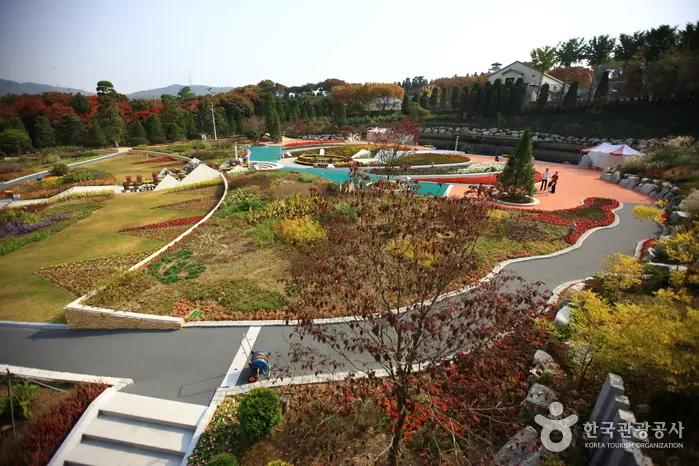
Located in Jeondong-myeon, Sejong Special Self-Governing City, Bear Tree Park is a private arboretum founded by Chairman Lee Jae-yeon. It began when its founder, still active in the business world in his younger days, would drive out every weekend to tend and cultivate it. Over the 45 years since, junipers transplanted from a country wall have grown into stately, thick trees, and a pair of Asiatic black bears and deer have multiplied across generations into colonies of several hundred, as it stands today. MoreLess
- 3
Biamsa Temple
비암사
Biamsa Temple sits about 10km south of Jeonui Station on the Gyeongbu rail line. As there are no surviving records, the exact date of its founding is unknown. According to tradition, it is said to have been founded in the first year of Wufeng under Emperor Xuan of the Han more than 2,000 years ago, one of the ancient temples of the Three Han period, though this is not certain. Judging from Biamsa's Geungnakbojeon Hall and three-story stone pagoda, both designated Chungcheongnam-do cultural heritage, it is presumed to have been founded in the mid-Goryeo period. The canopy above the altar inside Biamsa's Geungnakbojeon Hall is skillfully and splendidly crafted, and was restored in the 8th year of King Hyojong's reign (1657). MoreLess
Source: Korea Tourism Organization (TourAPI) · Machine-translated