Animal Experience Farms and the Vibrant Charm of Korean Culture
3 stops · 6 hours
Running across broad meadows, hand-feeding animals, and simply enjoying nature is the best gift you can give children. Along with the livestock experience at Anseong Farmland, the craft experience at Neorigul Cultural Village is a delight, and visiting its workshops at a leisurely pace to soak up the artistic atmosphere is a treat too. Don't miss Chiljangsa Temple, said to have been founded by the Great Master Jajang during the reign of Queen Seondeok of Silla, or the Namsadang Training Center, where performances of Namsadang Nori take place.
- Duration
- 6 hours
- Distance
- 53km
Along the way
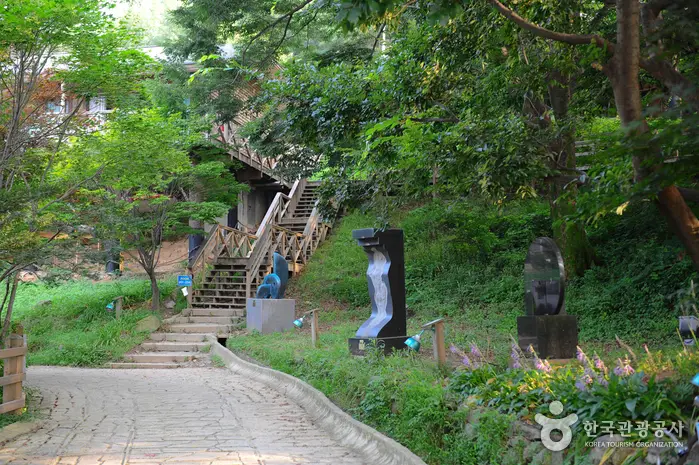
- 1Neorigul Cultural Village
너리굴 문화마을
Neorigul Cultural Village is nestled at the foot of Mt. Bibongsan. In the local Anseong dialect, 'Neorigul' describes the wide valley formed where the mountain range beginning at Cheonji, the crater lake atop Mt. Baekdusan, meets the foot of Mt. Bibongsan at the end of the Charyeong Mountains — hence the name. Neorigul Cultural Village can be described as a place where nature and art come together as one. MoreLess
- 2
Cheongnyongsa Temple
청룡사
Cheongnyongsa Temple was founded in 1265, the 6th year of King Wonjong of Goryeo, by State Preceptor Myeongbon at the foot of Mt. Seounsan. At its founding it was called Daejangam ('Great Scripture Hermitage'), but in 1364, the 13th year of King Gongmin's reign, the monk Naong greatly rebuilt it and renamed it Cheongnyongsa. The name 'Cheongnyongsa' ('Blue Dragon Temple') is said to come from a story in which Naong, while searching for a temple site to spread the Buddhist teachings, saw a blue dragon descending from the clouds at this very spot. MoreLess
- 3
Anseong Machum Namsadang Nori Saturday Regular Performance
안성마춤 남사당놀이 토요상설공연
The Namsadang troupe was a group of folk performers that arose spontaneously among the common people in the late Joseon Dynasty. A professional performing troupe with the character of a traveling fundraising band, it presented a range of performances including nongak (farmers' music and dance), plate spinning, acrobatics, tightrope walking, mask dance, and puppet theater, and lived off the money or grain collected. Anseong Pungmullori, a type of Namsadang Nori, once encompassed many varied arts such as plate spinning and acrobatics, but most of these have now disappeared, leaving pungmullori (farmers' music) as the main tradition passed down today. It is often called Utdari Nongak and plays a central role in Gyeonggi-style nongak. MoreLess
Source: Korea Tourism Organization (TourAPI) · Machine-translated