Enjoy What's Good for the Body, Clear the Mind
6 stops · 6 hours
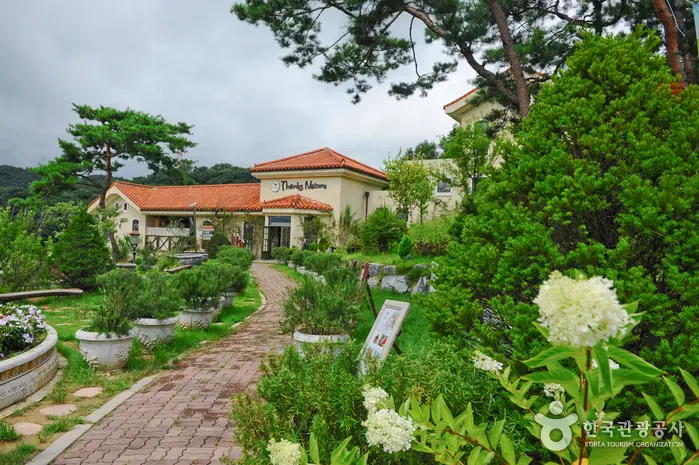
Filled with the fresh scent of herbs, Anseong Herb Village is all the more special for its variety of herb-related activities, from aromatherapy massage to making aromatic cosmetics. The doenjang jjigae (soybean paste stew) at Seoil Farm, famous for its spectacular display of hundreds of earthenware jars, is also excellent. Be sure to visit Jukjusanseong Fortress as well, said never once to have fallen to an enemy since its construction, along with the 5.6m-tall Standing Stone Buddha of Maesan-ri and Chiljangsa Temple.
- Duration
- 6 hours
- Distance
- 33.6km
Along the way
- 1
Anseong Herb Village
안성허브마을
In step with well-being culture, Anseong Herb Village is a practical, experience-focused herb village that goes beyond a typical herb farm, offering deeper hands-on engagement with herbs. It pursues natural food, a good environment, and a healthy lifestyle. MoreLess
- 2
Jukjusanseong Fortress
죽주산성
Jukjusanseong Fortress stands on Mt. Bibongsan in Maesan-ri, where the Taepyeong Mireuk Buddha statue leans against its back. The fortress's inner wall was built during the Silla period and its outer wall during the Goryeo period. The main wall, whose construction date is unknown, runs 1.7km, with the outer wall extending 1.5km and the inner wall 270m — three layers of stone fortification that still survive today in good condition. Continue past the ritual hall and you'll find a rest area. Rather than simply looking around Jukjusanseong, the real pleasure is in walking along the fortress wall as if on a stroll. MoreLess
- 3Seoil Farm (Lunch)
서일농원(점심식사)
Located in Hwabong-ri, Iljuk-myeon, Anseong, Gyeonggi Province, since 1983, Seoil Farm feels like a visit to your childhood hometown, with village guardian posts, evergreen bamboo, and lotus flowers visible beyond moss-covered stone walls. The menu features nutritious black rice, doenjang jjigae made with soybean paste aged for two years, aged kimchi, deodeok (bellflower root), sesame porridge, mung bean kimchi pancake, and handmade tofu coagulated using deep East Sea water, along with cheonggukjang (fermented soybean paste) — a light yet savory flavor just like a mother's home cooking, wonderfully rustic. MoreLess
- 4
Standing Stone Buddha of Maesan-ri
매산리석불입상
Exiting Iljuk IC and heading toward downtown Anseong, Maesan-ri in Juksan-myeon lies to the right. Here stands Mt. Bibongsan, and against its back stands a Maitreya Buddha statue known as the Taepyeong Mireuk. Though the stone pagoda beside it has suffered considerable weathering, it complements the Buddha statue beautifully. Enclosed within a low wall, the Buddha statue and pagoda create a homely, comfortable atmosphere. MoreLess
- 5
Five-Story Stone Pagoda of Bongeopsa Temple Site
봉업사지오층석탑
The five-story stone pagoda of Juksan-ri is estimated to predate the mid-Goryeo period. Standing 6m tall, it consists of a base built from several large, flat stones, a single-tier platform above that, and a five-story pagoda body on top. It draws attention as a massive work that never loses its balance in the stonework. Many stone pagodas remain in the Anseong area, but the Juksan-ri five-story pagoda is regarded as the finest among them. MoreLess
- 6
Chiljangsa Temple
칠장사
Chiljangsa Temple, at the foot of Mt. Chilhyeonsan, is said to have been founded in the mid-7th century by the Great Master Jajang of Silla. Records show that at the height of its prosperity, the temple complex comprised a total of 56 buildings, including the main hall. Chiljangsa holds a large number of cultural treasures, including items designated as National Treasures and Treasures. The mountain came to be called Chilhyeonsan ('Mountain of Seven Sages') after a story from around the 11th century, in which State Preceptor Hyeso reformed seven outlaws there, and the temple was named Chiljangsa because the seven sages are said to have stayed there for a long time. MoreLess
Source: Korea Tourism Organization (TourAPI) · Machine-translated