Experiencing the Miracle of Moses Along Jindo's Mystical Sea Road
6 stops · 7 hours
Jindo is the site of an annual 'Miracle of Moses,' an unusual natural phenomenon that occurs in the sea between Geumgye-ri, Gogun-myeon, and Modo-ri, Uisin-myeon. From Jindo's Mystical Sea Road and Jungnim Fishing Village Experience to Jeopdo's Wellbeing Trail with Supum Port, the journey through southern Jindo becomes one of encountering a mystical, beautiful sea.
- Duration
- 7 hours
- Distance
- 47km
Along the way
- 1
Gagye Beach
가계해변
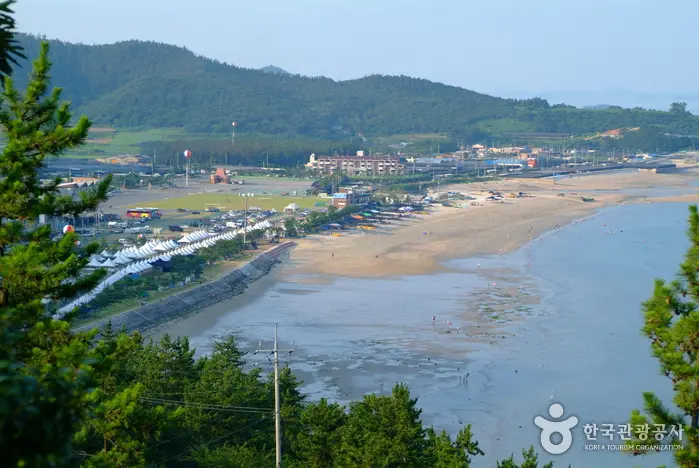
This beach lies within Hoedong National Tourist Resort, famous for its modern-day 'Miracle of Moses,' where the sea parts. Not only is it easy to reach, but it's also well equipped with amenities such as a spacious 99,174㎡ (about 30,000 pyeong) parking lot, showers, and drinking fountains, drawing many summer visitors who come by car. There are also many rocky shores and uninhabited islands nearby for sea fishing. \nMoreLess
- 2Jindo's Mystical Sea Road
진도 신비의 바닷길
Every year, around the Yeongdeung tidal period in late lunar February and again around mid-June, the sea parts between Hoedong Village in Gogun-myeon, Jindo-gun, and Modo in Uisin-myeon just offshore, in what's known as \"Korea's Miracle of Moses.\" When the water recedes, a sea road opens, about 30~40m wide and 2.8km long. During this period, the Mystical Sea Road Festival is held around the Hoedong-ri area. The sea road remains fully exposed for about an hour before closing again. \nMoreLess
- 3
Jungnim Fishing Village Experience
죽림어촌체험마을
Jungnim Village forms a beautiful scene in harmony with its pine forest, and visitors can wait for the tide to go out to gather shellfish along the water's edge, or enjoy the fun of catching mullet and other fish in the traditional 'gaemaegi' tidal traps at the lowest tide -- a place to fully soak in the charm of a fishing village.\nMoreLess

- 4
Jeopdo
접도
A small island located in Uisin-myeon, Jindo-gun, Jeollanam-do, Jeopdo was once an island within an island, formerly used as an exile site called Geumgapdo, but is now connected by a bridge with smooth access. Among Jeopdo's three villages, Supum Village has been designated a state-managed fishing port, with breakwaters and a loading dock already completed in its first phase of investment, and a second phase of investment for multi-purpose port development has also been applied for, giving it the look of a beautiful fishing port.\nMoreLess
- 5
Bae Jung-son Shrine
배중손 사당
Since before the Japanese colonial period, a village shrine stood here, and every year on the 15th day of the first lunar month, farmers' music (nongak) was performed and memorial rites held for General Bae Jung-son, the Sambyeolcho army, and Gosan Yun Seon-do. In 1959, the shrine was destroyed by Typhoon Sarah and left in ruins, until Gwak Nam-bae, a traditional Korean painter (pen name Baekpo) from Gulpo, used donations from local residents along with his own funds to build a shrine and memorial stele of about 5 pyeong at the current site, where residents of Gulpo have continued to hold memorial rites. \nMoreLess
- 6
Jindo Namdojinseong (formerly Namdoseokseong)
진도 남도진성(구, 남도석성)
Jindo, with its fertile land and thriving agriculture, is also called 'Okju.' The saying 'one year's harvest feeds three years' still circulates today, reflecting how abundant the land and generous the people of this region are. Namdoseokseong is believed to have been the center of Maegurihyeon during the Baekje period; the Sambyeolcho army of Goryeo rebuilt the fortress here to resist the Mongol forces, and it is known to have been repaired again in 1438 (the 20th year of King Sejong's reign, Joseon). \nMoreLess
Source: Korea Tourism Organization (TourAPI) · Machine-translated