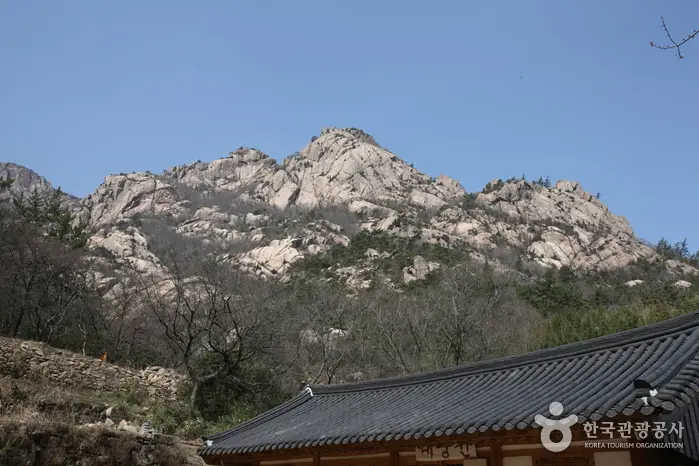
Admiring the Scenic Beauty of Wolchulsan National Park
3 stops · 7 hours
Wolchulsan is a beautiful mountain formed entirely of oddly shaped rocks, and is also the birthplace of Baekje's Dr. Wang In and Silla's State Preceptor Doseon. Known as the 'Sogeumgang of Honam,' Wolchulsan's highest peak, Cheonhwangbong, stands at 809m above sea level. Though under 1,000m, the mountain is famous for its rugged terrain. Wolchulsan is also home to the thousand-year-old temples Cheonhwangsa and Dogapsa, making it a perfect destination for exploring cultural heritage.
- Duration
- 7 hours
- Distance
- 9.4km
Along the way
- 1
Cheonhwangsa Temple
천황사
Cheonhwangsa shares its name with Cheonhwangbong (804m above sea level), the highest peak of Wolchulsan, and can be seen as symbolizing the mountain itself. Today, Wolchulsan is guarded by Muwisa to the south, Dogapsa to the west, and Cheonhwangsa to the east. According to records, more than 50 temples and hermitages once stood on Wolchulsan, and folklore says there were as many as 99 hermitages.\nMoreLess
- 2Wolchulsan National Park
월출산국립공원
True to its name, meaning 'mountain where the moon rises,' Wolchulsan is a mountainous national park at the southernmost tip of the Korean peninsula, harmoniously combining beautiful natural scenery, rich cultural resources, and the local flavor of the southern provinces. Formed where the Sobaek mountain range flows toward the sea off Mokpo and rises abruptly from the plain, Wolchulsan is centered on Cheonhwangbong (809m) and is covered in oddly shaped rocks from top to bottom, resembling an exhibition hall of ornamental stones. \nMoreLess
- 3Dogapsa Temple
도갑사
About 100m past the Iljumun Gate of Dogapsa stands Haetalmun Gate, National Treasure No. 50. Built in the 4th year of King Seongjong's reign (1473), it is an old building with a highly distinctive architectural style. In the front bays on either side of Haetalmun are statues of the Vajra guardians, and in the next bays are enshrined the statues of the boy bodhisattvas Manjusri and Samantabhadra, Treasure No. 1134. \nMoreLess
Source: Korea Tourism Organization (TourAPI) · Machine-translated