A Healing Camping Trip in the Forests of Baegunsan
6 stops · 1 night 2 days
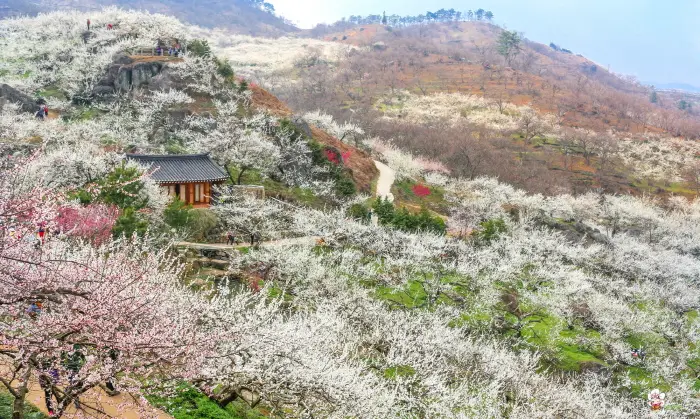
Gwangyang is a beautiful place in spring. Along the Seomjin River, plum blossoms fill the air at Seomjin River Maehwa Village and Cheongmaesil Farm, and at the site of Ongnyongsa Temple on the slopes of Baegunsan, a historic camellia forest bursts into a vivid red spectacle. Enjoy camping at Baegunsan Recreational Forest and take in the vibrant, colorful energy of spring.
- Duration
- 1 night 2 days
- Distance
- 54.6km
Along the way
- 1Seomjin River Maehwa (Plum Blossom) Village
섬진강 매화마을
Following the winding Seomjin River as it flows along the foothills of Jirisan, you'll find Seomjin Village, where plum trees are planted everywhere. The farming households here have planted plum trees instead of crops across their hills and fields, so that every March, the fully bloomed white plum blossoms create a spectacular scene, as if snow has fallen or white flower-clouds have settled into the valley. \nMoreLess
- 2
Lunch (Hanguk Sikdang, Samdae Gwangyang Bulgogi, Maesil Hanwoo)
점심식사(한국식당, 삼대광양불고기집, 매실한우)
[Hanguk Sikdang] \nA living tradition, this restaurant has served bulgogi in the same spot across four generations for over 100 years. These days, few restaurants still grill meat over charcoal, since it's difficult to maintain. \n[Samdae Gwangyang Bulgogi] \nA bulgogi restaurant now in its third generation, currently run jointly by the third and fourth generations. It has also been designated a model restaurant and a Namdo culinary house of distinction by the city. \n[Maesil Hanwoo] \nMaesil Hanwoo is certified by the Korea Hanwoo Association to sell Korean beef. The restaurant runs its own farm raising cattle, and a few years ago even patented a method of feeding the cattle plums. The menu includes a wide range of cuts, including sanggang kkotsal, saeng-galbi, deungsim kkotsal, galbi kkotsal, and Gwangyang bulgogi. \nMoreLess
- 3Baegunsan Recreational Forest
백운산자연휴양림
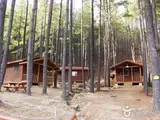
Centered on the 1,218m peak of Baegunsan, the forest spreads out in a blend of planted and natural woodland, with towering pine trees stretching out like a carpet, and valleys among cedar and hinoki cypress groves that leave visitors in awe. Nearby lies the site of Ongnyongsa Temple (National Historic Site No. 407), where Master Doseon practiced for 35 years, and in early spring (February–March), some 7,000 camellia trees around the temple site burst into full, spectacular bloom.\nMoreLess
- 4
Gwangyang Ongnyongsa Camellia Forest
광양 옥룡사 동백나무숲
Located around the site of Ongnyongsa Temple, 7km south of Baegunsan. Ongnyongsa was where Seongak Guksa Doseon — an eminent monk of the late Unified Silla period and a master of Korean geomancy — spent 35 years teaching hundreds of disciples until his passing, making it a thousand-year Buddhist sacred site of great importance in Korea's Buddhist history. The Ongnyongsa temple site is now located in Chusan-ri, Ongnyong-myeon; the place name \"Ongnyong\" is said to derive from Doseon's Buddhist title, \"Ongnyongja.\" \nMoreLess
- 5
Ongnyongsa Temple Site
옥룡사지
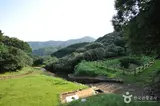
Baegyesan (505.8m), which cradles the Ongnyongsa temple site, is a modest peak formed as a spur extending from the main peak, Baegunsan (1,218m), and sits at the center of the Baegunsan range. Ongnyongsa began as a small hermitage in the late Silla period, which National Preceptor Doseon renovated and made his residence in 864; as hundreds of monks flocked to hear his teachings, forming a group known as the "Ongnyongsa school," an additional temple called Unamsa was built nearby to accommodate the growing numbers.\nMoreLess
- 6
Jungheungsa Temple
중흥사
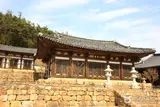
Surrounded by the old site of Jungheung Mountain Fortress, a battleground between Japanese forces and righteous army fighters during the Imjin War, Jungheungsa is a temple with a history of national defense. Founded in the late Unified Silla period, it was destroyed by fire during the Imjin War; a small hermitage was later built and kept alive through the efforts of Buddhist nuns, then rebuilt in 1936, only to fall into ruin again. It was rebuilt once more in 1963 by the philanthropist Ha Tae-ho, giving it the scale it has today.\nMoreLess
Source: Korea Tourism Organization (TourAPI) · Machine-translated