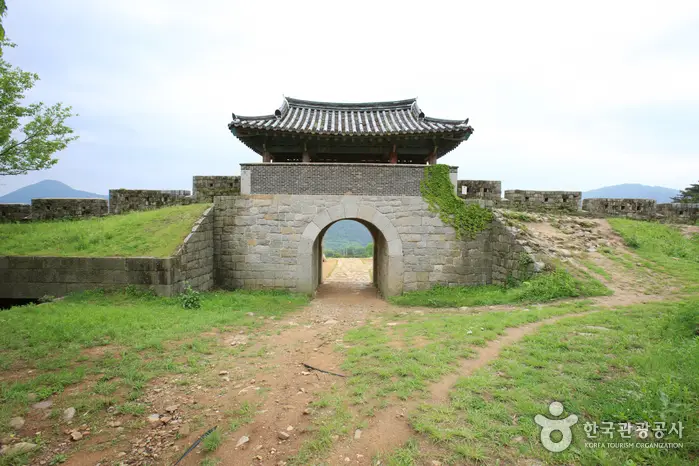
Climbing Gasan on Palgongsan
3 stops · 6 hours
Gasan, at the western edge of Palgongsan Provincial Park, still holds the remains of Gasan Fortress, built during the Joseon dynasty. The 5.4km trail from Jinnammun Gate to Gasan Fortress and Gasan Rock is generally not steep, running through dense broadleaf forest, making for an easy, unhurried climb, and the summit at Gasan Rock opens up to a sweeping view. From Gasan, it's also worth following the ridge to Hantijae for a ridge traverse, or stopping by Songnimsa Temple, which still holds a five-story brick pagoda.
- Duration
- 6 hours
- Distance
- 11km(incl. 5.4km Gasan Fortress trekking)
Along the way
- 1
Gasan Fortress and Gasan Rock
가산산성 및 가산바위
A stone fortress built using the mountain valley terrain, constructed in the 18th year of King Injo of Joseon (1640). Gasan, where the fortress stands, is a 901m peak located about 10km west of the summit of Palgongsan, a famous mountain and center of Silla-era worship of the "Five Sacred Peaks." Made up of seven peaks, Gasan is also known as Chilbongsan ("Seven Peaks Mountain"). At the summit lies a flat area ringed by seven low peaks, from which seven valleys extend outward in every direction.\nMoreLess
- 2
Songnimsa Temple
송림사
Located at the western edge of Palgongsan, Songnimsa is surrounded by dense pine forest, with a clear stream flowing through the neighboring valley. Sitting right beside the road, it lets visitors breathe in Palgongsan's fresh air and unwind without a strenuous hike. To the east of Songnimsa lies Palgongsan, named in honor of the eight loyal officials — including Sin Sung-gyeom — who served Wang Geon, founder of Goryeo. As Buddhism took root, Palgongsan naturally came to be regarded as a sacred site of Silla Buddhism, a spiritual mountain where Buddhist culture flourished.\nMoreLess
- 3
Palgongsan Provincial Park (Gatbawi District)
팔공산도립공원(갓바위지구)
At 1,193m, Palgongsan is a tall mountain north of Gyeongsan, known in the Silla period as Jungak or Buak, one of its renowned peaks. The area holds many Silla-era temples and cultural sites, including the Stone Seated Buddha of Gwanbong (Gatbawi Rock), Wonhyosa, Cheonseongsa, and Bulgulsa.\nMoreLess
Source: Korea Tourism Organization (TourAPI) · Machine-translated