A Healing Getaway in the Land of Cheongdo Bansi Persimmons
6 stops · 7 hours
Cheongdo, with its clear mountains, clean water, and warm hospitality, is known as the land of "samcheong" (three clarities) for its pristine natural surroundings, and preserves a wealth of cultural heritage, including Unmunsa Temple, Cheongdo Eupseong Fortress, and a stone ice house. Cheongdo is especially famous for bansi, a seedless persimmon prized for its tender flesh and high sweetness. Visitors can enjoy a variety of hands-on experiences using bansi persimmons — persimmon wine-making at Cheongdo Wine Tunnel and persimmon dyeing at Gambitgoeul.
- Duration
- 7 hours
- Distance
- 59.3km
Along the way
- 1
Cheongdo Wine Tunnel
청도와인터널
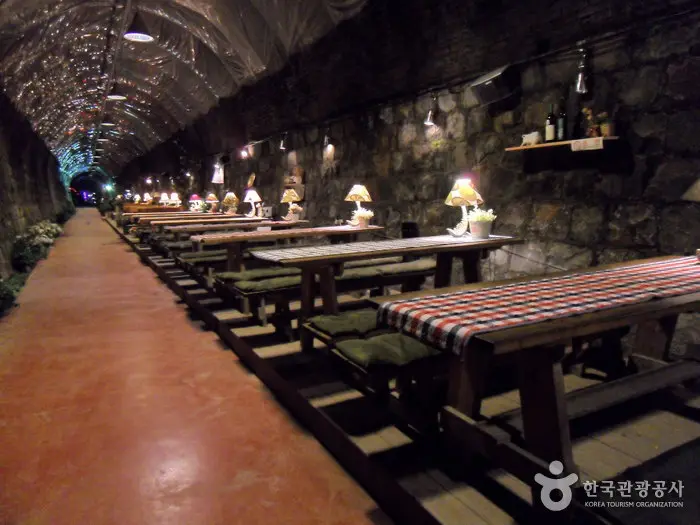
Opened in Songgeum-ri, Namseonghyeon, Cheongdo-gun, Gyeongsangbuk-do, "Wine Tunnel" has become a popular date spot for couples, families, and friends. Turning heads by transforming a former railway tunnel into a wine-aging cellar and cafe, Cheongdo Wine Co. in Bonggi-ri, Punggak-myeon, Cheongdo-gun, makes wine from bansi persimmons, the region's specialty. Located in Songgeum-ri, Hwayang-eup, Cheongdo-gun, Gyeongsangbuk-do, the tunnel is 1.01km long, 5.3m high, and 4.5m wide, storing and aging more than 150,000 bottles of wine.\nMoreLess
- 2Cheongdo Eupseong Fortress
청도읍성
Dating back to the Goryeo period, the original fortress combined stone and earthen ramparts, and inside stood government offices, a guesthouse, the yuhyangso (local gentry council hall), an arms depot, a translation office, jakcheong (clerks' office), and other buildings. In the 23rd year of King Seonjo (1590), the originally earthen fortress was rebuilt in stone, but during the Japanese invasions of Korea (Imjin War), the east, west, and north gates were destroyed and the walls damaged; the walls were later repaired and the gate towers rebuilt, but under Japanese colonial rule's policy of demolishing town fortresses, the walls were torn down again and the gate towers rebuilt once more. Today, only part of the wall and its foundation remain due to the city's expansion. \nMoreLess
- 3Cheongdo Seokbinggo (Stone Ice House)
청도 석빙고
A seokbinggo is an underground chamber dug into the ground to store ice. Only four of the semicircular arches (hongye) that once connected the two side walls remain, and the roof has completely collapsed, leaving the structure incomplete. Even so, among surviving stone ice houses in Korea, it is the second-largest after the Gyeongju Seokbinggo (Treasure No. 66), and one of the oldest in age of construction. Built in an elongated east-west shape with its entrance on the west side, the floor slopes gently as you descend the stairs into the interior. \nMoreLess
- 4
Lunch (Yeokjeon Chueotang, Uiseong Sikdang)
점심식사(역전추어탕, 의성식당)
[Yeokjeon Chueotang] \nGyeongsang-do style chueotang (mudfish soup) is made by boiling and mashing loach so that only the meat is used in cooking, giving it a deep flavor without being overpowering. A representative Cheongdo restaurant carrying on its tradition for over 40 years across two generations, it showcases the essence of Gyeongsang-do style chueotang. Using 100% loach rather than mixed fish, it has no fishy smell, and instead of MSG, it adds a catfish-based seasoning for a milder, cleaner taste — a key reason for its popularity with visitors from outside the area. \n[Uiseong Sikdang] \nUiseong Sikdang specializes in chueotang made from wild freshwater fish. \nThe original Cheongdo freshwater chueotang is said to trace back to Grandma Kim Mal-du's chueotang. Uiseong Sikdang first opened in Cheongdo in 1963. \nMoreLess
- 5
Gambitgoeul
감빛고을
At Gambitgoeul, visitors can enjoy a variety of hands-on activities, including natural dyeing, across a spacious 1,200-pyeong site. Programs are run at beginner, intermediate, and advanced levels, making it an experiential village where visitors can appreciate the value of nature.\nMoreLess
- 6
Unmunsa Temple
운문사
Unmunsa is a temple located on Hogeosan in Sinwon-ri, Unmun-myeon, Cheongdo-gun, Gyeongsangbuk-do, and a branch temple of Donghwasa, the head temple of the 9th district of the Jogye Order of Korean Buddhism. Although part of Cheongdo-gun, it is closely tied to Daegu's living sphere for convenience of transportation. Founded in 560 CE (the 21st year of King Jinheung of Silla) by an unnamed monk, it has taken its current form through eight rounds of reconstruction led by figures such as State Preceptor Wongwang, State Preceptor Boyang, and State Preceptor Wonung, and a ninth round led by the nun Myeongseong, head of the Buddhist nuns' college here.\nMoreLess
Source: Korea Tourism Organization (TourAPI) · Machine-translated