Walking Goun-sa's Forest Trail and Trying Apple Wine
3 stops · 6 hours
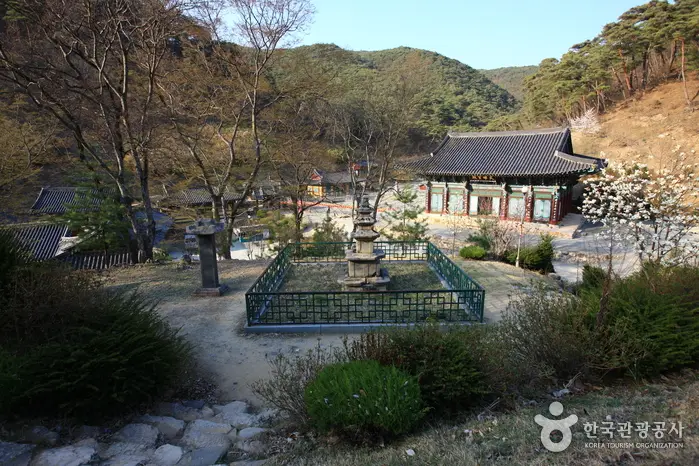
Goun-sa is a thousand-year-old temple named after the pen name of Choe Chi-won, "Goun," with a beautiful approach path leading into the temple grounds. The road to Goun-sa runs through forest, making it a great spot for an unhurried stroll, and a separate Cheonnyeonsongnim (Thousand-Year Pine Forest) trail lets visitors fully soak in the woods. A cozy forest trail paired with a mellow glass of apple wine is the perfect recipe for healing.
- Duration
- 6 hours
- Distance
- 10.6km
Along the way
- 1
Goun-sa Temple
고운사
Goun-sa is the head temple of the 16th district of the Jogye Order of Korean Buddhism. It was founded by Master Uisang in the first year of King Sinmun of Silla (681), and was originally called Goun-sa (高雲寺, "High Cloud Temple"). About 200 years later, Choe Chi-won — whose pen name was "Goun" (孤雲, "Lone Cloud") — practiced here and built the pavilions Gaunru and Uhwaru, and the temple's name was changed to Goun-sa (孤雲寺) after his pen name. During the reign of King Heongang, Doseon built a statue of the Medicine Buddha and a stone pagoda. \nMoreLess
- 2
Sachon-ri Roadside Grove, Uiseong
의성 사촌리 가로숲
About 600 years ago, in the late Goryeo period, when the founding ancestor of the Andong Kim clan moved from Andong to Sachon, this grove was planted to make up for the "weak" energy on the west side of the village, following the geomantic belief that a village produces no notable figures if its west side is exposed. Legend has it that Ryu Seong-ryong (Seoae), while visiting his mother's family home in Sachon, was born in this grove when his mother went into labor. Designated Natural Monument No. 405, this 33,862㎡ grove is owned by the Andong Kim clan and consists of about 500 old trees of some 10 species, chiefly zelkova, forming a dense single-layer stand. Home to nesting grey herons, the grove holds great academic value, and as a village grove created according to geomantic principles to compensate for a perceived weakness in the landscape, it also has significant scenic value, offering a vivid picture of our ancestors' views of nature and Confucian values as a natural cultural asset. \nMoreLess
- 3
Sachon Village, Uiseong
의성 사촌마을
Sachon Village is said to have been a nearly perfect example of auspicious feng shui terrain, missing just one element: behind the village stands Munpilbong Peak, and to the left rises Jwasan, forming the shape of the Blue Dragon of the left, but to the right lies wide-open fields, meaning there was no White Tiger of the right. So a windbreak forest was planted to compensate — and this is the very forest now designated Natural Monument No. 405, the "Sachon-ri Roadside Grove." Villagers call it "Seorim," meaning "west forest," for its location west of the village. The windbreak trees are mostly hackberry and oak varieties like sawtooth oak, planted when the village was founded; now roughly 600 years old, they form a wooded path about 1km long and 45m wide, making for a lovely forest walk along the embankment.\nMoreLess
Source: Korea Tourism Organization (TourAPI) · Machine-translated