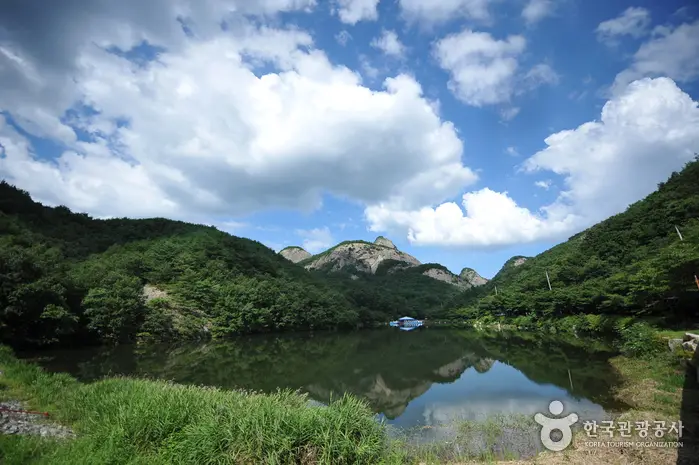
Walking Maisan
12 stops · 8 hours (incl. 3 hours for hiking Maisan)
Maisan evokes a sense of mystery with its two peaks resembling a horse's ears. The countless stone towers decorating the area around Geumdangsa Temple are also a spectacular sight, offering plenty to talk about as you explore with children. Enjoy the scenic beauty of Baegundong Valley, the source of the Seomjin River, and finish with a spa themed around Jinan red ginseng for a fun outing the whole family can enjoy.
- Duration
- 8 hours (incl. 3 hours for hiking Maisan)
- Distance
- About 19km (excl. Maisan climbing trail)
Along the way
- 1
Maisan Provincial Park
마이산도립공원
Maisan, visible from any direction within Jinan-eup, takes on four different names depending on the season. In spring, the two peaks rising through the mist look like a pair of sailboat masts, so it is called Dotdaebong ('mast peak'); in summer, when the trees grow lush, it resembles dragon horns, so it is called Yonggakbong ('dragon-horn peak'); in autumn, with its autumn foliage, it looks like a horse's ears, so it is called Maibong ('horse-ear peak'); and in winter, since snow does not settle on it, it looks like the tip of an ink-dipped brush, so it is called Munpilbong ('writing-brush peak').MoreLess
- 2Maisan Tapsa Temple
마이산 탑사
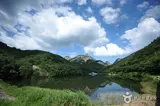
Tapsa Temple stands on the southern slope of Maisan, in Dongchon-ri, Maryeong-myeon, Jinan County, Jeollabuk-do. Located about 1.9km from Maisan's southern parking lot, Maisan Tapsa is famous for its roughly 80 stone towers built by the lay Buddhist Yi Gap-yong. These stone towers are known to have been built single-handedly by Yi Gap-yong in the late 1800s. It is said that he gathered stones by day and built the towers by night. These towers are now over 100 years old, and remarkably, they say the towers have never once collapsed no matter how fierce the wind — a truly astonishing feat.\nMoreLess
- 3
Geumdangsa Temple
금당사
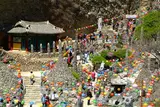
Climbing Maisan from the southern entrance, Geumdangsa Temple is on the left just past the ticket booth. Climbing 1.4km further from Geumdangsa brings you to Maisan Tapsa. It is said to have been founded by the great monk Hyegam in the 2nd year of King Heongang of Silla (876). Geungnakjeon Hall houses the wooden seated Buddha of Geumdangsa (Jeollabuk-do Tangible Cultural Heritage No. 18), carved from a gingko tree said to be over a thousand years old, and a hanging Buddhist painting measuring 5m by 9m (Treasure No. 1266). \nMoreLess
- 4
Eunsusa Temple
은수사
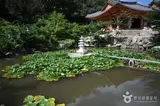
Eunsusa Temple currently belongs to the Jogye Order. In the early Joseon period it was called Sangwonsa, and by around the reign of King Sukjong, Sangwonsa had disappeared, leaving only the temple site, after which someone built a hermitage called Jeongmyeongam. Eunsusa originally consisted only of a building used as both a Buddha hall and living quarters, along with a mountain spirit shrine above it, but in recent years Geungnakjeon, Taegeukjeon, Daeungjeon halls and living quarters have been built, and the temple is now poised to grow into a large temple complex.MoreLess
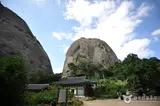
- 5Maisan Tapsa Temple
마이산 탑사
Tapsa Temple stands on the southern slope of Maisan, in Dongchon-ri, Maryeong-myeon, Jinan County, Jeollabuk-do. Located about 1.9km from Maisan's southern parking lot, Maisan Tapsa is famous for its roughly 80 stone towers built by the lay Buddhist Yi Gap-yong. These stone towers are known to have been built single-handedly by Yi Gap-yong in the late 1800s. It is said that he gathered stones by day and built the towers by night. These towers are now over 100 years old, and remarkably, they say the towers have never once collapsed no matter how fierce the wind — a truly astonishing feat.MoreLess
- 6
Lunch (Chogajeongdam, Beotkkotmaeul)
점심식사(초가정담, 벚꽃마을)
[Chogajeongdam] \nChogajeongdam's signature dish is black pork back ribs — pre-grilled rib meat that is then lightly grilled again over charcoal. Other dishes include wild greens bibimbap and grilled wild deodeok (bellflower root). \n[Beotkkotmaeul] \nLocated at the entrance to Geumdangsa Temple in Maisan Provincial Park, Beotkkotmaeul is a tavern-style restaurant typical of the mountain area. Here you can enjoy oak-grilled pork and dongdongju (rice wine); the oak-grilled black pork back ribs are especially delicious. \nMoreLess
- 7
Geumdangsa Temple
금당사
Climbing Maisan from the southern entrance, Geumdangsa Temple is on the left just past the ticket booth. Climbing 1.4km further from Geumdangsa brings you to Maisan Tapsa. It is said to have been founded by the great monk Hyegam in the 2nd year of King Heongang of Silla (876). Geungnakjeon Hall houses the wooden seated Buddha of Geumdangsa (Jeollabuk-do Tangible Cultural Heritage No. 18), carved from a gingko tree said to be over a thousand years old, and a hanging Buddhist painting measuring 5m by 9m (Treasure No. 1266).MoreLess
- 8
Jinan Red Ginseng Spa
진안홍삼스파
Jinan Red Ginseng Spa was built near Maisan, with a view of the mountain, at a cost of 20.8 billion won, comprising one basement level and three above-ground floors with a total floor area of 7,720㎡. Combining red ginseng and oriental medicine ingredients with the principles of yin-yang and the five elements, it is an experiential spa that, unlike conventional spas, systematically and comprehensively operates various health-related facilities and programs so visitors can find genuine health and rest for body and mind.\nMoreLess
- 9
Eunsusa Temple
은수사
Eunsusa Temple currently belongs to the Jogye Order. In the early Joseon period it was called Sangwonsa, and by around the reign of King Sukjong, Sangwonsa had disappeared, leaving only the temple site, after which someone built a hermitage called Jeongmyeongam. Eunsusa originally consisted only of a building used as both a Buddha hall and living quarters, along with a mountain spirit shrine above it, but in recent years Geungnakjeon, Taegeukjeon, Daeungjeon halls and living quarters have been built, and the temple is now poised to grow into a large temple complex. \nMoreLess
- 10
Lunch (Chogajeongdam, Beotkkotmaeul)
점심식사(초가정담, 벚꽃마을)
[Chogajeongdam] Chogajeongdam's signature dish is black pork back ribs — pre-grilled rib meat that is then lightly grilled again over charcoal. Other dishes include wild greens bibimbap and grilled wild deodeok (bellflower root). [Beotkkotmaeul] Located at the entrance to Geumdangsa Temple in Maisan Provincial Park, Beotkkotmaeul is a tavern-style restaurant typical of the mountain area. Here you can enjoy oak-grilled pork and dongdongju (rice wine); the oak-grilled black pork back ribs are especially delicious.MoreLess
- 11
Maisan Provincial Park
마이산도립공원
Maisan, visible from any direction within Jinan-eup, takes on four different names depending on the season. In spring, the two peaks rising through the mist look like a pair of sailboat masts, so it is called Dotdaebong ('mast peak'); in summer, when the trees grow lush, it resembles dragon horns, so it is called Yonggakbong ('dragon-horn peak'); in autumn, with its autumn foliage, it looks like a horse's ears, so it is called Maibong ('horse-ear peak'); and in winter, since snow does not settle on it, it looks like the tip of an ink-dipped brush, so it is called Munpilbong ('writing-brush peak'). \nMoreLess
- 12
Jinan Red Ginseng Spa
진안홍삼스파
Jinan Red Ginseng Spa was built near Maisan, with a view of the mountain, at a cost of 20.8 billion won, comprising one basement level and three above-ground floors with a total floor area of 7,720㎡. Combining red ginseng and oriental medicine ingredients with the principles of yin-yang and the five elements, it is an experiential spa that, unlike conventional spas, systematically and comprehensively operates various health-related facilities and programs so visitors can find genuine health and rest for body and mind.MoreLess
Source: Korea Tourism Organization (TourAPI) · Machine-translated