The Taste of Sunchang, Gochujang
14 stops · 8 hours
Clear and pristine Sunchang has captivated Korea with the taste of its gochujang (red chili paste). Head to Sunchang Traditional Gochujang Folk Village to meet Sunchang's gochujang. The Fermented Sauce Museum and Fermented Sauce Experience Hall let you learn about gochujang in detail and even try making it yourself. Explore Gangcheonsa Temple, then visit the two stone guardian posts (jangseung) and the hyanggyo (Confucian school) still standing in downtown Sunchang. Finish the trip at the Seomjingang River, which flows through Sunchang's mountains and fields.
- Duration
- 8 hours
- Distance
- 23.5km (incl. 4km round trip to Gangcheonsa Temple)
Along the way
- 1
Gangcheonsa Temple
강천사
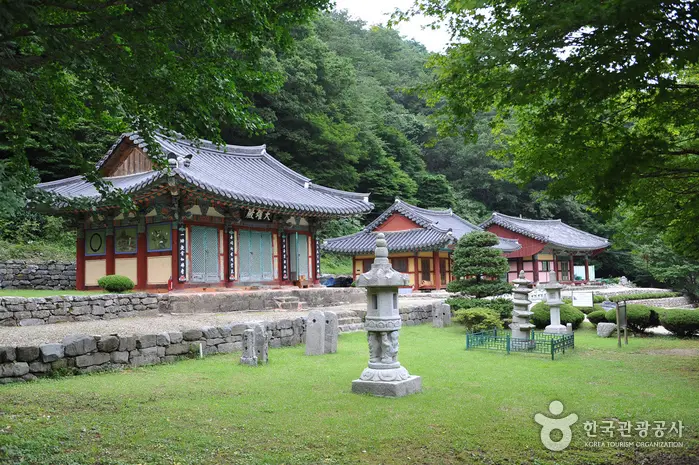
Located just below the summit of Songhaksan Mountain, Gangcheonsa Temple began about 60 years ago, on July 15, 1945, when Zen Master Yi Dae-hwi built a thatched hut on the former site of a temple known as Soaksa. It later became well known among Buddhists in the area and grew into the temple grounds it is today, renowned especially as a place of Neungeom and Nahan prayer practice. Climb up to the main hall of Gangcheonsa Temple - the view that unfolds before you is sure to draw an involuntary "Ah!" from anyone who sees it.MoreLess
- 2
Chungsinri Stone Jangseung
충신리석장승
This stone jangseung in Sunchang-eup, Sunchang-gun, Jeollabuk-do stands on a rice-paddy embankment on the right (east) side of the main road leading north about 500m from Sunchang-eup through Imsil toward Jeonju. According to local geomantic (pungsu) tradition, a protective grove once stood here to block the north wind, with a shrine inside the woods; the shrine building is gone today, but it is said a stone jangseung stood in the seat in front of it. MoreLess
- 3
Sunchang Fermented Sauce Experience Hall
순창장류체험관
Located in front of the Traditional Gochujang Folk Village in Baeksan-ri, Sunchang-eup, Jeollabuk-do, the Sunchang Fermented Sauce Experience Hall was established to carry on the traditional taste and craft of Sunchang's fermented sauces while researching, spreading, and promoting the globalization of the fermented sauce industry. Here visitors can make and take home Sunchang's traditional gochujang, Korea's representative red chili paste, and enjoy an open hands-on space where they can cook and taste delicious dishes made with it.MoreLess
- 4
Sunchang Hyanggyo (Confucian School)
순창향교
Crossing Okcheongyo Bridge from the Sunchang County Office leads to Gyoseong-ri village, and Sunchang Hyanggyo sits on the mountainside behind the village. It appears to have been built in the early Joseon period, though the exact founding date is unknown. It was originally built above Gokcheon Stream and later moved near Okcheon Stream; at that time Mongam Yi Suk-gam is said to have written the memorial inscription. Since Yi Suk-gam was appointed governor of Jeolla-do in the 20th year of King Seongjong's reign (1489), the school is presumed to have been built during King Seongjong's reign (r. 1469-1494). MoreLess
- 5
Sunchang Namgye-ri Stone Jangseung
순창남계리석장승
This is a lone stone jangseung standing in Namgye-ri, Sunchang-eup. It appears to have originally been erected as a pair, but only one remains today. Following the stream embankment about 200m along the road from Sunchang-eup toward Namwon leads to the stone jangseung, which was erected to pray for the village's peace and the residents' health. The exact date this jangseung was made is unknown, but as it dates to the Joseon period, it is a folk artifact of research value for being an unconventional, native, and popular work of folk art. MoreLess
- 6
Lunch (Okcheongol Hanjeongsik)
점심식사(옥천골한정식)
Okcheongol Hanjeongsik is a restaurant where the homemade taste of old times lives on, from pork bulgogi and beef bulgogi grilled directly over charcoal to more than 20 side dishes and doenjang-jjigae (soybean paste stew). Not only the vegetables but even the rice served at the table are grown by the restaurant itself.MoreLess
- 7
Gangcheonsa Temple
강천사
Located just below the summit of Songhaksan Mountain, Gangcheonsa Temple began about 60 years ago, on July 15, 1945, when Zen Master Yi Dae-hwi built a thatched hut on the former site of a temple known as Soaksa. It later became well known among Buddhists in the area and grew into the temple grounds it is today, renowned especially as a place of Neungeom and Nahan prayer practice. Climb up to the main hall of Gangcheonsa Temple - the view that unfolds before you is sure to draw an involuntary "Ah!" from anyone who sees it. MoreLess
- 8
Chungsinri Stone Jangseung
충신리석장승
This stone jangseung in Sunchang-eup, Sunchang-gun, Jeollabuk-do stands on a rice-paddy embankment on the right (east) side of the main road leading north about 500m from Sunchang-eup through Imsil toward Jeonju. According to local geomantic (pungsu) tradition, a protective grove once stood here to block the north wind, with a shrine inside the woods; the shrine building is gone today, but it is said a stone jangseung stood in the seat in front of it.MoreLess
- 9
Sunchang Namgye-ri Stone Jangseung
순창남계리석장승
This is a lone stone jangseung standing in Namgye-ri, Sunchang-eup. It appears to have originally been erected as a pair, but only one remains today. Following the stream embankment about 200m along the road from Sunchang-eup toward Namwon leads to the stone jangseung, which was erected to pray for the village's peace and the residents' health. The exact date this jangseung was made is unknown, but as it dates to the Joseon period, it is a folk artifact of research value for being an unconventional, native, and popular work of folk art.MoreLess
- 10
Seomjingang River
섬진강
The Seomjingang River rises in the valley west of Palgongsan Mountain in Sinam-ri, Baegun-myeon, Jinan-gun, Jeollabuk-do, flows northwest to form Galdam Reservoir at the border of Jeongeup-si and Imsil-gun, then flows southeast through Sunchang, Gokseong-gun, and Gurye-gun before emptying into Gwangyang Bay at the border of Geumseong-myeon in Hadong-gun and Jinwol-myeon in Gwangyang-si. Geographically it spans the three provinces of Jeollanam-do, Jeollabuk-do, and Gyeongsangnam-do; historically it was a zone of contact between ancient Gaya and Baekje cultures, a border between Silla and Baekje, an invasion route for Japanese forces during the Imjin and Jeongyu Wars, and a site where the Donghak Peasant Revolution unfolded in the late Joseon period. MoreLess
- 11
Lunch (Okcheongol Hanjeongsik)
점심식사(옥천골한정식)
Okcheongol Hanjeongsik is a restaurant where the homemade taste of old times lives on, from pork bulgogi and beef bulgogi grilled directly over charcoal to more than 20 side dishes and doenjang-jjigae (soybean paste stew). Not only the vegetables but even the rice served at the table are grown by the restaurant itself. MoreLess
- 12
Sunchang Hyanggyo (Confucian School)
순창향교
Crossing Okcheongyo Bridge from the Sunchang County Office leads to Gyoseong-ri village, and Sunchang Hyanggyo sits on the mountainside behind the village. It appears to have been built in the early Joseon period, though the exact founding date is unknown. It was originally built above Gokcheon Stream and later moved near Okcheon Stream; at that time Mongam Yi Suk-gam is said to have written the memorial inscription. Since Yi Suk-gam was appointed governor of Jeolla-do in the 20th year of King Seongjong's reign (1489), the school is presumed to have been built during King Seongjong's reign (r. 1469-1494).MoreLess
- 13
Sunchang Fermented Sauce Experience Hall
순창장류체험관
Located in front of the Traditional Gochujang Folk Village in Baeksan-ri, Sunchang-eup, Jeollabuk-do, the Sunchang Fermented Sauce Experience Hall was established to carry on the traditional taste and craft of Sunchang's fermented sauces while researching, spreading, and promoting the globalization of the fermented sauce industry. Here visitors can make and take home Sunchang's traditional gochujang, Korea's representative red chili paste, and enjoy an open hands-on space where they can cook and taste delicious dishes made with it. MoreLess
- 14
Seomjingang River
섬진강
The Seomjingang River rises in the valley west of Palgongsan Mountain in Sinam-ri, Baegun-myeon, Jinan-gun, Jeollabuk-do, flows northwest to form Galdam Reservoir at the border of Jeongeup-si and Imsil-gun, then flows southeast through Sunchang, Gokseong-gun, and Gurye-gun before emptying into Gwangyang Bay at the border of Geumseong-myeon in Hadong-gun and Jinwol-myeon in Gwangyang-si. Geographically it spans the three provinces of Jeollanam-do, Jeollabuk-do, and Gyeongsangnam-do; historically it was a zone of contact between ancient Gaya and Baekje cultures, a border between Silla and Baekje, an invasion route for Japanese forces during the Imjin and Jeongyu Wars, and a site where the Donghak Peasant Revolution unfolded in the late Joseon period.MoreLess
Source: Korea Tourism Organization (TourAPI) · Machine-translated