Finding Comfort on That Path
3 stops · 6 hours
Odaesan National Park spans Pyeongchang-gun, Hongcheon-gun, and Gangneung-si, but the Pyeongchang side is by far the most famous. The fir tree path at Woljeongsa Temple, ranked among Korea's three great fir forests, and Seonjae-gil, the trail leading up from Woljeongsa to Sangwonsa Temple, offer more than enough happiness for a walking trip. The autumn foliage in five brilliant colors adds even more beauty in fall. Bangadari Mineral Spring, rich in carbonic acid and iron, is famous nationwide, and the path leading to it, through a forest of fir trees, makes it all the more special.
- Duration
- 6 hours
- Distance
- 39km (incl. a one-way 10km walking course along the fir tree path and Seonjae-gil)
Along the way
- 1
Bangadari Mineral Spring
방아다리약수터
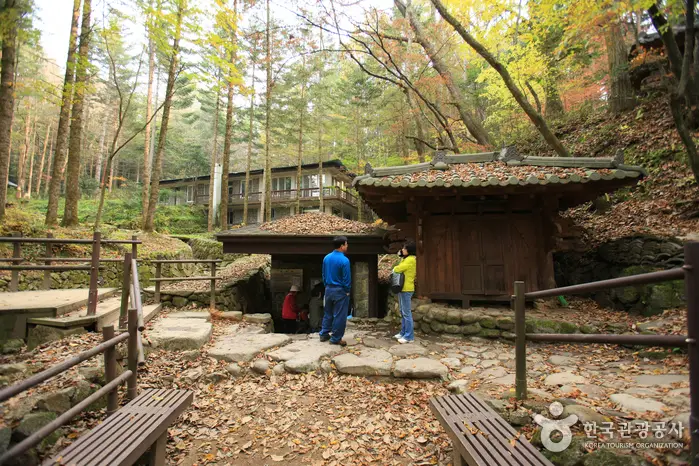
Located 12km north of the Jinbu IC on the Yeongdong Expressway, this mineral spring has a long history dating back to the reign of King Sukjong of Joseon. The water contains more than 30 kinds of minerals, including carbonic acid and iron; the iron content in particular is said to be especially effective for stomach ailments, anemia, and neuralgia. The surrounding area is densely forested with about a million fir trees, along with Korean white pine, pine, spruce, birch, yew, and some 70 other tree species, making it excellent for forest bathing, and its fine scenery also makes it a good summer retreat. MoreLess
- 2
Woljeongsa Temple
월정사
Woljeongsa Temple sits amid dense forest in the valley on the eastern side of Mt. Odaesan, in Dongsan-ri, Jinbu-myeon, Pyeongchang-gun, Gangwon-do. Backed by Mt. Manwolsan to the east, settled quietly where the mountain's energy gathers, Woljeongsa is surrounded year-round by evergreen conifers and has a serene beauty. It is the head temple of the 4th District of the Jogye Order, overseeing some 60 temples and 8 hermitages, and was founded in the 12th year of Queen Seondeok of Silla (643) by the monk Jajang. Today, Woljeongsa holds numerous cultural assets, including the Octagonal Nine-Story Stone Pagoda, National Treasure No. 48, and the Seated Stone Bodhisattva of Woljeongsa, Treasure No. 139. MoreLess
- 3
Sangwonsa Temple
상원사
Sangwonsa Temple on Mt. Odaesan was built, along with Woljeongsa, by the monk Jajang during the reign of Queen Seondeok of Silla, and was rebuilt in the 4th year of King Seongdeok (705); it burned down in 1946 and was rebuilt again in 1947. The temple preserves Korea's oldest bronze bell (National Treasure No. 36), cast in the 24th year of King Seongdeok of Silla, standing 1.67m tall and 91cm in diameter, famous for the beauty of its sound. It also holds a statue of the Bodhisattva Manjusri, said to depict the very form King Sejo himself once witnessed, and the Jungchanggwonseonmun, a document written in King Sejo's own hand soliciting donations for the temple's reconstruction. MoreLess
Source: Korea Tourism Organization (TourAPI) · Machine-translated