Following the Source of Korea's Great Rivers
5 stops · 6 hours
When people think of Taebaek, the image that comes to mind is a city of highlands and mountains, but it is also, in another sense, a special city of water. Hwangji Pond, the source of the Nakdonggang River, and Geomnyongso, the source of the Hangang River, are both located in Taebaek, as is Samsuryeong, the watershed dividing the Han, Nakdong, and Oship rivers. Take a special journey to meet the sources of Korea's great rivers, hidden throughout this highland city.
- Duration
- 6 hours
- Distance
- 31km
Along the way
- 1
Gumunso
구문소
Where the waters of Hwangjicheon Stream, the upper reaches of the Nakdonggang River, reach this spot, they cut through a large mountain, forming a stone gate (seokmun) and a deep pool (so) — hence the name Gumunso. From Jagaeru Pavilion at Gumunso, you can see the 'Eight Scenic Views of Gumun,' including Madangso Pool, Samhyeongje Falls, and Dakbyeoseul Rock. The site preserves Paleozoic fossils and a variety of 500-million-year-old coastal geological formations, and is used as a natural study site. MoreLess
- 2Hwangji Pond
황지연못
The source of the 1,300-ri-long Nakdonggang River, located in the center of the city, this pond's waters flow majestically down into the broad Yeongnam Plain. It is divided into upper, middle, and lower ponds, each with a circumference of 100m, and about 5,000 tons of water gush out daily, some of which was once drawn for the municipal water supply. Legend has it that a wealthy man named Hwang once gave a monk who asked for alms a scoop of manure instead of rice; heaven and earth shook, and his house sank and turned into this pond. Hwangji Pond is also listed among Korea's 100 Famous Waters. MoreLess
- 3
Lunch (Kim Seobangne Dakgalbi, Dabok Hoegwan)
점심식사(김서방네닭갈비, 다복회관)
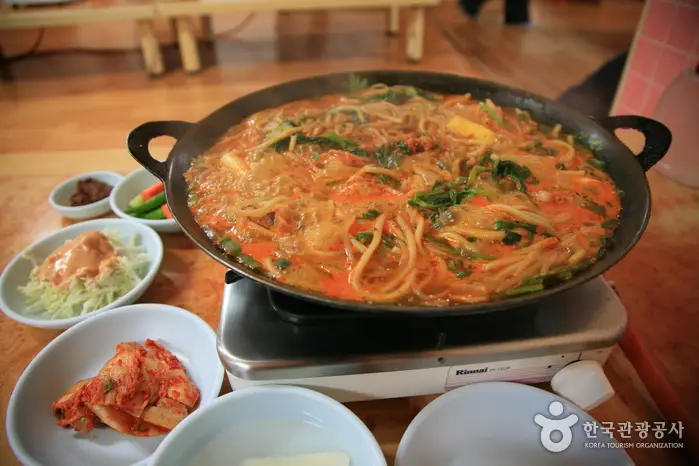
[Kim Seobangne Dakgalbi] Most of Taebaek's dakgalbi restaurants are clustered around Hwangji Pond, and among them Kim Seobangne Dakgalbi is considered the best. Tucked in an alley across from the Shinhyeop credit union near the entrance to Hwangji Pond, it has been run by the same family for three generations. The old building doesn't look fancy from outside, but the inside is quite spacious and comfortable. [Dabok Hoegwan] Here you can enjoy hanwoo (Korean beef), one of Taebaek's points of pride, along with a variety of other dishes, and the restaurant also displays photographs of Taebaek's transformation over the years, offering plenty to look at as well.MoreLess
- 4
Samsuryeong
삼수령
The Baekdudaegan mountain range, running down from Mt. Baekdusan, turns west at the center of Taebaek and branches off the Nakdongjeongmaek range toward the southeast. As a result, this spot forms Korea's only watershed dividing water toward three different seas, hence the name Samsuryeong ('Three Waters Pass'). Samsuryeong stands at about 935m. Driving up from downtown Taebaek on National Route 35, you reach the top so quickly that you may not fully sense its height, but near the summit, the steep cliffs to the east and the sweeping view make passersby stop in their tracks and marvel. MoreLess
- 5
Geomnyongso
검룡소
Geomnyongso is the source of the Hangang River. Groundwater rising through a limestone bed of unknown depth, with a circumference of 20m, immediately forms a spectacular 20m waterfall as it pours out. Over a long span of time, the flowing water has carved a winding channel, 1 to 1.5m deep and 1 to 2m wide, into the rock, so that the water running through it looks as if a writhing dragon lives there — hence the name Geomnyongso ('Black Dragon Pond'). The surrounding rock is covered with green water moss, giving it a mysterious appearance, and the area is a protected natural ecosystem zone and an educational site for studying natural ecology; the Hangang Daeje festival is also held here every year on Yudujeol (the first Sunday of August). MoreLess
Source: Korea Tourism Organization (TourAPI) · Machine-translated