Land of Snow Crab: Enjoying the Sea Along Yeongdeok Snow Crab Road
4 stops
In Yeongdeok, the 'land of snow crab,' savor fresh snow crab and seafood while enjoying the romance of the blue sea.
- Distance
- approx. 42.3km
Along the way
- 1Ganggu Port
강구항
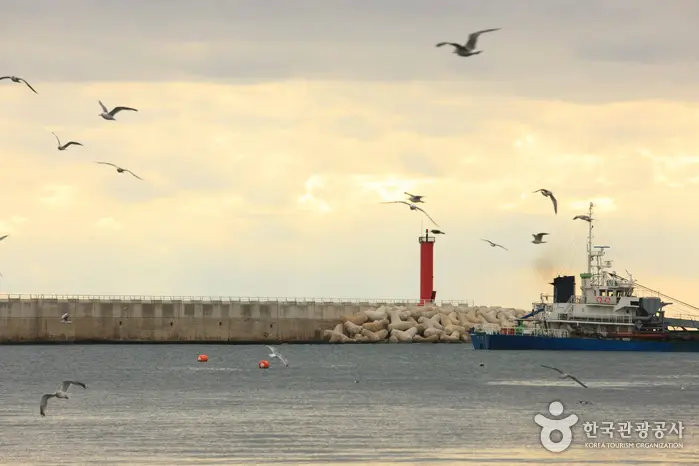
Ganggu Port is the largest port in Yeongdeok County, Gyeongsangbuk-do, and is famous for its snow crab. During the crab season, from November through April–May of the following year, countless crab boats gather here. A wholesale crab market operates in the port, and a restaurant strip known as 'Snow Crab Street' stretches for 3km. Osipcheon Stream, Yeongdeok's main river and known for sweetfish fishing, empties into the sea just south of Ganggu Port. Since gaining fame as a filming location for the TV drama You and I, it has become a tourist spot bustling with visitors year-round. MoreLess
- 2
Lunch (Jukdosan, Daegejongga)
점심식사(죽도산, 대게종가)
[Jukdosan] Steamed snow crab and fresh raw fish sashimi are the main dishes; after enjoying the mild, clean-tasting crab meat, pair it with the complimentary spicy crab stew, made by frying rice in the crab's innards, for a real treat. The restaurant's third floor has guesthouse rooms, so lodging is also available. [Daegejongga] If a crab served at your table doesn't have enough meat, the owner rushes right over to swap it for a full one. Perhaps it's this dedication that has kept regulars coming back for years, making it a landmark of Yeongdeok snow crab. Yeongdeok snow crab is famous for its thin shell relative to its large body. Take a bite of the meat packed beneath that thin shell, and you'll taste the crab's distinctive aroma along with a chewy, clean flavor that is simply superb. MoreLess

- 3Yeongdeok Sunrise Park
영덕해맞이공원
The east coast area of Changpo-ri, once surrounded by some of the country's cleanest waters and dense pine forest, was left in ruins by a massive wildfire in February 1997. After four years of effort, it was transformed into a landscaped park showcasing its stunning coastal scenery and an unmanned lighthouse. A walking trail was built with steps made from timber damaged in the fire, along with an observation deck for photos and sweeping views, and a pergola for a rest area. Eighteen kinds of fish-shaped sculptures were installed to the accompaniment of live-broadcast music, and a nature study area was created with wildflowers and native tree species — 300,000 plants of 15 wildflower species, including daffodils, sea asters, and Korean fleabane, and 70,000 plants of 8 native tree species, including rugosa rose, camellia, and golden rain tree. MoreLess
- 4
Yeongdeok Mt. Daesosan Beacon Mound
영덕 대소산 봉수대
A beacon mound (bongsudae) was an old means of communication used to send urgent news by torch fire and smoke — a fire lit atop a high mountain sent signals by smoke in the daytime and by firelight at night. The Yeongdeok Mt. Daesosan Beacon Mound was one link in a relay that carried news of conditions around Chuksanpo, Yeongdeok, all the way to Namsan in Seoul. It relayed signals south to the Byeolban beacon mound, north to the Hurisan beacon mound in Pyeonghae, and west via the Gwangsan beacon mound to the Namgaksan beacon mound in Jinbo. A defensive wall was built atop the mountain, and within it stands a beacon platform (bongdon) 11m in diameter and 3.5m high. Because the beacon mound's form remains relatively well preserved, it is regarded as valuable material for understanding Joseon-era communication methods. MoreLess
Source: Korea Tourism Organization (TourAPI) · Machine-translated