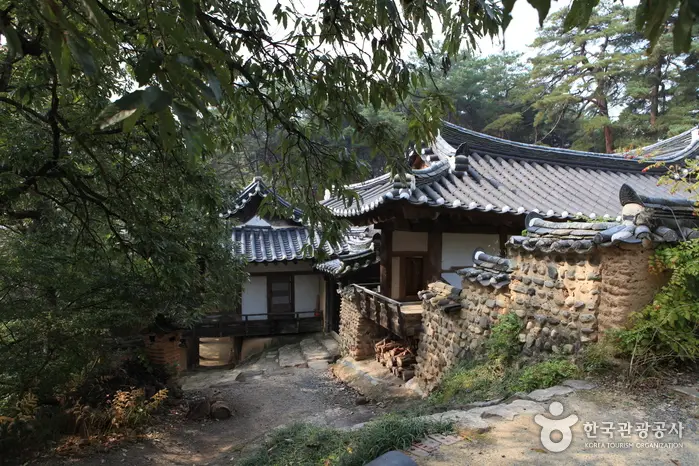
Andong Hahoe Village, Shining as a World Heritage Site
4 stops
Hahoe Village is a traditional village inscribed as a UNESCO World Heritage Site, where you can visit historic old houses such as Bukchon-daek, Yangjindang, and Chunghyodang. Byeongsan Seowon, dedicated to Seoae Ryu Seong-ryong, Buyongdae Cliff with its beautiful view of the Nakdong River, and Manjeong Pine Forest with its lovely woods are also not-to-be-missed spots.
- Distance
- 18km
Along the way
- 1
Hahoe Gyeomamjeongsa
하회 겸암정사
Hahoe Gyeomamjeongsa is a study retreat built by Gyeomam Ryu Un-ryong (1539–1601) for scholarly pursuit and to train disciples. Ryu Un-ryong built it in 1567 for that purpose. The sandy riverbank and pine forest across the water, seen from the retreat, are quite picturesque. The pen name 'Gyeomam' was given to Ryu Un-ryong by Toegye Yi Hwang, impressed by his scholarship, and Ryu is said to have treasured it and taken it as his own pen name. As people currently live here, the interior cannot be viewed, and only the exterior of the retreat can be seen. MoreLess
- 2Buyongdae Cliff
부용대
Buyongdae is a 64m-high cliff at the very end of the Taebaek mountain range, offering a full view of Andong Hahoe Village from its summit. The name 'Buyongdae' comes from a Chinese classical tale, where buyong means lotus flower — the name reflects the way Hahoe Village, seen from here, resembles a lotus in bloom, and it is called Buyongdae because it is the best place to view the village. It was originally called 'Buga' (Bugae), meaning 'the hill north of Hahoe.' Where the Nakdong River curves below, Okyeonjeongsa, Gyeomamjeongsa, and Hwacheon Seowon are located. MoreLess
- 3
Andong Hahoe Village [UNESCO World Heritage]
안동 하회마을 [유네스코 세계문화유산]
Five farming households in Hahoe Village take part in the farm-stay program, offering cultural experiences you can't find elsewhere, including a pheasant farm experience. At the pheasant farm, more than a thousand birds are raised free-range on a netted hillside, and visitors get the chance to feed them and even catch one by hand. When someone tries to catch a pheasant, a huge flock takes off all at once in a spectacular sight — one that can startle first-time visitors. MoreLess
- 4Andong Byeongsan Seowon
안동 병산서원
Byeongsan Seowon's predecessor was Pungak Seodang in Pungsan-hyeon, a hall of learning for the sarim (Confucian literati) since the late Goryeo period. In 1613 (the 5th year of Gwanghaegun), on the collective initiative of the local Confucian scholars led by Ubok Jeong Gyeong-se (1563–1633), Jondeoksa Shrine was built to honor the scholarship and virtue of Seoae Ryu Seong-ryong (1542–1607), and his memorial tablet was enshrined there. In 1629, his third son, Suam Ryu Jin (1582–1635), was added to those honored. In 1863 (the 14th year of King Cheoljong), the seowon received the royal plaque 'Byeongsan.' When the Daewongun's order to abolish seowon was issued in 1868 (the 5th year of King Gojong), Byeongsan Seowon was one of only 47 seowon nationwide — and one of just 2 in Andong — spared from closure. MoreLess
Source: Korea Tourism Organization (TourAPI) · Machine-translated