Discovering Sangju, Once the Heart of Gyeongsang-do
5 stops · 6 hours
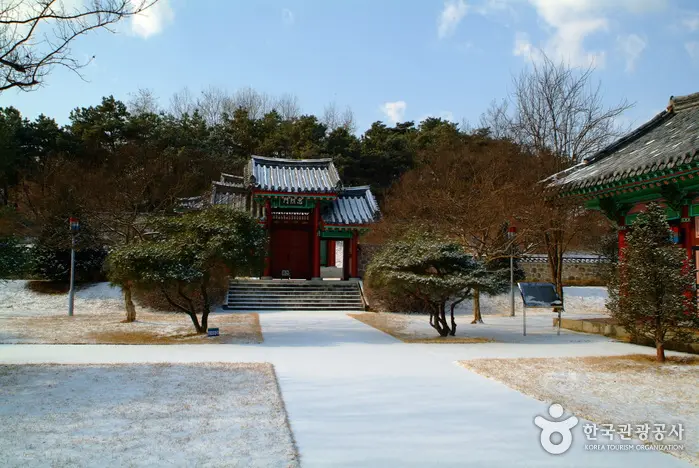
During the Joseon dynasty, Sangju served for over 200 years as the seat of the Gyeongsang Provincial Office, making it, along with Gyeongju, one of the twin centers of Gyeongsang-do. Here you can visit the Imnan Bukcheon Battle Site, where fierce fighting against Japanese forces took place during the Japanese invasions, and trace the footsteps of General Jeong Gi-ryong, known as 'the Yi Sun-sin of the land.' Gyeongcheondae and Cheongnyongsa Temple are viewpoints offering spectacular views of Sangju along the Nakdong River, and are must-see spots in the city.
- Duration
- 6 hours
- Distance
- 41.3km
Along the way
- 1
Namjangsa Temple
남장사
Namjangsa Temple, located partway up Mt. Noaksan, is said to have been founded by National Preceptor Jingam, Master Hyeso, in the 7th year of Silla's 42nd king, Heungdeok, and later moved to its present site and renamed Namjangsa in the 16th year of Goryeo King Myeongjong. It is especially known as the place where eosan (beompae), traditional Buddhist ritual music, was first introduced to Korea. MoreLess
- 2General Jeong Gi-ryong Historic Site
정기룡장군유적지
Chunguisa Shrine enshrines the memorial tablet of General Jeong Gi-ryong, a military officer under King Seonjo of Joseon who achieved great merit as a renowned land-battle commander during the Japanese invasions. Together with its memorial stele and the general's tomb, it was designated Local Cultural Property Monument No. 13 in 1974. In 1978, as part of a project to restore patriotic heritage sites, the original roughly 16.5㎡ shrine was expanded onto a site of about 13,223㎡, adding a shrine hall, exhibition hall, and management office, and it now stands as a sanctuary of patriotic spirit. MoreLess
- 3
Imnan Bukcheon Battle Site
임란북천전적지
The Imnan Bukcheon Battle Site is a sanctuary of patriotic sacrifice where Joseon's central army and local militia met the main Japanese force in battle during the Japanese invasions, and some 900 soldiers died for their country. When Japanese forces landed at Busan in 1592, about 60 Joseon central-army troops marched south to stop them. Together with roughly 800 local men mustered overnight by Sangju magistrates Gwon Gil and Bak Geol, this force of about 900 fought desperately against some 17,000 Japanese troops, and all of them perished. The site was designated Local Monument No. 77 in 1988. MoreLess
- 4
Gyeongcheondae, Nakdong River
낙동강 경천대
Along the roughly 1,300-ri course of the Nakdong River, Gyeongcheondae holds such an air of ancient mystery that it is said to have lent its name to the river itself. A place of striking scenery formed by sheer cliffs and old pines, it is also called Jacheondae ('heaven-given terrace'), for it was said heaven itself brought it into being. However, after Chae Deuk-gi carved the inscription 'Daemyeong cheonji, Sungjeong ilwol' there, it came to be called Gyeongcheondae instead. MoreLess
- 5
Cheongnyongsa Temple
청룡사
Built on a steep cliff partway up Mt. Bibongsan in Osang-ri, Jungdong-myeon, Sangju, Gyeongsangbuk-do, Cheongnyongsa Temple looks down over the Nakdong River. Jungdong-myeon, where the temple stands, lies to the east of Sangju. Although Sangju has many temples, Cheongnyongsa is the only one in the area of Jungdong-myeon, around which the Nakdong River curves. Heading east from Sangju through Nakdong-myeon brings you to the middle reaches of the Nakdong River. MoreLess
Source: Korea Tourism Organization (TourAPI) · Machine-translated