Slow Time in Agyang Slow City
6 stops · 6 hours
Agyang in Hadong County, where the Seomjin River meets Jirisan Mountain, was designated Korea's fifth Slow City. Agyang-myeon in particular is the setting of the novel and TV drama 'Toji' (The Land), and here you can visit the story's backdrops one by one — the Agyang fields, the pine trees of Dongjeong-ri, and the Choi Champan House. Gososanseong Fortress, which offers views of Jirisan's ridgeline curving alongside the Seomjin River, and the Maeam Tea Culture Museum in Agyang town are also worth a stop.
- Duration
- 6 hours
- Distance
- 20.1km
Along the way
- 1
Hadong Pine Forest (Songnim)
하동송림
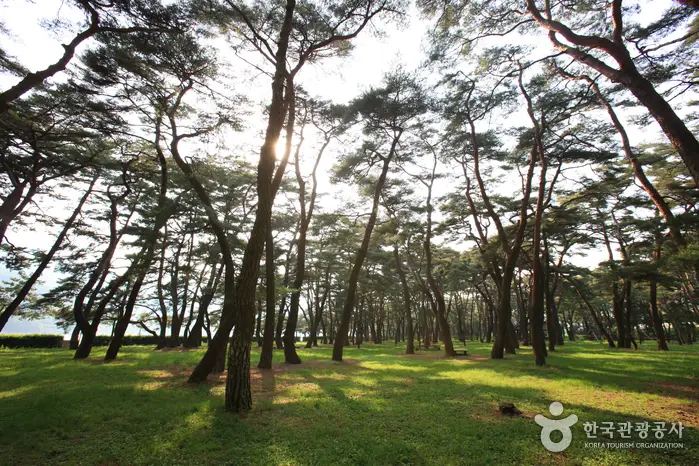
Follow the Seomjin River and beneath the Seomjin Railway Bridge you'll find a pine forest that has stood dignified beside the river for centuries, its dark green boughs swaying like waving hands. This forest is said to have been planted in 1745 (the 21st year of King Yeongjo of Joseon) by Jeon Cheon-sang, then the local magistrate, to protect against river winds and blowing sand — and it has since become Korea's finest forest of old pines. MoreLess
- 2Pyeongsa-ri Fields
평사리들판
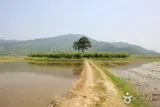
The Seomjin River, winding through its gorge, opened out into these fields and drew people to settle, and the people who gathered here built a village and a culture. This is the first of three reasons novelist Park Kyong-ni planted the roots of her novel here in Pyeongsa-ri, Agyang-myeon, Hadong County. During her lifetime, Park Kyong-ni named three of the most pleasant sounds in the world, and one of them was 'the sound of water flowing into a dry paddy.' In that spirit, these abundant fields gather in all living things and sustain them with the rice and barley they grow. Pyeongsa-ri Fields (also called Mudimi-deul), the widest fields along the Seomjin River's 500-ri course, span about 830,000 pyeong. MoreLess
- 3
Gososanseong Fortress
고소산성
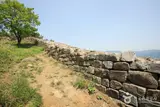
Hadong County borders Jirisan Mountain to the north and the South Sea to the south. To the west, across the Seomjin River, it adjoins Gurye and Gwangyang in Jeolla-do, making it a place where the grandeur of Jirisan, the freshness of the sea, and the tranquility of the Seomjin River all come together. Gososeong Fortress sits at an elevation of 300m on the slope of the Seongjebong ridge, which extends down from Jirisan behind Pyeongsa-ri. Backed by rugged mountains, with the Seomjin River and Dongjeong Lake spread out below to the southwest, it is a natural strategic point commanding the route between the South Sea and the Honam region. MoreLess
- 4Lunch (Yeoyeo Restaurant, Haongchon)
점심식사(여여식당, 하옹촌)
[Yeoyeo Restaurant] Yeoyeo Restaurant, which carries on the tradition of Seomjin River marsh clams, cooks with clams grown in the river's clear waters. The clam soup, with its milky broth that's refreshing enough to double as a hangover cure, is seasoned with nothing but salt. Beyond the soup, eating the clams raw lets you enjoy their chewy texture. [Haongchon] At the junction leading from Hadong IC into Hadong town, a few neat new buildings have gone up on either side of the road. This is Hadong Jaecheop Special Village, created by Hadong County to preserve and promote the Seomjin River marsh clam. Haongchon, located here, is run by Jeong Gang-geun, who has been catching clams for 14 years. Jeong, who also heads the local fishing village council, is said to have opened Haongchon because he wanted to spread the word about Seomjin River clams and give clam lovers a trustworthy place to eat them. MoreLess

- 5Setting of the Novel Toji (Choi Champan House)
소설 토지배경지(최참판댁)
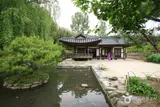
Pyeongsa-ri in Agyang, famous as the setting of Park Kyong-ni's epic novel Toji (The Land), is land that has fully benefited from the Seomjin River. Agyang, the name of the area where Pyeongsa-ri sits, was so named because it resembles Yueyang in China; following that Chinese place name, the sandy riverbank at Pyeongsa-ri was called Geumdang and the lake within the sandbar was named Dongjeong Lake. Among the poems celebrating Agyang's beauty are the 'Eight Views of Xiaoxiang,' and the Dongjeong Lake in Pyeongsa-ri together with Agyang's Eight Views of Xiaoxiang are a source of local pride, evoking scenery full of Korean beauty. Also, Gososeong Fortress — Historic Site No. 151 — sits 300m up the slope of Hyeongjebong Peak; built during the Silla dynasty, it looks down over the Seomjin River and Dongjeong Lake, bearing witness to a thousand years of history. MoreLess
- 6
Hadong Agyang-myeon Slow City
하동 악양면 슬로시티
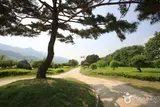
Agyang-myeon is one of Hadong County's 1 eup and 12 myeon, with an area of 51.8㎢ (12.4㎢ farmland, 35.2㎢ forest, 4.2㎢ other). It borders Jeollyang-myeon to the east, Hwagae-myeon to the west, Hadong-eup and, across the Seomjin River, Damap-myeon of Gwangyang City to the south, and Cheongam-myeon to the north, adjoining a total of 1 province, 1 city, and 5 eup/myeon. The terrain follows a one-myeon, one-village pattern; three sides are basin-shaped mountains formed by the ridgelines of Jirisan, with the Agyangcheon Stream flowing through the fertile center. Administratively it consists of 14 legally designated ri/dong, made up of 30 natural villages and 53 wards, home to about 3,800 people in 1,735 households. MoreLess
Source: Korea Tourism Organization (TourAPI) · Machine-translated