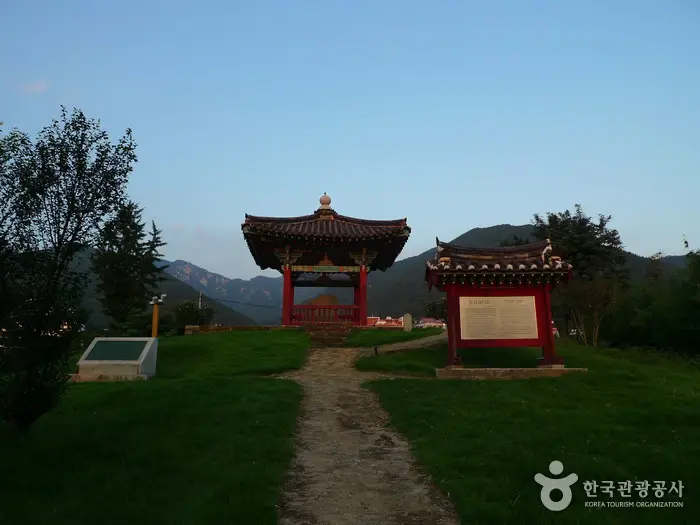
Meeting a Girl from the Gaya Period, 1,500 Years Ago
5 stops · 8 hours
Changnyeong is a heritage town preserving relics of the Gaya and Silla kingdoms. At the Gyo-dong and Songhyeon-dong Tumuli, ancient burial mounds from the Gaya period, human remains have been recovered, allowing the reconstruction of a young girl believed to have been sacrificed in a burial ritual (sunjang) of the Gaya era. Encounter heritage spanning the ages, from the Cheokgyeongbi Monument erected by King Jinheung of Silla and the Suljeong-ri East Three-Story Stone Pagoda, both designated National Treasures, to the Joseon-era stone ice storage (Seokbinggo).
- Duration
- 8 hours
- Distance
- 38.6km
Along the way
- 1
Manokjeong Park
만옥정공원
Also known as Changnyeong Park, this is a small park. Though only 10,000 square meters in area, it is famous for its designated cultural properties and its spectacular spring cherry blossoms. It is said that about 250 years ago there was a pavilion called Manokjeong here, where singing (myeongchang) and swing competitions were once held every spring. A hiking trail to Hwawangsan Mountain runs alongside it. MoreLess
- 2
Changnyeong Seokbinggo (Stone Ice Storage)
창녕석빙고
A seokbinggo is an ice storage that showcases our ancestors' wisdom in harvesting ice during the cold winter and storing it for use through the hot summer. This particular bingo (氷庫, ice storage) is thought to have been rebuilt during the Joseon dynasty, based on its structural style and the fact that the custom of ice storage (jangbing) was institutionalized and widely practiced at that time. MoreLess
- 3Changnyeong Gyo-dong and Songhyeon-dong Tumuli
창녕 교동과 송현동 고분군
Located southwest of the Songhyeon-dong Tumuli, below Mongmasan-seong Fortress on the western foot of Hwawangsan Mountain, across the road leading to Hyeonpung, this is a large ancient tomb cluster. Between 1918 and 1919, part of this tomb cluster was excavated by Japanese researchers, and most of the artifacts were taken to Japan, with only a portion remaining in Korea today. According to records from the excavation, the large tombs were of the yokgu-sik (side-entrance) or hoenghyeol-sik (horizontal-chamber) type. Excavated artifacts reportedly included a large quantity of items such as a gold crown, pure gold earrings, and other jewelry made of precious metals, along with bronze and iron weapons and pottery. MoreLess
- 4
Lunch (Okcheon Neutinamujip, Okcheon Gwangwang Nongwon Sikdang)
점심식사(옥천느티나무집. 옥천관광농원식당)
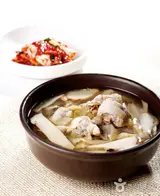
[Okcheon Neutinamujip] Hwawangsan Mountain in Gyeongnam is well known for its excellent pine mushrooms (song-i), so near its entrance there are quite a few restaurants centered on pine mushroom dishes; among them, this restaurant is famous for its chicken soup. The plainly savory shredded chicken, fragrant wild pine mushrooms, and the deeply satisfying broth make for a wonderful gift to hikers visiting Hwawangsan. It's one special way to savor nature with the mountains as your companion. [Okcheon Gwangwang Nongwon Sikdang] Located in Okcheon Valley, this restaurant prepares traditional dishes using Okcheon's spring water. It owns a 75,000-pyeong pine mushroom mountain, and its specialties are native chicken baeksuk (whole boiled chicken) made with pine mushrooms and traditional soybean paste. In pine mushroom season, the uniquely fragrant mushroom dishes are outstanding and draw many food lovers.< MoreLess
- 5
Gwallyongsa Temple
관룡사
Gwallyongsa is one of the eight great temples of Silla, located beneath Byeongpungbawi Rock on Guryongsan, within Hwawangsan County Park; it is said to have been founded in the 39th year of King Naemul (394), though this is not certain. It was rebuilt by the monk Jeungbeop in 583 (5th year of King Jinpyeong), and after the unification of the Three Kingdoms, Wonhyo preached to 1,000 Chinese monks here, making it a great center of Buddhist learning. It was rebuilt again in 748 (7th year of King Gyeongdeok) by Chudam. In the Joseon dynasty, the main hall (Daeungjeon) was rebuilt in 1401 (1st year of King Taejong), but most of the temple buildings were destroyed by fire during the Imjin War; it was rebuilt by Yeongun in 1617 (9th year of King Gwanghaegun) and repaired again in 1749 (25th year of King Yeongjo). MoreLess
Source: Korea Tourism Organization (TourAPI) · Machine-translated