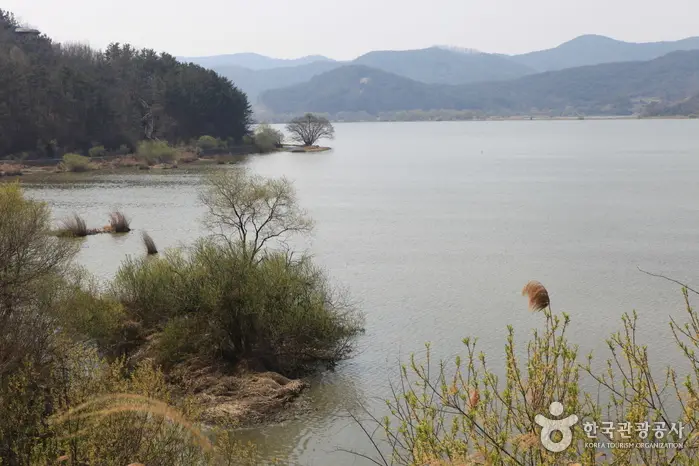
A Living Natural History Museum: Upo Wetland Journey
2 stops · 7 hours
Upo Wetland is Korea's largest natural wetland, and calling it a living natural history museum is no exaggeration. Upo Wetland consists of Upo, Sajipo, Jjokjibeol, and Mokpo wetlands, and is protected as an ecosystem conservation area and, since 1998, as an internationally protected wetland under the Ramsar Convention. Along with the Upo Wetland Ecology Center, it's also worth walking or cycling the Upo Wetland Life Trail, which circles the entire wetland.
- Duration
- 7 hours
- Distance
- 11km
Along the way
- 1Changnyeong Upo Wetland Ecological Park
창녕우포늪생태공원
Upo Wetland is Korea's largest natural wetland. The name 'neup' (wetland) encompasses not just Upo, the largest, but also the four wetlands of Mokpo, Sajipo, and Jjokjibeol together. This wetland area spans three myeon (townships) — Yueo, Ibang, and Daehap — in Changnyeong-gun, Gyeongsangnam-do, with a perimeter of 7.5km and a total area of 2,314,060 square meters. The wetland is said to have first formed about 140 million years ago. During the Cretaceous period, the age of dinosaurs, sea levels rose sharply and the ground along the Nakdong River basin subsided. As a result, water that had flowed into the Nakdong River from this area began pooling, creating wetlands and natural lakes throughout the region, which became playgrounds for the dinosaurs that ruled the earth at the time. MoreLess
- 2
Changnyeong Upo Prickly Waterlily Village Experience
창녕 우포가시연꽃마을 체험
Administratively known as Sindang-ri, this refers to the natural villages of Jaengban and Dakgae on either side of Local Road 1080. Jaengban is named for the tray-like (jaengban) shape of the land where the village sits, while Dakgae ('chicken') is named for the village's chicken-like shape. Sindang (神堂), a common place name, usually refers to a village that once had a shrine housing a guardian spirit. Though there are no houses today on the west side of Sindang-ri, there is a place called Gusindang ('old shrine village'), and it is said that an old shrine village once stood near the ancestral shrine of the Changnyeong Jo clan nearby. Families of the Andong Kim, Dalseong Seo, and Miryang Park clans once lived below Bisokdeung and in the Mangjobong valley, but were all forced to leave when the land was requisitioned for military use during the Japanese colonial period, and the villages here were abandoned. MoreLess

Source: Korea Tourism Organization (TourAPI) · Machine-translated