Reflecting on the Imjin War Along Jinjuseong Fortress
3 stops · 5 hours
Jinjuseong Fortress is the historic site of the Battle of Jinju, one of the three great victories of the Imjin War. At Jinjuseong, it is best to first tour the Jinju National Museum, dedicated to the Imjin War, and then explore the fortress grounds. Uiam Rock beneath Chokseongnu Pavilion, where Nongae embraced a Japanese general and leapt into the river, is also a must-see spot at Jinjuseong. Nearby Jinyangho Lake Park, an artificial lake created when Namgang Dam was built, offers superb views of the sunset over the lake and Jirisan Mountain from the Jinyangho Observatory, and you can also stop by the nearby bullfighting arena, where regular bullfights are held.
- Duration
- 5 hours
- Distance
- 9km (incl. about 3km on foot within Jinjuseong Fortress)
Along the way
- 1Jinjuseong Fortress
진주성
Jinjuseong was known as Georyeolseong in the Three Kingdoms period and Chokseokseong in the Goryeo dynasty, before being renamed Jinjuseong in the Joseon dynasty. Rebuilt as a defense against Japanese pirates at the end of Goryeo, this fortress became the gateway blocking Japanese forces trying to advance into Honam when the Imjin War broke out in the 25th year of King Seonjo of Joseon (1592). The First Battle of Jinju is counted among the three great victories of the Imjin War, both because some 3,800 troops defeated a Japanese force nearly ten times their number, and because holding the fortress protected Honam, Korea's granary region. In the Second Battle of Jinju in 1593, some 70,000 civilians, officials, and soldiers faced roughly 120,000 Japanese troops; after 11 days of fierce fighting, all were martyred, and it was here that Nongae embraced an enemy general and threw herself into the Namgang River in an act of loyalty and honor. Within the fortress are Chokseongnu Pavilion, the Stele of General Kim Si-min's Victory, Uigisa Shrine, Seojangdae, Bukjangdae, Changnyeolsa Shrine, Jinju National Museum, Hogooksa Temple, and an outdoor performance venue. MoreLess
- 2
Lunch (Gabeul Garden, Hayeonok)
점심식사 (갑을가든, 하연옥)
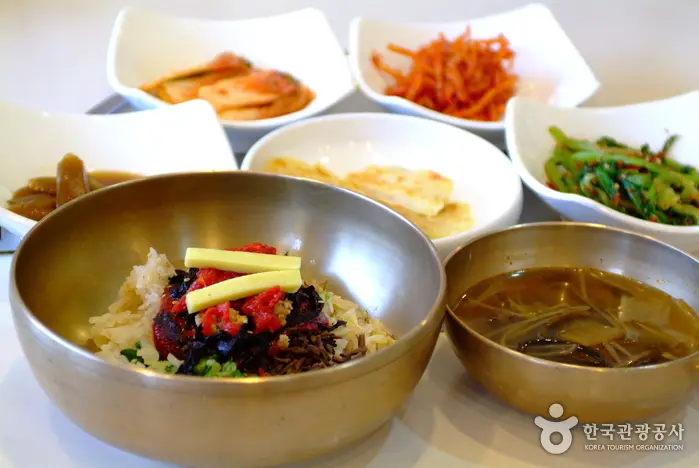
[Gabeul Garden] Going up the road along the Namgang River from the rear gate of Chokseongnu Pavilion, Gabeul Garden, located across from Cheonsu Bridge, impresses with its well-kept garden and beautiful view of the Namgang River. The restaurant can seat up to about 450 people; the first floor serves à la carte dishes mainly for individual guests, while the second floor is arranged into several rooms for group banquets. [Hayeonok] Hayeonok, run for 70 years by the founder Grandmother Hwang Deok-i and now her daughter carrying on the family tradition, is famous for its proud local dish, Jinju naengmyeon (cold noodles). Made with broth simmered from anchovy, shrimp, dried pollock, mussels, clams, beef bones, and beef brisket, it features buckwheat noodles topped with beef yukjeon (pan-fried beef), cucumber, pear, gimjang (winter) napa cabbage kimchi, and shredded egg garnish — a true local dish of Jinju. From onmyeon (warm noodles) with bulgogi to hanwoo yukjeon eaten wrapped together with the naengmyeon, its varied menu captivates diners. Both the naengmyeon and the side dishes are served in brassware; the first floor serves as a reception area and parking lot, while the main building and annex on the second floor are used as the restaurant.MoreLess

- 3Jinyangho Lake Park
진양호공원
Formed where the Gyeongho River and Deokcheon River flowing down from Jirisan Mountain meet, this is the only artificial lake in western Gyeongsangnam-do, fully equipped with recreational facilities and a resting place for tourists. It has Gyeongnam's only zoo, where visitors can see wild animals such as tigers, lions, bears, eagles, and giraffes up close, making it especially popular with children. 3-story modern rest area and observatory offers sweeping views of the open lake, the surrounding city, and Jirisan, Waryongsan, Jagulsan, and Geumosan mountains all at once, and has become a new tourist attraction in Jinju. It is also widely known as the filming location for the film Sky Garden (starring Ahn Jae-wook and Lee Eun-ju). MoreLess
Source: Korea Tourism Organization (TourAPI) · Machine-translated