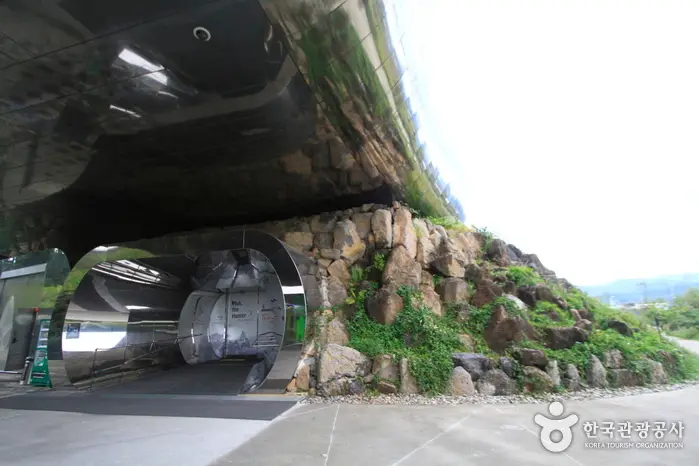
Encountering Traces of Ancient Goguryeo
5 stops · 7 hours
Yeoncheon is well known as a site where a large number of Paleolithic artifacts have been discovered. Beyond its Paleolithic remains, it is a historic site where you can find traces of ancient Goguryeo fortresses not found anywhere else, such as Dangpo-seong and Horogoru. Yeoncheon offers a journey through a cross-section of Korean history — from the Paleolithic era, through Goguryeo fortresses, to the tomb of Gyeongsun, the last king of Silla, and Sunguijeon, a shrine built in the Joseon dynasty to honor the kings and meritorious subjects of Goryeo.
- Duration
- 7 hours
- Distance
- 52.3km
Along the way
- 1Jeongok-ri Prehistory Museum
전곡리선사박물관
Jeongok Prehistory Museum was built at the Jeongok-ri Paleolithic site, the historic ground where the discovery of an East Asian Acheulean-type hand axe rewrote the history of world Paleolithic research. Centered on Paleolithic artifacts such as the Acheulean-type hand axe excavated at the Jeongok-ri site, the exhibition space is organized around various themes so visitors can systematically understand human evolution and Paleolithic culture. MoreLess

- 2
Yeoncheon Dangpo-seong Fortress
연천 당포성
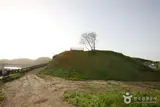
Dangpo-seong is a stone fortress built to block the eastern entrance of a triangular cliff-top plateau formed between the Danggye tributary flowing into Dangpo Ferry and the main stream of the Imjin River. Along with Horogoru and Eundaeri-seong, it is a riverside plain fortress found only along the northern banks of the Imjin and Hantan Rivers in Yeoncheon-gun. Judging from the artifacts recovered here and its construction techniques, it appears to have been first built by Goguryeo to defend against Baekje and Silla south of the Imjin River, and later rebuilt after being occupied by Silla, serving as a forward base to block northern forces. MoreLess
- 3
Lunch (Hanam Sikdang)
점심식사 (하남식당)
The largest restaurant in the Hantangang National Tourist Resort, well known for its outstanding freshwater spicy fish stew (maeuntang).

- 4
Yeoncheon Sunguijeonji
연천 숭의전지
Sunguijeonji (崇義殿址) is the site of Sunguijeon, a shrine built in the Joseon dynasty to hold memorial tablets and hold rites for the kings and meritorious subjects of the preceding Goryeo dynasty. It was originally the site of Angamsa Temple, the vow temple of Goryeo founder King Taejo Wang Geon (王建). In 1397 (6th year of King Taejo of Joseon), a shrine was built to enshrine the memorial tablet of Goryeo's King Taejo — this was the beginning of today's Sunguijeon. After the shrine was built, in 1399 (1st year of King Jeongjong), the memorial tablets of eight Goryeo kings — Taejo, along with Hyejong (惠宗), Seongjong (成宗), Hyeonjong (顯宗), Munjong (文宗), Wonjong (Chunggyeongwang, 元宗), Chungnyeolwang (忠烈王), and Gongminwang (恭愍王) — were enshrined by royal decree. MoreLess

- 5
Yeoncheon Royal Tomb of King Gyeongsun
연천 경순왕릉
King Gyeongsun was the 56th and last king of Silla. His surname was Kim and his given name Bu; he was a sixth-generation descendant of King Munseong of Silla, and ascended the throne in 927 after King Gyeongae was killed in an attack by Gyeon Hwon of Later Baekje. When Gyeongsun took the throne, the nation was divided among Later Baekje, Goryeo, and Unified Silla, and state functions were paralyzed by repeated invasions from Later Baekje and the independent rule of regional gentry. To spare the innocent people further suffering, King Gyeongsun surrendered to Goryeo against the objections of his ministers and his eldest son, Crown Prince Maui. At that time, Crown Prince Maui went into Geumgangsan Mountain, and his youngest son Beomgong entered Hwaeomsa Temple to become a monk. After surrendering, Gyeongsun was granted the title Jeongseunggong, equivalent to that of a crown prince, given Yuhwagung Palace, and received Gyeongju as his fief, being appointed the first Sasimgwan (a Goryeo post overseeing a former ruler's home region). He married Princess Nangnang, daughter of King Taejo Wang Geon, and had several children, before passing away 43 years later, in the 3rd year of King Gyeongjong of Goryeo (978). MoreLess

Source: Korea Tourism Organization (TourAPI) · Machine-translated