Time-Worn Temple Scenery Along a Forest Path: Naesosa and Gaeamsa
8 stops · 5-6 hours
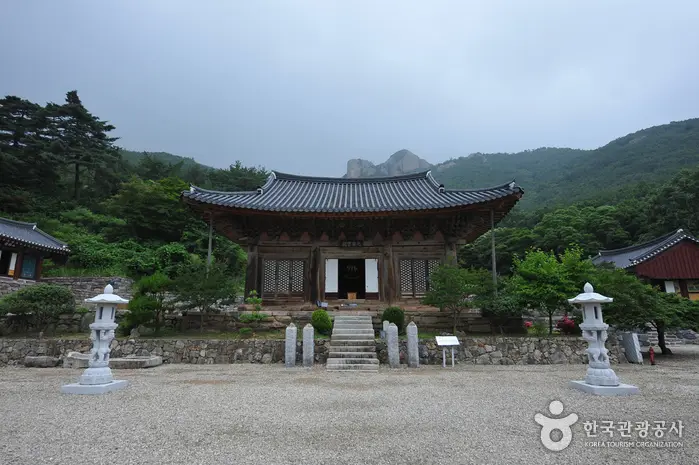
Naesosa and Gaeamsa are strikingly similar temples. The approach road leading into the temple grounds, the main hall left unpainted for an antique feel, and even the beautiful flower-patterned latticework are alike. Yet, as thousand-year-old temples steeped in history, the feeling of walking through each is quite different. The fir tree path at Naesosa, its Grandmother and Grandfather Dangsan (guardian trees), the flower lattice and bronze bell of Daeungbojeon, and the view where Gaeamsa's Daeungbojeon meets Ulgeumbawi Rock are must-see temple highlights.
- Duration
- 5-6 hours
- Distance
- 38km
Along the way
- 1
Gaeamsa Temple
개암사
Heading south from Buan toward Boan, then winding up around Gaeam Reservoir from Bongeun, Gaeamsa sits beneath Ulgeumbawi Rock. The temple's origin dates to the 35th year of King Mu of Baekje (634), when the monk Myoryeon-wangsa converted palaces in Byeonhan into temples, naming the palace of Myoam as Myoamsa and the palace of Gaeam as Gaeamsa. Today it is a quiet temple with Daeungbojeon (main hall), Eungjinjeon, Wolseongdae, and monks' quarters. The bamboo fence and reeds around the newly built quarters to the right of the main hall, together with the maple-lined entrance path, add to Gaeamsa's tranquil charm. Daeungjeon, designated Treasure No. 292, is a three-bay by three-bay hip-and-gable roofed hall showing the architectural style of the early Joseon period.MoreLess
- 2
Lunch (Gomso Swimteo)
점심식사(곰소쉼터)
The salted seafood here is aged in the shade for over two years before being served; no unnecessary seasoning is mixed in, focusing instead on bringing out the natural flavor of the salted seafood itself. MoreLess
- 3
Naesosa Temple
내소사
Located about 1.2km north of Seokpo-ri, Jinseo-myeon, Buan-gun, Jeollabuk-do, Naesosa is said to have been founded in the 34th year of King Mu of Baekje (633). The monk Hyegu (惠丘) Duta built temples here, naming the larger one 'Daesoraesa' and the smaller one 'Sosoraesa'; Daesoraesa was later destroyed by fire, so today's Naesosa is in fact Sosoraesa. Its cultural assets include 4 state-designated cultural properties and 2 provincial tangible cultural properties. Well-preserved old structures such as Bongnaeru Pavilion stand harmoniously alongside recently built structures such as Museoldang, Jinhwasa, Beomjonggak, Bojonggak, Seonwon, and Hoeseungdang. MoreLess
- 4
Lunch (Gomso Swimteo)
점심식사(곰소쉼터)
The salted seafood here is aged in the shade for over two years before being served; no unnecessary seasoning is mixed in, focusing instead on bringing out the natural flavor of the salted seafood itself.MoreLess
- 5
Gaeamsa Temple
개암사
Heading south from Buan toward Boan, then winding up around Gaeam Reservoir from Bongeun, Gaeamsa sits beneath Ulgeumbawi Rock. The temple's origin dates to the 35th year of King Mu of Baekje (634), when the monk Myoryeon-wangsa converted palaces in Byeonhan into temples, naming the palace of Myoam as Myoamsa and the palace of Gaeam as Gaeamsa. Today it is a quiet temple with Daeungbojeon (main hall), Eungjinjeon, Wolseongdae, and monks' quarters. The bamboo fence and reeds around the newly built quarters to the right of the main hall, together with the maple-lined entrance path, add to Gaeamsa's tranquil charm. Daeungjeon, designated Treasure No. 292, is a three-bay by three-bay hip-and-gable roofed hall showing the architectural style of the early Joseon period. MoreLess
- 6
Gomso Salt Farm
곰소염전
Located in Jinseo-ri, Jinseo-myeon, Buan-gun, Gomso Salt Farm is one of Korea's few sun-dried salt fields; unlike other salt farms adjoining the open sea, it lies inside Gomso Bay. During the Joseon dynasty, salt made by boiling seawater (hwayeom) was produced from Julpo Bay to Gomso Bay and stored at the government granary in Nampo-ri, then sent along with rice from Geonmopo (Gujin) to Noryangjin.MoreLess
- 7
Naesosa Temple
내소사
Located about 1.2km north of Seokpo-ri, Jinseo-myeon, Buan-gun, Jeollabuk-do, Naesosa is said to have been founded in the 34th year of King Mu of Baekje (633). The monk Hyegu (惠丘) Duta built temples here, naming the larger one 'Daesoraesa' and the smaller one 'Sosoraesa'; Daesoraesa was later destroyed by fire, so today's Naesosa is in fact Sosoraesa. Its cultural assets include 4 state-designated cultural properties and 2 provincial tangible cultural properties. Well-preserved old structures such as Bongnaeru Pavilion stand harmoniously alongside recently built structures such as Museoldang, Jinhwasa, Beomjonggak, Bojonggak, Seonwon, and Hoeseungdang.MoreLess
- 8
Gomso Salt Farm
곰소염전
Located in Jinseo-ri, Jinseo-myeon, Buan-gun, Gomso Salt Farm is one of Korea's few sun-dried salt fields; unlike other salt farms adjoining the open sea, it lies inside Gomso Bay. During the Joseon dynasty, salt made by boiling seawater (hwayeom) was produced from Julpo Bay to Gomso Bay and stored at the government granary in Nampo-ri, then sent along with rice from Geonmopo (Gujin) to Noryangjin. MoreLess
Source: Korea Tourism Organization (TourAPI) · Machine-translated