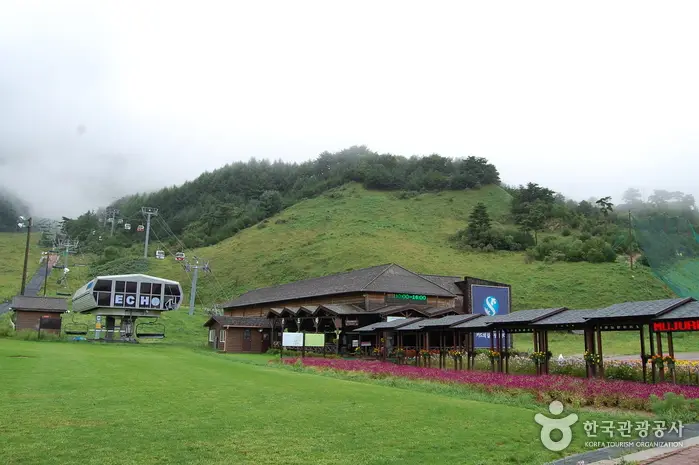
Riding the Gondola Up to Hyangjeokbong Peak on Deogyusan Mountain
8 stops · 5-6 hours
Muju is home to Hyangjeokbong Peak, the 1,614m summit of Deogyusan Mountain. Taking the tourist gondola from Deogyusan Resort, you can reach the summit of Hyangjeokbong in about 30 minutes. The hiking trail from Samgong Visitor Center to Hyangjeokbong passes through Baengnyeonsa Temple, and along the way from Wolhatan Falls to Hyangjeokbong you'll pass 19 of the '33 Scenic Spots of Muju Gucheondong' following the valley. A recommended route is to take the gondola up to Hyangjeokbong and then trek back down past Baengnyeonsa Temple to Samgong Ticket Office.
- Duration
- 5-6 hours
- Distance
- 20.7km (incl. 2km Seolcheonbong-Hyangjeokbong section, 12km Samgong Ticket Office-Baengnyeonsa section)
Along the way
- 1
Muju Resort Tourist Gondola
무주리조트 관광곤도라
Taking the tourist gondola up to Seolcheonbong Peak at 1,522m above sea level, you can easily reach Hyangjeokbong, the summit of Deogyusan Mountain, in just 20 minutes. The mountain isn't rugged, making it a comfortable climb for elderly couples and families, and from the summit you can enjoy a stunning panoramic view taking in Jeoksangsan, Maisan, Gayasan, Jirisan, Gyeryongsan, and Mudeungsan mountains all at once.MoreLess
- 2
Lunch (Hangukgwan Muju, Jeonju Sikdang)
점심식사(한국관_무주, 전주식당)
[Hangukgwan Muju] One of the local restaurants selected through a culinary review by North Jeolla Province. While gukbap (rice soup) usually contains beef, this restaurant uses shiitake mushrooms instead, giving the broth a light, refreshing taste without the greasiness of meat. [Jeonju Sikdang] Among the more than 30 restaurants named 'Jeonju' within the Muju Gucheondong tourist complex, Jeonju Sikdang is the largest and best known. Its specialty is grilled deodeok (bonnet bellflower root). The peeled and pounded deodeok, marinated in seasoning for over a day, is brought to the table grilled on a foil-lined griddle. Its crisp texture and rich aroma are outstanding — truly living up to its nickname, 'bulgogi from the field.'MoreLess
- 3
Muju Resort Tourist Gondola
무주리조트 관광곤도라
Taking the tourist gondola up to Seolcheonbong Peak at 1,522m above sea level, you can easily reach Hyangjeokbong, the summit of Deogyusan Mountain, in just 20 minutes. The mountain isn't rugged, making it a comfortable climb for elderly couples and families, and from the summit you can enjoy a stunning panoramic view taking in Jeoksangsan, Maisan, Gayasan, Jirisan, Gyeryongsan, and Mudeungsan mountains all at once.MoreLess
- 4
Hyangjeokbong Peak, Deogyusan Mountain, Muju
무주덕유산향적봉
Deogyusan Mountain rises across two provinces and four counties — Muju and Jangsu in North Jeolla Province, and Geochang and Hamyang in South Gyeongsang Province — forming part of the Baekdudaegan mountain range, with Hyangjeokbong Peak at 1,614m as its highest summit. Hyangjeokbong is the highest peak of Deogyusan and the fourth-highest peak in South Korea. Along the trail from Hyangjeokbong to Jungbong Peak grow dense stands of yew and Korean fir, and along the trail continuing from Jungbong through Deogyupyeongjeon Plateau to Muryongsan Mountain, royal azaleas grow in thick clusters. While the scenery during azalea season is superb, the snowy landscape around Hyangjeokbong, which receives especially heavy snowfall, is truly spectacular.MoreLess
- 5
Baengnyeonsa Temple
백련사
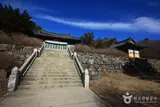
Baengnyeonsa Temple, nestled upstream in the Gucheondong Valley at the heart of Deogyusan Mountain, is said to have been built after a white lotus bloomed at the spot where the monk Baengnyeon Seonsa had lived in seclusion during the reign of King Sinmun of Silla. It is said to be the only one of the 14 temples of Muju Gucheondong still standing today. Past the arched bridge called 'Baengnyeongyo' at the entrance and through the Iljumun Gate, a stone stairway (Baengnyeonsa Stairway, Local Monument No. 42) leads up to the main hall. The stupa of the world-renowned newspaper magnate Lord Rothermere stands here, a testament to the temple's renown as a sacred mountain site. Many eminent monks have trained here.MoreLess
- 6
Lunch (Hangukgwan Muju, Jeonju Sikdang)
점심식사(한국관_무주, 전주식당)
[Hangukgwan Muju] One of the local restaurants selected through a culinary review by North Jeolla Province. While gukbap (rice soup) usually contains beef, this restaurant uses shiitake mushrooms instead, giving the broth a light, refreshing taste without the greasiness of meat. [Jeonju Sikdang] Among the more than 30 restaurants named 'Jeonju' within the Muju Gucheondong tourist complex, Jeonju Sikdang is the largest and best known. Its specialty is grilled deodeok (bonnet bellflower root). The peeled and pounded deodeok, marinated in seasoning for over a day, is brought to the table grilled on a foil-lined griddle. Its crisp texture and rich aroma are outstanding — truly living up to its nickname, 'bulgogi from the field.'MoreLess
- 7
Baengnyeonsa Temple
백련사
Baengnyeonsa Temple, nestled upstream in the Gucheondong Valley at the heart of Deogyusan Mountain, is said to have been built after a white lotus bloomed at the spot where the monk Baengnyeon Seonsa had lived in seclusion during the reign of King Sinmun of Silla. It is said to be the only one of the 14 temples of Muju Gucheondong still standing today. Past the arched bridge called 'Baengnyeongyo' at the entrance and through the Iljumun Gate, a stone stairway (Baengnyeonsa Stairway, Local Monument No. 42) leads up to the main hall. The stupa of the world-renowned newspaper magnate Lord Rothermere stands here, a testament to the temple's renown as a sacred mountain site. Many eminent monks have trained here.MoreLess
- 8
Hyangjeokbong Peak, Deogyusan Mountain, Muju
무주덕유산향적봉
Deogyusan Mountain rises across two provinces and four counties — Muju and Jangsu in North Jeolla Province, and Geochang and Hamyang in South Gyeongsang Province — forming part of the Baekdudaegan mountain range, with Hyangjeokbong Peak at 1,614m as its highest summit. Hyangjeokbong is the highest peak of Deogyusan and the fourth-highest peak in South Korea. Along the trail from Hyangjeokbong to Jungbong Peak grow dense stands of yew and Korean fir, and along the trail continuing from Jungbong through Deogyupyeongjeon Plateau to Muryongsan Mountain, royal azaleas grow in thick clusters. While the scenery during azalea season is superb, the snowy landscape around Hyangjeokbong, which receives especially heavy snowfall, is truly spectacular.MoreLess
Source: Korea Tourism Organization (TourAPI) · Machine-translated