Touring the Four Great Religious Sites at the Foot of Moaksan Mountain
7 stops · 5 hours
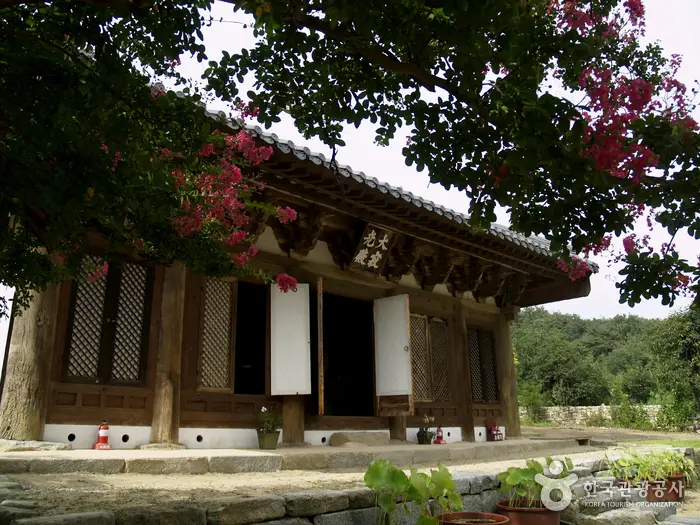
Moaksan Mountain, standing on the border between Gimje and Wanju, embraces everything like a warm mother's arms. At its foot lie sacred sites of Buddhism, Protestantism, Catholicism, and Jeungsangyo, all preserved intact: Geumsansa and Gwisinsa temples representing Buddhism, Geumsan Church representing Protestantism, Suryu Cathedral representing Catholicism, and Donggok Pharmacy representing Jeungsangyo. As the religions differ, so do the impressions and scenery at each site. Setting aside religious bias, this is an utterly beautiful journey to take in.
- Duration
- 5 hours
- Distance
- 17.8km
Along the way
- 1
Gwisinsa Temple
귀신사
Gwisinsa Temple sits in Cheongdo Village, alongside the road leading from Geumsansa Temple over the western ridge of Moaksan Mountain to Jeonju. Today the temple belongs to the Jogye Order of Korean Buddhism, though it is said to have originally belonged to the Hwaeom school. It is generally believed to have been founded by Master Uisang in 676, the 16th year of King Munmu.MoreLess
- 2
Geumsan Church
금산교회
Geumsan Church is a hanok-style church built in 1908 by missionary Lewis Boyd Tate of the Jeonju mission. According to the records of the Presbyterian Church of Korea, the first church building had 5 kan (bays) and was built in 1905, before being relocated and rebuilt at its current site in 1908. Today, a new sanctuary and manse, built in 1988, stand beside the historic Geumsan Church.MoreLess
- 3Geumsansa Temple
금산사
Standing prominently at the entrance to Moaksan Provincial Park, Geumsansa Temple was founded in 599, the first year of King Beop of Baekje, and was rebuilt by Master Jinpyo in 776 to take on the form of a great monastery. The temple grounds include Mireukjeon Hall, designated National Treasure No. 62, along with about ten other designated cultural properties, and with its many auxiliary buildings, it is regarded as the foremost ancient temple in the Honam region.MoreLess
- 4
Geumsan Church
금산교회
Geumsan Church is a hanok-style church built in 1908 by missionary Lewis Boyd Tate of the Jeonju mission. According to the records of the Presbyterian Church of Korea, the first church building had 5 kan (bays) and was built in 1905, before being relocated and rebuilt at its current site in 1908. Today, a new sanctuary and manse, built in 1988, stand beside the historic Geumsan Church.MoreLess
- 5Geumsansa Temple
금산사
Standing prominently at the entrance to Moaksan Provincial Park, Geumsansa Temple was founded in 599, the first year of King Beop of Baekje, and was rebuilt by Master Jinpyo in 776 to take on the form of a great monastery. The temple grounds include Mireukjeon Hall, designated National Treasure No. 62, along with about ten other designated cultural properties, and with its many auxiliary buildings, it is regarded as the foremost ancient temple in the Honam region.MoreLess
- 6
Gwisinsa Temple
귀신사
Gwisinsa Temple sits in Cheongdo Village, alongside the road leading from Geumsansa Temple over the western ridge of Moaksan Mountain to Jeonju. Today the temple belongs to the Jogye Order of Korean Buddhism, though it is said to have originally belonged to the Hwaeom school. It is generally believed to have been founded by Master Uisang in 676, the 16th year of King Munmu.MoreLess
- 7
Geumpyeong Reservoir (Donggok Village)
금평저수지(동곡마을)
Geumpyeong Reservoir, spanning Geumsan-ri and Cheongdo-ri in Geumsan-myeon, Gimje, was built in 1961 and is fed by clear water flowing down from Moaksan Mountain, so it is said never to dry up even in severe drought. Moaksan Mountain, named for a summit rock resembling a mother holding a child, is beloved by many residents of Jeonju, Wanju, and Gimje. Several reservoirs formed by water flowing down from the mountain serve as a lifeline for the Honam Plain. Geumpyeong Reservoir has few pollution sources nearby, keeping its water clean, and it is also well known as a wintering site for migratory birds visiting Korea.MoreLess
Source: Korea Tourism Organization (TourAPI) · Machine-translated