Land of the Horizon: Across Gimje's Open Fields
8 stops · 5 hours
Gimje sits at the heart of the Honam Plain, the region that produces the most rice in Korea, and is the only place in the country where you can see a true horizon. The historic Byeokgolje Reservoir, built during the Three Kingdoms period, is closely tied to the creation of the fertile Mangyeong Plain through its irrigation system. Jo Jeong-rae's novel 'Arirang' depicts the exploitation and oppression of the Japanese colonial period against the backdrop of the Mangyeong Plain. Don't miss the spectacular sunset viewed from Manghaesa Temple, where the Mangyeonggang River, the lifeline of the Mangyeong Plain, meets the West Sea.
- Duration
- 5 hours
- Distance
- 44.5km
Along the way
- 1
Manghaesa Temple
망해사
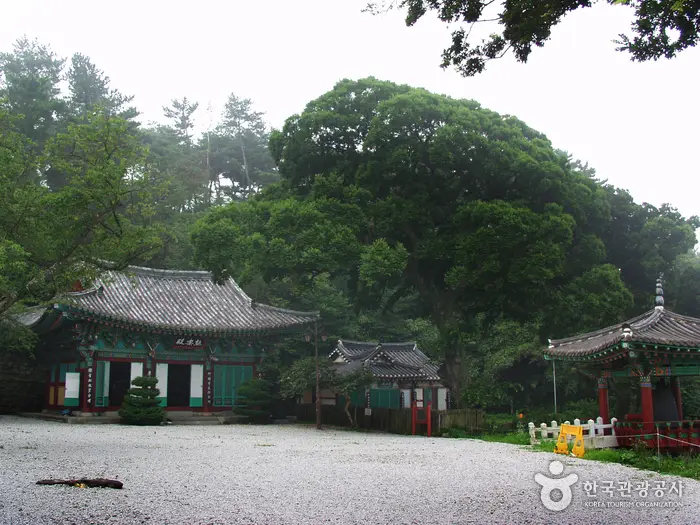
Heading from Gimje on National Route 29 toward Geumsan, when you reach Mangyeong, turn west and drive 12.3km across endless plains until you reach Manghaesa Temple, perched on a low cliff at the edge of the plain by the sea. Standing atop a cliff of oddly shaped rocks past the Jinbongsan Pass, overlooking the vast open sea, the temple is aptly named Manghaesa ('Temple Facing the Sea'). It is said that Buseol-geosa built and practiced at a temple here in 642, the 2nd year of King Uija of Baekje, and that the Tang monk Dobeopsa later rebuilt it; during the reign of King Injo of Joseon, Master Jinmuk built and expanded Nakseojeon Hall (Cultural Heritage Material No. 128) in 1589, and in 1933 the monk Kim Jeong-hui built and renovated Bogwangjeon Hall and Chilseonggak Shrine.MoreLess
- 2
Gimje Oegatjip Village
김제 외갓집마을
Oegatjip Village (Maternal Grandmother's Village) is located about 4km from Gimje toward Jeonju, in North Jeolla Province, at a transportation hub encircled by the Honam Expressway and National Route 1, with three interchanges nearby (Gimje IC, Seojeonju IC, and Namjeonju IC). Situated amid the vast Honam Plain, most residents of the village engage in farming and livestock. Major crops include a variety of vegetables grown in large-scale greenhouse complexes, pears grown in eco-friendly certified orchards, and rice.MoreLess
- 3
Lunch (Barangsan Freshwater Catfish Stew)
점심식사(바랑산 민물메기탕)
Located at the foot of Barangsan Mountain beside Daeyul Reservoir, along the road from Gimje toward Geumgu and Jeonju, this restaurant has served freshwater catfish stew for 20 years. Made with wild catfish caught in Daeyul Reservoir and pollution-free dried radish greens gathered during the autumn kimjang season, seasoned generously and simmered in a perilla-seed broth known to be good for lifestyle diseases, the catfish stew served here in earthenware pots has a well-earned reputation among food lovers visiting Daeyul Reservoir.MoreLess
- 4Byeokgolje Reservoir
벽골제
This is the embankment and restoration monument of Korea's first man-made reservoir. The 'Samguk Sagi' (History of the Three Kingdoms) records that 'Byeokgolje was first built' in 330, the 21st year of King Heulhae of Silla, with 'a circumference of 1,800 bo.' However, since this region belonged to Baekje rather than Silla at that time, it is quite likely that the date was later altered to make it appear as though Silla had built it.MoreLess

- 5
Lunch (Barangsan Freshwater Catfish Stew)
점심식사(바랑산 민물메기탕)
Located at the foot of Barangsan Mountain beside Daeyul Reservoir, along the road from Gimje toward Geumgu and Jeonju, this restaurant has served freshwater catfish stew for 20 years. Made with wild catfish caught in Daeyul Reservoir and pollution-free dried radish greens gathered during the autumn kimjang season, seasoned generously and simmered in a perilla-seed broth known to be good for lifestyle diseases, the catfish stew served here in earthenware pots has a well-earned reputation among food lovers visiting Daeyul Reservoir.MoreLess
- 6
Gimje Oegatjip Village
김제 외갓집마을
Oegatjip Village (Maternal Grandmother's Village) is located about 4km from Gimje toward Jeonju, in North Jeolla Province, at a transportation hub encircled by the Honam Expressway and National Route 1, with three interchanges nearby (Gimje IC, Seojeonju IC, and Namjeonju IC). Situated amid the vast Honam Plain, most residents of the village engage in farming and livestock. Major crops include a variety of vegetables grown in large-scale greenhouse complexes, pears grown in eco-friendly certified orchards, and rice.MoreLess
- 7
Manghaesa Temple
망해사
Heading from Gimje on National Route 29 toward Geumsan, when you reach Mangyeong, turn west and drive 12.3km across endless plains until you reach Manghaesa Temple, perched on a low cliff at the edge of the plain by the sea. Standing atop a cliff of oddly shaped rocks past the Jinbongsan Pass, overlooking the vast open sea, the temple is aptly named Manghaesa ('Temple Facing the Sea'). It is said that Buseol-geosa built and practiced at a temple here in 642, the 2nd year of King Uija of Baekje, and that the Tang monk Dobeopsa later rebuilt it; during the reign of King Injo of Joseon, Master Jinmuk built and expanded Nakseojeon Hall (Cultural Heritage Material No. 128) in 1589, and in 1933 the monk Kim Jeong-hui built and renovated Bogwangjeon Hall and Chilseonggak Shrine.MoreLess
- 8Byeokgolje Reservoir
벽골제
This is the embankment and restoration monument of Korea's first man-made reservoir. The 'Samguk Sagi' (History of the Three Kingdoms) records that 'Byeokgolje was first built' in 330, the 21st year of King Heulhae of Silla, with 'a circumference of 1,800 bo.' However, since this region belonged to Baekje rather than Silla at that time, it is quite likely that the date was later altered to make it appear as though Silla had built it.MoreLess
Source: Korea Tourism Organization (TourAPI) · Machine-translated