Shall We Walk in Dasan's Footsteps?
5 stops · 6 hours
Gangjin was the place of exile for Dasan Jeong Yak-yong, and this journey lets you fully encounter his traces. Starting at Dasan Chodang, the thatched cottage where Dasan stayed and completed his Silhak (Practical Learning) scholarship, the path Dasan walked to meet Monk Hyejang at Baengnyeonsa Temple — through the camellia forest and on to the temple — is a popular course among travelers. From Sauijae in downtown Gangjin, the route continues past the Gangjin Celadon Kiln Site to Maryang Port, renowned as one of Korea's most beautiful harbors, tracing Dasan's footsteps along a beautiful coastal pilgrimage route following Gangjin Bay.
- Duration
- 6 hours
- Distance
- 40.4km
Along the way
- 1
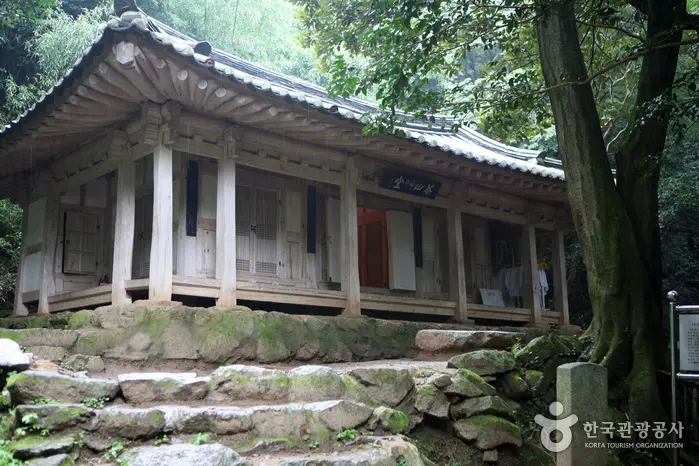
Dasan Chodang
다산초당
Dasan Chodang, nestled at the foot of Mandeoksan Mountain with a sweeping view over Gangjin Bay, is where Jeong Yak-yong (pen name Dasan), the great scholar who brought together the Silhak (Practical Learning) school of late Joseon, lived in exile. The name 'Dasan' comes from the mountain behind Gyul-dong village in Gangjin where he stayed, which he later adopted as his own pen name. Dasan, a leading Silhak scholar of the late Joseon period, was exiled to Gangjin in 1801 and spent over 18 years there in confinement, writing some 500 volumes including 'Mongmin Simseo' and 'Gyeongse Yupyo.' It was here that he completed his Silhak philosophy of Sasilguisi (seeking truth from facts), steering the abstract, idealistic tendencies of Joseon Neo-Confucianism toward practical scientific thought.MoreLess
- 2
Baengnyeonsa Temple (Gangjin)
백련사(강진)
Baengnyeonsa Temple was founded in 839 by the monk Muyeom of Muju during the reign of King Munseong of Silla. It was later rebuilt with some 80 buildings in the 7th year of King Huijong of Goryeo by National Preceptor Wonmyo Yose. Over 120 years in the late Goryeo period, the temple produced eight national preceptors. Based on Cheontae (Tiantai) thought, the temple established a retreat community that played a central role in reviving Buddhism during a period of decline.MoreLess
- 3
Gangjin Goryeo Celadon Kiln Site
강진고려청자도요지
The Daegu-myeon area of Gangjin County was the production center of Goryeo celadon, a representative art form of Korea's medieval period. Designated Historic Site No. 68 in 1963, the Daegu Goryeo Celadon Kiln Site produced celadon collectively for some 500 years from the 9th to the 14th century. About 180 kiln sites are scattered across nine villages, and roughly 180,000 pyeong (about 595,000 m2) is designated and managed as a cultural heritage protection zone.MoreLess

- 4Maryang Port
마량미항
Maryang Port lies at the southernmost tip of Korea's southwest, past Gangjin from Gwangju, in the pristine waters connecting the Wando archipelago and Jeju Island — a rich fishing ground for black porgy, sea bass, and rockfish. In 1417, during the reign of King Taejong in the early Joseon period, Madujin naval base was established here under a manhojeoljedowi (naval commander), and during the Japanese invasions of Korea, a turtle ship stood permanently on guard at this strategic stronghold. The historic site of the old Manhoseong fortress remains, the small island of Kkamakseom floats offshore like an ink-wash painting, and Gogeumdo and Yaksando islands shelter the harbor from storms — making Maryang, a first-class fishing port, one of Korea's most beautiful natural harbors. Maryang's charm is even more striking at night than by day, and every Saturday the port hosts a lively concert where the beautiful harbor and visitors come together as one.MoreLess
- 5Maryang Port
마량미항
Maryang Port lies at the southernmost tip of Korea's southwest, past Gangjin from Gwangju, in the pristine waters connecting the Wando archipelago and Jeju Island — a rich fishing ground for black porgy, sea bass, and rockfish. In 1417, during the reign of King Taejong in the early Joseon period, Madujin naval base was established here under a manhojeoljedowi (naval commander), and during the Japanese invasions of Korea, a turtle ship stood permanently on guard at this strategic stronghold. The historic site of the old Manhoseong fortress remains, the small island of Kkamakseom floats offshore like an ink-wash painting, and Gogeumdo and Yaksando islands shelter the harbor from storms — making Maryang, a first-class fishing port, one of Korea's most beautiful natural harbors. Maryang's charm is even more striking at night than by day, and every Saturday the port hosts a lively concert where the beautiful harbor and visitors come together as one.MoreLess
Source: Korea Tourism Organization (TourAPI) · Machine-translated