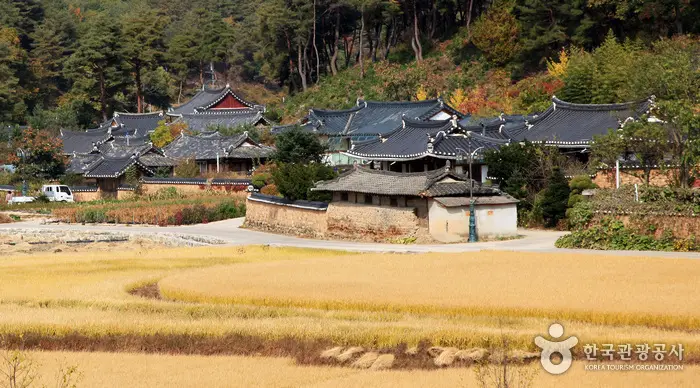
GeumgyepoRan Feng Shui: A Look Inside Dakssil Village
4 stops · 1 day
Dakssil Village is a clan village formed by the family of Chungjae Gwon Beol in the mid-Joseon period, renowned as an auspicious site of 'geumgyepoRan' (a golden hen brooding an egg) feng shui form. With a history spanning more than 500 years, it is also famous for its traditional confections (hangwa). Alongside the historic sites of Chungjae Gwon Beol, designated as treasures, the Chungjae head house features the beautiful Cheongam-jeong Pavilion, well known as a filming location for dramas and movies. The walk from Dakssil Village along Seokcheon Valley to Seokcheonjeongsa and Samgye Seowon is also well worth taking.
- Duration
- 1 day
- Distance
- 28.7km
Along the way
- 1
Dakssil Village (Bonghwa Cheongam-jeong Pavilion, Naeseong-yugok Gwon Chungjae Historic Site, Seokcheon Valley)
닭실마을(봉화청암정, 내성유곡권충재관계유적,석천계곡)
Water originating from the Taebaeksan mountain range passes through Eungbangsan and Okjeokbong peaks, joining with clear water flowing down from the Bonghwa mountain valleys; by the time it reaches Yugok-ri, Bonghwa-eup, it finally opens into a refreshing valley — this is Seokcheon Valley. Seokcheon Valley has gently sloping surrounding mountains and dense pine forests, and since the valley is not deep, one can walk far into it without much effort. The valley is wide and flat, with broad, flat rocks scattered throughout as if laid out as seating. Clear, transparent water flows over the white rocks. Few valleys are this safe for children to play in. In Seokcheon Valley stands Seokcheonjeongsa, built by Cheongam Gwon Dong-bo, eldest son of Chungjae Gwon Beol. Centered on this historic site, the area including the valley is designated Historic and Scenic Site No. 3. The village is said to be named Dakssil ('chicken nest') because Okjeokbong Peak to the east of the village resembles a rooster and Baegunryeong Ridge to the west resembles a hen.\nMoreLess
- 2
Bonghwa Bukji-ri Rock-carved Seated Buddha
봉화 북지리마애여래좌상
This stone Buddha was originally enshrined as the principal image within a niche, a rare example of a massive rock-carved seated Buddha from the Silla period. Although the stone now shows cracks here and there, the Buddha's majestic presence still largely remains, carved in high relief nearly as deep as a fully rounded sculpture, which makes its dignified aura all the more striking. It was discovered in 1947 during land clearing work, and to preserve and manage the statue, a single wooden hanok gabled protective shelter was later built, along with dancheong (traditional decorative painting), which remain to this day.\nMoreLess
- 3
Gapyeong-ri Gyeseodang House
가평리 계서당
Gyeseodang is the house where Gyeseo Seong I-seong (1595–1664), a mid-Joseon-period court official, once lived. A native of Changnyeong, Seong I-seong was the son of Buyongdang Seong An-ui, who served as magistrate of Namwon; he passed the state examination in 1627 (the 5th year of King Injo). He served as magistrate of six counties, including Jinju, and was appointed royal secret inspector (amhaeng-eosa) four times, becoming renowned for his frugality and integrity. He was later posthumously granted the position of Vice Minister of Culture and honored as an exemplar of incorruptibility.\nMoreLess
- 4
Bonghwa Geumgang Pine Forest
봉화 금강소나무림
The Southern Regional Office of the Korea Forest Service, in response to the decline of Geumgang pine trees caused by artificial logging and environmental changes, has created 'Ecotour-led Geumgang Pine Ecological Management Forests' at three sites — Sogwang-ri in Uljin, Bonsin-ri in Yeongyang, and Goseon and Daehyeon-ri in Bonghwa — in order to restore the once-dense Geumgang pine forests of the late Joseon period and allow the public to directly experience healthy forests.\nMoreLess

Source: Korea Tourism Organization (TourAPI) · Machine-translated